
For years, the global technology race has focused on one thing: who will dominate artificial intelligence.
Most people picture that race happening inside massive office buildings, sprawling data centers, and advanced research laboratories.
China just changed the picture entirely.
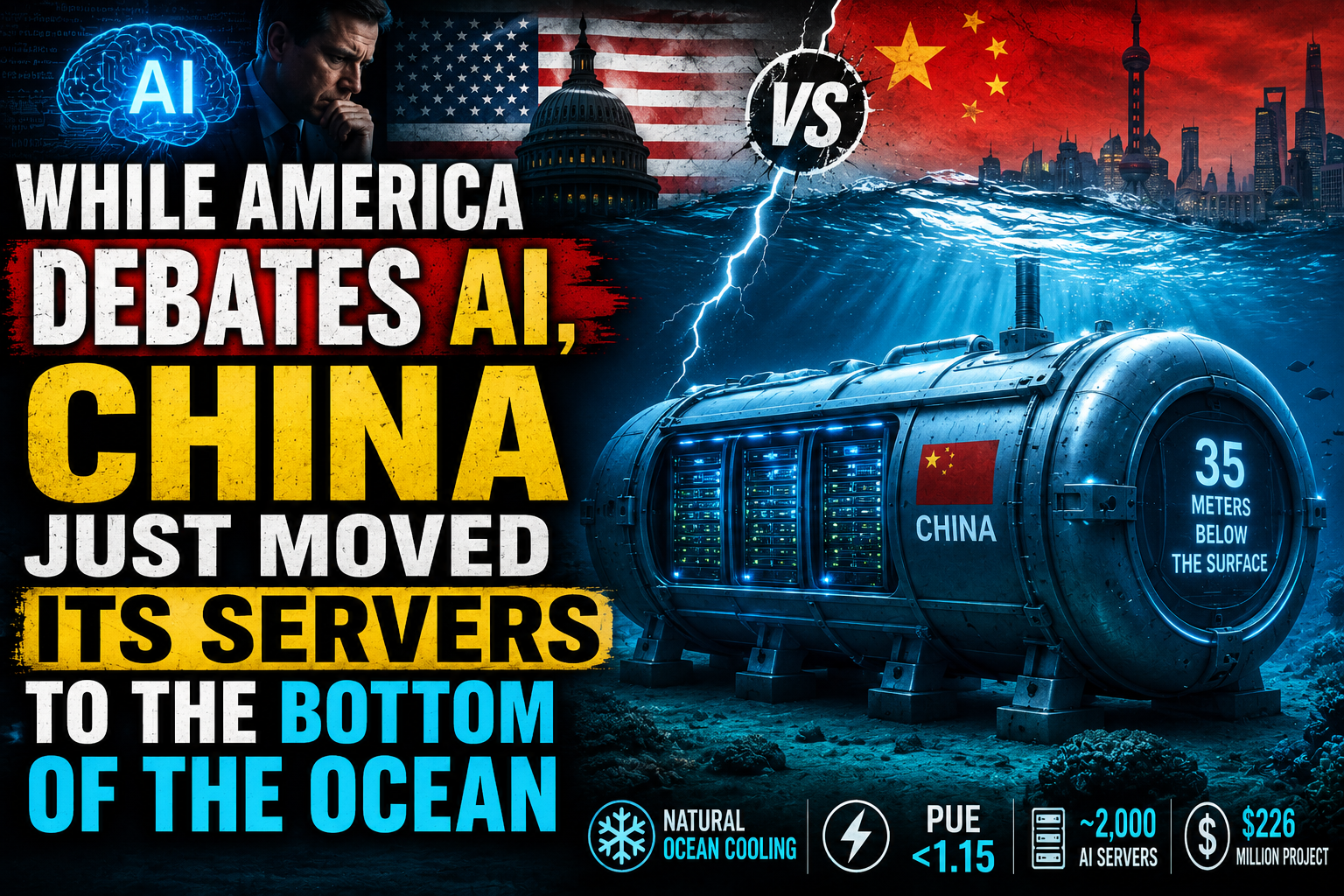
In a move that sounds like something out of a science fiction movie, China has officially brought the world’s first commercial offshore underwater data center into full operation.
The facility sits beneath the ocean near Shanghai.
Not beside the ocean.
Not overlooking the ocean.
Under it.
Thirty-five meters below the surface.
And it could represent a major shift in how the future of AI infrastructure is built.
The Hidden Problem Behind AI
Most people never think about what happens when they type a question into an AI chatbot, stream a movie, upload a photo, or use cloud services.
Behind every digital action is a data center.
Thousands of servers are working around the clock.
Processing requests.
Storing information.
Running artificial intelligence systems.
Powering the modern internet.
The problem is that these facilities generate enormous amounts of heat.
The more powerful the computers become, the more cooling they require.
Cooling isn’t just expensive.
It consumes huge amounts of electricity and freshwater.
As AI demand explodes, cooling has become one of the biggest challenges facing the technology industry.
That is where China’s underwater experiment enters the picture.
Why Put a Data Center Underwater?
The answer is surprisingly simple.
The ocean is cold.
Instead of relying on giant cooling towers and energy-intensive air conditioning systems, the underwater facility uses surrounding seawater as a natural cooling mechanism.
Heat generated by thousands of servers is absorbed by the stable ocean temperatures surrounding the structure.
This dramatically reduces energy consumption.
The result is a level of efficiency that many traditional facilities struggle to achieve.
According to project officials, the data center operates with a Power Usage Effectiveness rating below 1.15.
For comparison, many conventional data centers operate between 1.5 and 2.0.
In the data center industry, lower numbers are better.
Much better.
The Numbers Are Impressive
The facility reportedly contains around 2,000 servers.
That includes specialized GPU systems designed for artificial intelligence workloads.
These processors handle machine learning, big data analytics, cloud computing services, and next-generation telecommunications infrastructure.
The project reportedly cost approximately $226 million.
It was developed by HiCloud Technology alongside major Chinese telecommunications companies backed by the state.
This isn’t a small experimental project.
It’s commercial infrastructure.
Built to handle real workloads, generate real revenue and support China’s growing AI ambitions.
Microsoft Tried Something Similar
China wasn’t the first country to test the concept.
Microsoft explored underwater data centers through a research effort known as Project Natick.
The company deployed sealed data center pods off the coast of Scotland.
The results surprised many experts.
Microsoft reported lower hardware failure rates than traditional land-based facilities.
The sealed environment reduced exposure to humidity, oxygen, and temperature fluctuations.
Those findings suggested underwater infrastructure might actually be more reliable than conventional alternatives.
Yet Microsoft eventually ended the project as a commercial initiative.
China has now become the first nation to move the concept into large-scale operational deployment.
That distinction matters.
A lot.
Why This Matters for AI
Artificial intelligence is creating an unprecedented demand for computing power.
Training large AI models requires enormous quantities of electricity.
Operating those systems requires even more.
As governments and corporations compete to build bigger AI platforms, energy consumption has become a strategic issue.
The nations that can operate AI infrastructure more efficiently may gain a significant advantage.
That is why China’s underwater data center is attracting global attention.
This isn’t just about cooling.
It’s about scaling AI, lowering costs, and reducing energy requirements.
And ultimately, it’s about technological leadership.
The Bigger Geopolitical Picture
Technology is increasingly becoming a matter of national power.
Countries are competing for dominance in artificial intelligence, semiconductor manufacturing, cloud infrastructure, and advanced computing.
Many analysts now view AI as the next major geopolitical battleground.
The country that controls the most powerful AI systems could gain enormous economic and strategic advantages.
That is why developments like China’s underwater data center are being watched closely around the world.
Supporters see innovation.
Critics see another sign of China’s accelerating technological ambitions.
Either way, the project is difficult to ignore.
Could Underwater Data Centers Become Normal?
What sounds futuristic today may eventually become commonplace.
Technology history is filled with ideas that initially seemed strange.
Cloud computing.
Smartphones.
Electric vehicles.
Remote work.
Artificial intelligence itself.
Many of these concepts faced skepticism before becoming mainstream.
Underwater infrastructure could follow a similar path.
If the economics work, companies may have strong incentives to build more facilities offshore.
Ocean cooling offers potential savings that become increasingly attractive as AI expands.
The question is whether those savings outweigh the costs and engineering challenges involved.
Not Everyone Is Convinced
Despite the excitement, challenges remain.
Maintenance becomes more complicated underwater.
Repairs require specialized equipment and logistics.
Environmental concerns may also emerge as projects expand.
Governments and regulators will likely demand extensive studies before approving large-scale deployments.
Questions about security, resilience, and long-term operational costs also remain unanswered.
Like any major technological innovation, the concept still faces significant hurdles.
A Glimpse Into the Future
Whether the project succeeds or fails, one thing is already clear.
The race to power artificial intelligence is forcing companies and governments to rethink everything.
Including where computers should live.
For decades, data centers were built on land.
Near cities, power grids, and transportation networks.
China is betting that the future may look very different.
Perhaps beneath the waves.
Final Thoughts
China’s underwater AI data center may be remembered as either a groundbreaking innovation or an ambitious experiment.
Time will tell.
But the project highlights something bigger than a single facility.
It shows how rapidly the AI race is evolving.
While much of the world is still debating the impact of artificial intelligence, engineers are already redesigning the physical infrastructure that powers it.
And in one corner of the Pacific Ocean, thousands of servers are now doing their work beneath the sea.
The future of computing may not be in the clouds.
It might be underwater.