
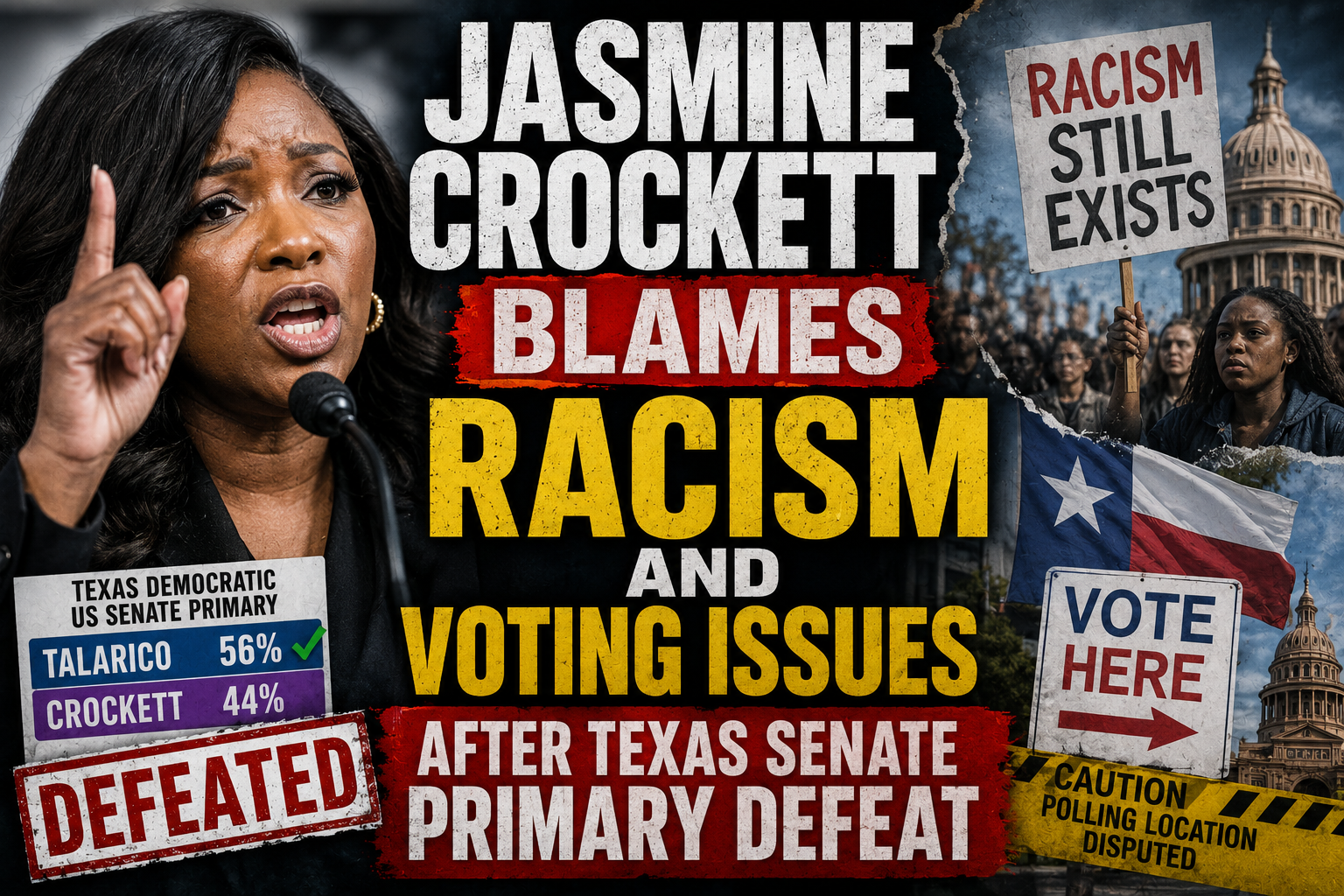
The political future of one of the Democratic Party’s most recognizable rising stars has taken a dramatic turn.
Following her defeat in the Texas Democratic U.S. Senate primary, Rep. Jasmine Crockett found herself at the center of another national controversy, not because she lost, but because of what she said afterward.
Crockett, who has built a national profile through viral congressional exchanges and frequent media appearances, argued that racism and voting access issues played a role in her loss.
Her comments immediately ignited fierce debate across the political spectrum.
Supporters said she was raising legitimate concerns.
Critics accused her of refusing to accept the voters’ decision.
The controversy quickly spread across social media, cable news, and political talk shows.
Now the discussion has become larger than a single election.
It has become another chapter in America’s ongoing debate about race, voting rights, and election confidence.
A Stunning Primary Defeat
Many political observers expected Crockett to be a major contender in the race.
As one of the Democratic Party’s most visible progressive voices, she entered the contest with strong name recognition and a loyal political following.
Yet when the votes were counted, the outcome surprised many analysts.
State Representative James Talarico emerged victorious.
Exit polling suggested Talarico performed particularly well among white Democratic voters, while Crockett maintained overwhelming support among Black voters.
The numbers immediately sparked conversations about voter coalitions, messaging, and the future direction of the Texas Democratic Party.
But the post-election discussion would soon focus on something else entirely.
Crockett Points to Racism
After the race, Crockett publicly suggested that racial factors contributed to her defeat.
The comments generated immediate attention.
America’s political history makes discussions about race especially sensitive, and allegations involving racial bias often trigger strong reactions from both supporters and opponents.
Crockett argued that racial dynamics influenced voter behavior during the primary.
Her supporters noted that Black candidates frequently face unique political challenges.
Critics countered that disagreements over policy and candidate preference should not automatically be attributed to racial motivations.
The debate quickly intensified online.
Questions About Election Day
Race was not the only issue Crockett raised.
She also pointed to concerns involving election administration and voting access.
Specifically, she referenced legal disputes involving polling locations in Dallas County.
According to supporters of Crockett’s position, certain court decisions created confusion and access challenges for some voters.
Voting rights advocates argued that even minor disruptions can affect turnout, particularly in densely populated urban areas.
Critics responded that election officials followed legal procedures and that no evidence has emerged showing the outcome would have been different.
The disagreement added another layer to an already heated political conversation.
Social Media Erupts
As clips of Crockett’s comments circulated online, reactions poured in from across the country.
Supporters praised her for speaking openly about issues they believe continue to affect American elections.
Some argued that conversations about race and voting access should not be dismissed simply because they make people uncomfortable.
Others saw the situation very differently.
Critics accused Crockett of making excuses for a political defeat.
Some compared her comments to the election-related complaints she and other Democrats have criticized when coming from political opponents.
The result was predictable.
Millions of views.
Thousands of comments.
And another political controversy is dominating social media feeds.
A Divided Democratic Party?
The primary result has also sparked discussion about the future of the Democratic Party in Texas.
For years, party leaders have debated how to build a coalition capable of competing statewide.
Different factions often disagree about messaging, priorities, and strategy.
Some analysts believe the election reflects growing support for candidates who focus on broad coalition-building.
Others argue the results reveal deeper tensions within the party regarding race, ideology, and political direction.
Regardless of interpretation, the outcome has generated significant discussion among Democratic activists and strategists.
The End of a Congressional Career
Perhaps the most significant aspect of the story is what comes next.
Crockett is not seeking re-election to her House seat.
That means her current term in Congress will be her last.
For a politician once viewed as a rapidly rising national figure, the development marks a major turning point.
Only a few years ago, many political observers saw Crockett as one of the Democratic Party’s most influential emerging voices.
Her media presence expanded rapidly, fundraising grew, and her national profile increased.
Now, questions about her political future are beginning to emerge.
Will she return to elected office?
Will she pursue another statewide campaign?
Or will she transition into media, advocacy, or legal work?
At this stage, nobody knows.
Why This Story Matters
Beyond the personalities involved, the controversy highlights several issues that continue to divide Americans.
How much does race influence modern elections?
What constitutes fair access to voting?
When candidates lose, where is the line between raising concerns and questioning results?
These questions have become increasingly central to American political life.
And they are unlikely to disappear anytime soon.
The Bigger Picture
The reaction to Crockett’s comments demonstrates how polarized political discussions have become.
Many Americans viewed her concerns as legitimate.
Many others viewed them as excuses.
Both sides believe they are defending important democratic principles.
That disagreement reflects a larger reality.
Americans increasingly interpret political events through very different lenses.
The same election result can produce completely different conclusions depending on who is analyzing it.
Final Thoughts
Jasmine Crockett’s Senate campaign may be over, but the debate surrounding her defeat is just beginning.
Her comments about racism and election administration have reignited discussions about voting rights, political accountability, and race in America.
Supporters believe she is highlighting real problems.
Critics believe she is avoiding responsibility for a loss.
The truth will continue to be debated long after the headlines fade.
One thing is certain.
Even in defeat, Jasmine Crockett remains one of the most talked-about figures in American politics.