
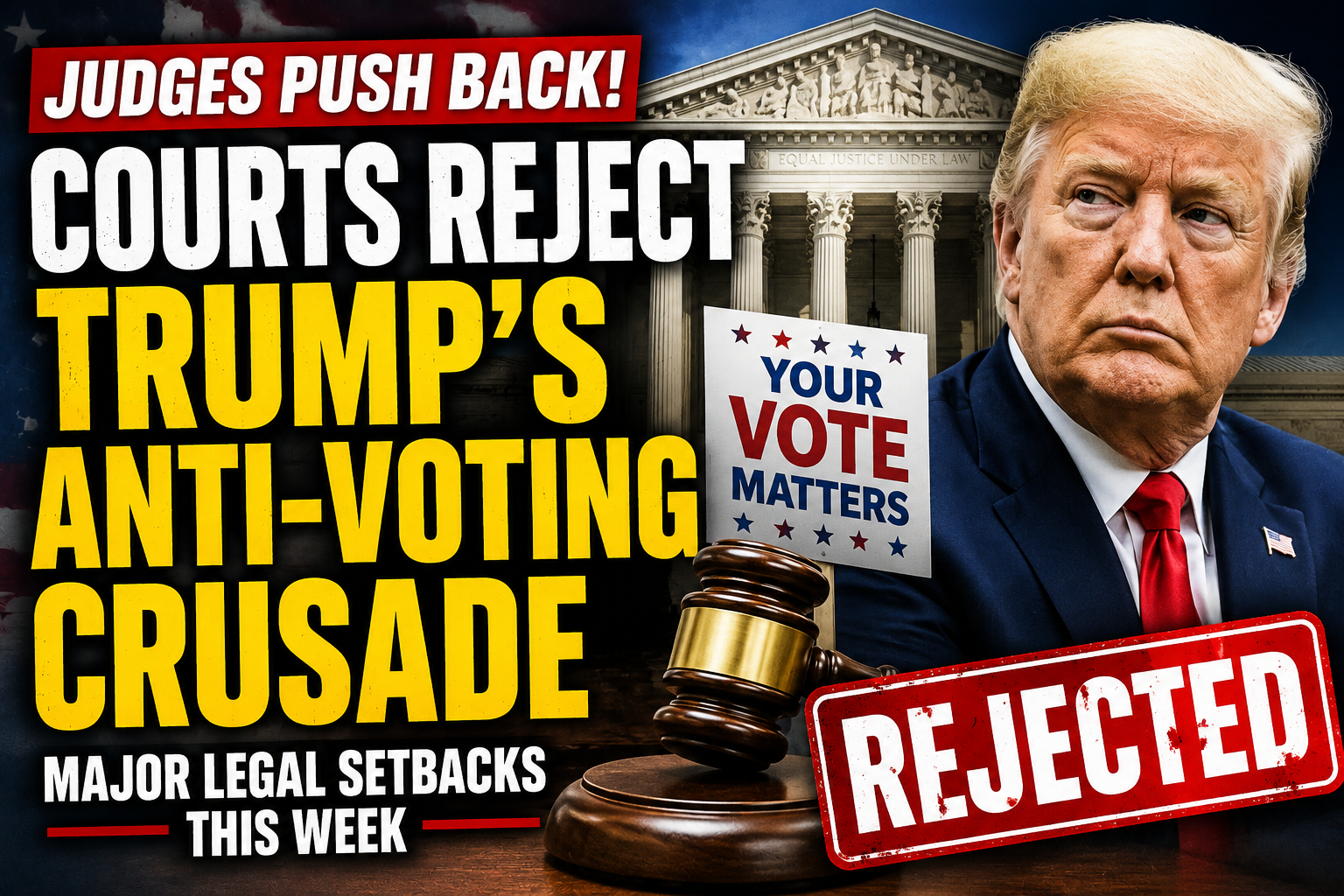
President Donald Trump’s push to reshape how Americans vote is encountering growing resistance in federal courts, with judges across the country issuing rulings that have slowed, blocked, or allowed legal challenges against several key election initiatives.
The latest decisions have intensified an already heated national debate over voting rights, election integrity, and presidential authority as the United States moves closer to the 2026 midterm elections.
Supporters of the Trump administration argue the proposed changes are necessary to strengthen election security and restore public confidence in the voting process.
Critics counter that many of the initiatives would make voting more difficult for eligible Americans and exceed the president’s legal authority.
Recent court rulings suggest judges are increasingly becoming the central referees in this growing constitutional battle.
Courts Become the New Battleground
Election law has become one of the most contested legal issues in America.
Rather than being settled primarily in Congress, many of the country’s biggest voting disputes are now unfolding inside federal courtrooms.
Over the past several weeks, judges have issued multiple decisions affecting lawsuits involving mail voting, voter registration, election administration, and access to voter information.
Some rulings have temporarily blocked portions of the administration’s policies.
Others have simply allowed legal challenges to move forward instead of dismissing them outright.
Although these decisions do not necessarily determine the final outcome, they represent significant legal hurdles for the administration’s broader election agenda.
Supreme Court Delivers a Significant Decision
One of the week’s most closely watched developments came from the U.S. Supreme Court.
In a closely divided 5-4 ruling, the Court held that states may continue counting mail-in ballots that are postmarked by Election Day but arrive afterward, upholding election laws used in numerous states.
The case arose after Republican-backed legal challenges argued that federal law requires ballots to be received—not merely postmarked—by Election Day.
The Court rejected that argument, preserving existing ballot-counting procedures in many jurisdictions.
Legal experts describe the decision as one of the most significant election rulings before the 2026 midterms because it maintains current mail-ballot practices in many states.
Lawsuits Continue Over Executive Actions
Separate litigation also continues regarding executive actions issued by the Trump administration concerning election procedures.
A federal judge recently ruled that lawsuits challenging portions of the administration’s election-related executive order may proceed.
Rather than dismissing the cases, the court concluded that states and voting-rights organizations presented sufficient legal questions to continue litigating the dispute.
The lawsuits challenge whether the executive branch possesses the authority to impose certain election requirements without congressional approval.
Final decisions remain months away, but allowing the litigation to proceed represents another obstacle for the administration’s agenda.
Voter Data Disputes Intensify
Another major legal battle centers on the Justice Department’s requests for state voter information.
Voting-rights organizations have questioned how the federal government intends to use sensitive voter-roll data requested from states.
Several groups have filed lawsuits seeking greater transparency regarding the administration’s plans.
Administration officials argue that accurate voter rolls are essential for election integrity.
Opponents fear the information could eventually be used to justify voter purges or other administrative actions affecting eligible voters.
The legal fight remains ongoing.
A Debate Over Election Integrity
Supporters of Trump’s election policies argue that stronger verification procedures help prevent fraud and improve public confidence.
They contend that maintaining accurate voter rolls and reviewing mail-voting procedures are reasonable steps designed to protect elections.
Critics respond that numerous investigations have found no evidence of widespread voter fraud capable of changing national election outcomes.
They argue that new restrictions could disproportionately affect military voters, overseas citizens, elderly voters, and people who rely on absentee voting.
The disagreement has become one of the defining political debates heading into the midterm elections.
The Role of the Judiciary
Recent rulings also underscore the judiciary’s growing influence over election policy.
Federal judges have repeatedly been asked to determine whether presidential actions comply with federal statutes and constitutional limits.
Legal scholars note that courts are not deciding political questions themselves.
Instead, judges are evaluating whether executive actions follow existing law and whether constitutional procedures have been respected.
Regardless of political affiliation, these rulings highlight the judiciary’s role as an independent check within the American system of government.
Why the Cases Matter
The outcome of these lawsuits could shape how Americans vote in future elections.
Issues involving mail ballots, voter registration databases, executive authority, and election administration have implications that extend far beyond any single election cycle.
Because many of the legal questions involve constitutional authority, some disputes could ultimately return to the Supreme Court.
Until then, lower federal courts will continue handling many of the nation’s most consequential election cases.
Looking Ahead
With the 2026 midterms approaching, both political parties are closely monitoring these legal battles.
Republicans continue emphasizing election security and voter confidence.
Democrats and voting-rights organizations argue that protecting ballot access remains equally important.
More rulings are expected in the coming months as lawsuits continue moving through the federal court system.
Each decision could influence how states administer future elections and how voters cast their ballots.
Final Thoughts
The latest court decisions do not end the debate over election law in the United States.
Instead, they represent another chapter in an ongoing legal struggle over voting rights, executive authority, and election administration.
Supporters view the administration’s proposals as necessary reforms.
Critics see them as restrictions requiring careful judicial review.
For now, federal judges—and ultimately the Supreme Court—are likely to remain central figures in determining how America’s election laws evolve in the years ahead.