
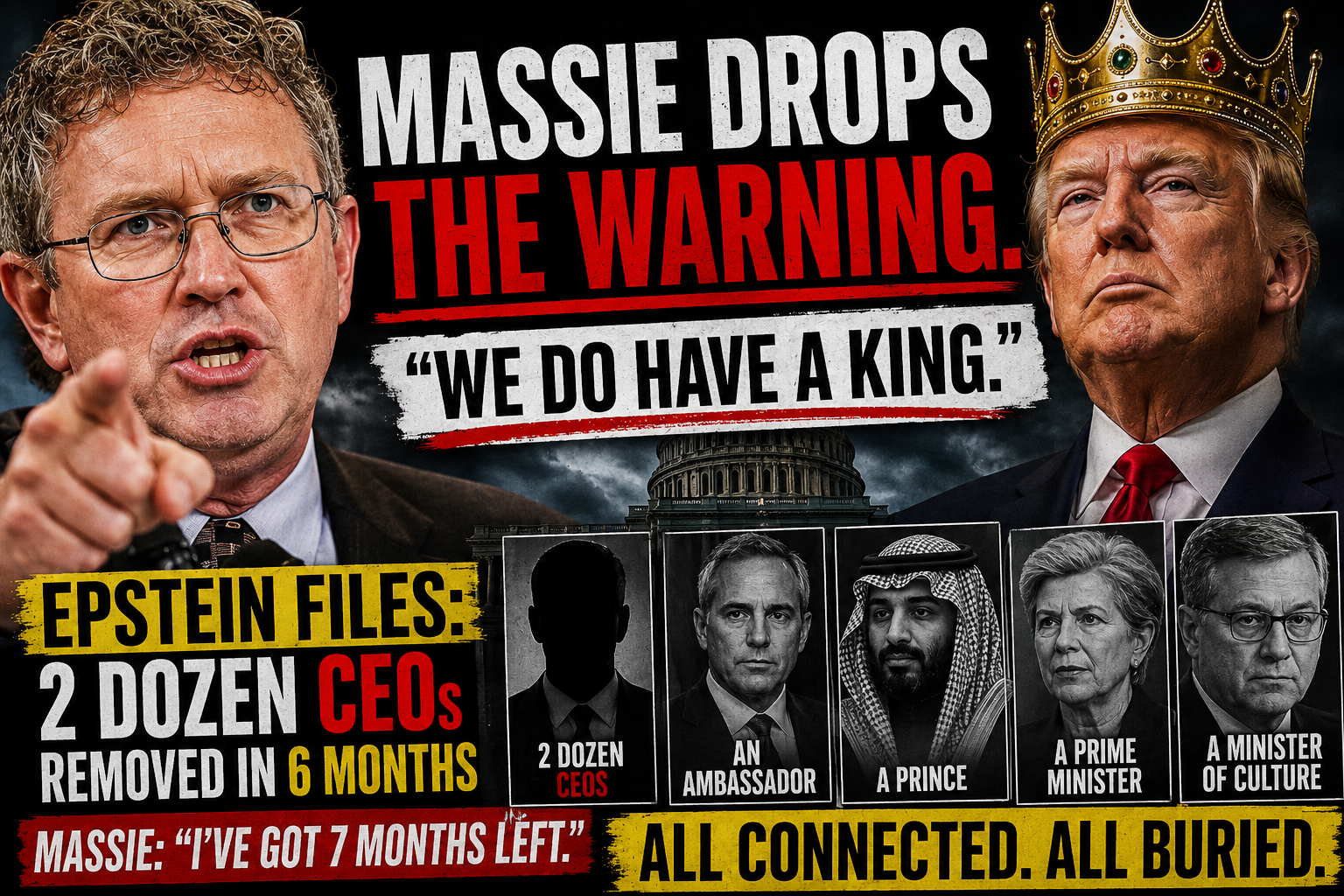
As his political career in Congress nears its end, Thomas Massie is once again at the center of a political firestorm.
During a controversial statement tied to the ongoing Epstein transparency debate, Massie issued a warning that immediately exploded across social media and alternative news platforms.
“If the legislative branch always votes with the president, we do have a king.”
The statement alone was enough to trigger backlash and fierce debate online. But it was what came next that truly ignited attention.
According to viral claims circulating online, Massie referenced the so-called “Epstein Files Transparency Act” and suggested that individuals connected to the Epstein scandal had already faced enormous consequences behind the scenes.
“By the way, today is the six-month anniversary of the Epstein Files Transparency Act,” Massie reportedly said.
“We’ve taken out two dozen CEOs, an ambassador, a prince, a prime minister, a minister of culture, and that was just six months. I’ve got seven months left in Congress.”
The remarks immediately sparked outrage, speculation, and countless questions across the political world.
Who were the people he was referring to?
What exactly did “taken out” mean?
And how deep do the Epstein files truly go?
Massie’s Growing War Against the Establishment
Thomas Massie has spent years positioning himself as one of Congress’s most rebellious and independent voices.
Known for opposing party leadership, challenging federal spending, criticizing surveillance powers, and resisting bipartisan consensus, Massie built a reputation as a lawmaker willing to confront both Democrats and Republicans.
But his recent comments surrounding Epstein-related transparency have pushed him into even more explosive territory.
Supporters see him as a rare politician willing to confront powerful elites and expose uncomfortable truths hidden within government institutions.
Critics accuse him of fueling conspiratorial narratives and making inflammatory claims without sufficient evidence.
Either way, his remarks ensured that the Epstein controversy returned to the center of public attention once again.
The Epstein Files Still Haunt Global Elites
Years after the death of Jeffrey Epstein, the scandal surrounding his connections continues to ripple through politics, finance, royalty, and global business circles.
Court records, leaked documents, lawsuits, flight logs, and testimony from victims have repeatedly revealed Epstein’s extraordinary access to influential figures across the world.
The public fascination persists because many Americans believe the full story has never been revealed.
Every new disclosure fuels suspicion that additional names, relationships, and details remain hidden from public view.
That is why statements like Massie’s spread so rapidly online.
When a sitting congressman suggests that CEOs, diplomats, princes, and world leaders have already fallen due to Epstein-related revelations, people immediately assume there is far more happening behind closed doors than the public has been told.
What Did Massie Mean by “Taken Out”?
One of the biggest reasons the comments went viral is the ambiguity of Massie’s wording.
The phrase “taken out” triggered immediate speculation online.
Some interpreted it literally and dangerously. Others believed Massie was referring to resignations, political removals, reputational collapses, investigations, or career destruction tied to Epstein-related exposure.
Recently, multiple high-profile executives and public figures connected in some way to Epstein have indeed faced public scrutiny, lawsuits, resignations, or reputational damage.
However, critics argue that viral narratives often exaggerate or oversimplify those developments.
The internet quickly turned the quote into something larger than the original statement itself, with users across social media claiming hidden global networks were collapsing in real time.
Whether factual or exaggerated, the controversy revealed how deeply distrust in institutions has grown.
The “King” Comment Sparked Another Debate
Massie’s warning about Congress voting with the president also added fuel to the fire.
“If the legislative branch always votes with the president, we do have a king.”
The statement reflected broader fears about executive power, party loyalty, and the erosion of institutional independence in Washington.
Supporters praised the comment as a defense of constitutional checks and balances.
Opponents accused Massie of political grandstanding after losing political support at home.
The timing mattered.
With his congressional future uncertain, many observers argued Massie now feels freer to say things other politicians would avoid.
That perception has transformed him into a hero for some anti-establishment voters and a dangerous provocateur for others.
Why the Epstein Story Refuses to Die
The Epstein scandal continues dominating public imagination because it sits at the intersection of wealth, power, secrecy, sex trafficking, politics, and elite protection.
People across the political spectrum believe influential figures escaped accountability.
Some believe the media intentionally avoided a more in-depth investigation into Epstein’s connections. Others argue that law enforcement and intelligence agencies shielded powerful individuals from scrutiny.
Whether those beliefs are accurate or not, distrust surrounding the case remains enormous.
Every leaked document, court filing, or public statement reignites speculation that the public still knows only a fraction of the full story.
Massie’s comments tapped directly into that frustration.
Social Media Turned the Story Into a Movement
Within hours, clips and quotes from Massie’s remarks spread across platforms like X, TikTok, YouTube, Telegram, and independent political blogs.
Supporters framed him as a lone congressman exposing a corrupt system before leaving office.
Critics warned that sensational claims without concrete evidence can fuel paranoia and misinformation.
But the viral nature of the controversy revealed something important:
Public trust in institutions is at a historic low.
Millions of people are increasingly willing to believe that governments, corporations, media organizations, and global elites work together to suppress damaging information.
That environment allows statements like Massie’s to explode online almost instantly.
The Real Question Americans Are Asking
Behind all the headlines, conspiracy theories, and political outrage lies a more profound question:
How much information connected to Epstein still remains hidden?
For years, the public has watched sealed court battles, delayed document releases, mysterious connections, and high-profile resignations tied to the Epstein network.
Every new development strengthens the belief that the scandal reaches far beyond what has already been revealed publicly.
Whether Massie’s claims were symbolic, exaggerated, or entirely literal, they reignited demands for transparency surrounding Epstein-related investigations and documents.
And until the public believes the entire truth has been exposed, the controversy is unlikely to disappear.
Final Thoughts
Thomas Massie has once again placed himself at the center of one of America’s most explosive political conversations.
His warning about executive power, combined with dramatic claims tied to the Epstein files, sent shockwaves through social media and alternative media circles.
Supporters see him as one of the few lawmakers willing to challenge powerful interests.
Critics see dangerous rhetoric designed to inflame public distrust.
But regardless of political perspective, one reality remains undeniable:
The Epstein scandal still holds enormous power over the public imagination.
And every time another politician, billionaire, or global figure becomes linked to the story, the demand for answers only grows louder.