
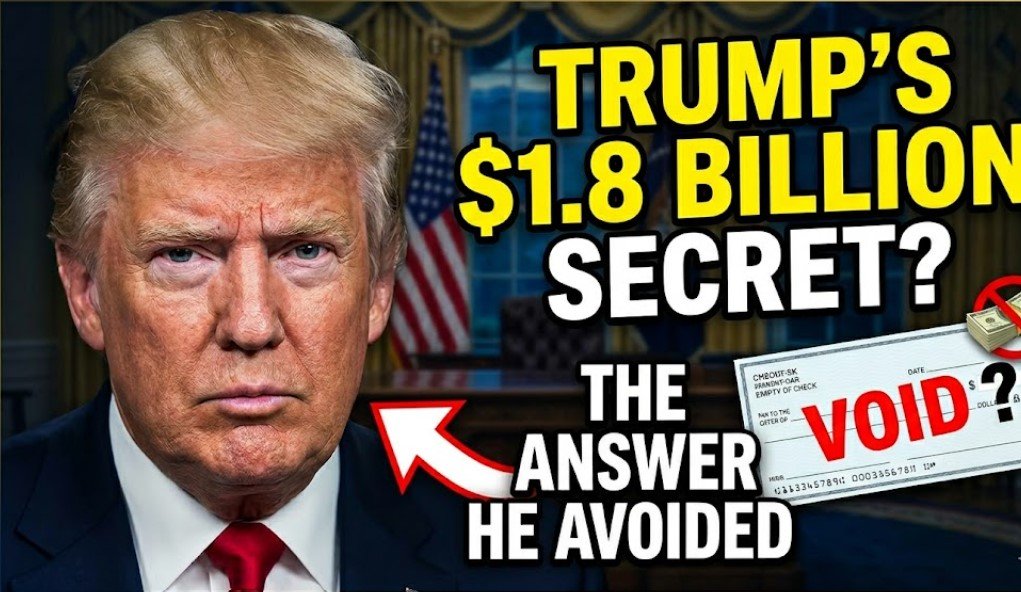
A tense Oval Office exchange has reignited a familiar debate about President Donald Trump’s relationship with the media and his approach to difficult questions.
During a recent appearance in the Oval Office, CNN’s Kaitlan Collins attempted to ask Trump about a controversial issue that has generated growing interest in Washington: the fate of a reported $1.8 billion fund that was recently scrapped.
What happened next quickly became the real story.
Rather than directly addressing the policy question, Trump turned his attention to Collins herself.
He criticized her coverage, accused her of approaching him with bias, and took aim at CNN more broadly.
The original question never received a clear answer.
For supporters, it was another example of Trump refusing to be pushed around by a media outlet he has long accused of unfair treatment.
For critics, it was a textbook example of avoiding a difficult subject by shifting the focus to the messenger.
The Question Everyone Was Waiting For
Political reporters often spend days preparing for brief opportunities to question presidents.
The questions asked in those moments can shape headlines for days.
In this case, Collins focused on a policy matter that many observers wanted clarified.
Questions surrounding the reported $1.8 billion fund had already begun circulating across political media.
Supporters and critics alike were looking for answers.
Instead, the exchange quickly moved away from the substance of the issue.
The discussion became personal.
A Familiar Trump Strategy?
Trump’s critics argue that this pattern has become predictable.
When faced with uncomfortable questions, they say, he often redirects attention toward the reporter, the media organization, or the motives behind the question itself.
The result is that the conversation shifts away from policy and toward conflict.
Trump supporters reject that interpretation.
They argue that many journalists approach Trump with openly adversarial attitudes and that he simply refuses to accept unfair treatment.
To them, challenging reporters is not avoidance.
It is self-defense.
The Media Battle Never Ends
One of the defining features of Trump’s political career has been his ongoing war with major news organizations.
Few relationships have been more contentious than the one between Trump and CNN.
The clashes have produced countless viral moments over the years.
Press conferences.
Campaign rallies.
Television interviews.
Social media posts.
The conflict has become so familiar that many Americans expect these confrontations whenever Trump and CNN journalists occupy the same room.
Why Critics Are Raising Questions
For Trump’s opponents, the issue isn’t the argument itself.
It’s what happened to the original question.
They argue that voters deserve direct answers from elected officials, especially when significant amounts of public money are involved.
When those answers fail to materialize, suspicion often grows.
Some critics believe that attacking the journalist instead of addressing the issue only increases public curiosity.
The unanswered question becomes the story.
Supporters See Something Different
Trump’s supporters view the exchange through a completely different lens.
Many believe mainstream media organizations frequently frame stories in ways that are hostile to conservatives.
As a result, they see Trump’s willingness to confront journalists as one of his strengths.
Rather than treating reporters as neutral observers, Trump openly challenges them.
That approach has helped him build a strong connection with supporters who share his distrust of major media institutions.
The Bigger Issue: Trust
At its core, the controversy highlights a broader problem facing American politics.
Trust.
Many Americans no longer trust politicians.
Many Americans no longer trust the media.
Increasingly, each side accuses the other of withholding information or manipulating narratives.
That environment makes even simple exchanges feel like political battles.
Every question becomes a confrontation.
Every answer becomes a controversy.
The Power of the Unanswered Question
History shows that unanswered questions often attract more attention than answered ones.
When public figures decline to engage directly with a topic, curiosity tends to grow.
People begin speculating.
Commentators fill the information gap.
Political opponents demand explanations.
Supporters defend the decision.
The cycle feeds itself.
That appears to be exactly what happened here.
What Happens Next?
Whether the administration eventually provides more details remains to be seen.
Political reporters are unlikely to stop asking questions.
Opposition lawmakers will almost certainly continue pressing for clarification.
And media organizations will keep examining the issue.
Meanwhile, the Oval Office confrontation is already generating headlines of its own.
The argument may have lasted only a few moments.
But its political impact could linger much longer.
Final Thoughts
The clash between Donald Trump and Kaitlan Collins was about more than a single question.
It reflected the larger struggle between politicians and journalists that has increasingly defined modern American politics.
Supporters saw a president standing up to a hostile media.
Critics saw a leader avoiding accountability.
The truth may depend on where one stands politically.
But one fact remains undisputed.
The question that started the exchange still hasn’t gone away.
And neither has the controversy surrounding it.