
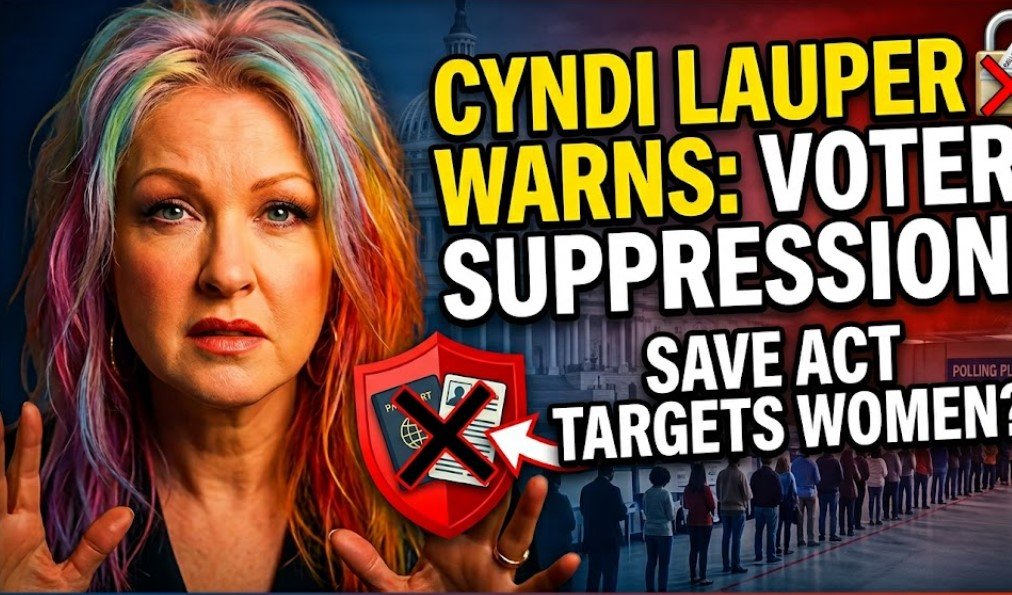
Legendary pop singer Cyndi Lauper has entered the growing national debate over voting rights, using her platform to speak out against the Republican-backed SAVE Act.
In an Instagram video posted in April 2026, Lauper urged Americans to pay attention to the proposed legislation, arguing that it could create significant barriers for millions of eligible voters. While supporters of the bill say it is designed to strengthen election integrity and ensure only U.S. citizens vote in federal elections, critics contend that the measure could make voter registration more difficult for many Americans.
The controversy has turned the SAVE Act into one of the most closely watched voting-related proposals in Washington.
What Is the SAVE Act?
The SAVE Act, short for the Safeguarding American Voter Eligibility Act, is legislation that seeks to tighten voter registration requirements across the United States.
Under the proposal, individuals registering to vote would be required to provide documentary proof of U.S. citizenship. The bill would also direct states to verify voter rolls and remove noncitizens who may be registered.
Additionally, the legislation would establish new criminal penalties related to the registration of individuals who are not legally eligible to vote.
Supporters argue that these measures are necessary to close gaps in the voter verification process and strengthen public confidence in elections.
Opponents argue that the legislation could create new obstacles for lawful voters who may not have immediate access to the required documentation.
Lauper’s Criticism of the Bill
In her video message, Lauper rejected the argument that the bill is primarily about preventing voter fraud.
Instead, she characterized the legislation as voter suppression and warned that it could disproportionately affect women.
According to Lauper, many married women could encounter difficulties if the names on their citizenship documents do not match their current legal names.
She argued that such discrepancies could create unnecessary hurdles during the voter registration process.
Lauper stated:
“This is not about protecting against voter fraud.”
She went on to describe the proposal as:
“Voter suppression, especially for millions of women.”
Her comments quickly spread across social media, drawing praise from voting rights advocates and criticism from supporters of the legislation.
The Debate Over Documentation Requirements
One of the central controversies surrounding the SAVE Act involves documentation requirements.
Supporters of the measure argue that proof of citizenship is a reasonable requirement because voting in federal elections is restricted to U.S. citizens.
They contend that:
- Citizenship verification strengthens election integrity.
- States should have clear mechanisms for maintaining accurate voter rolls.
- Public trust in elections depends on strong verification systems.
Critics counter that while citizenship verification sounds straightforward, obtaining acceptable documentation is not always simple.
Some concerns include:
- Name changes after marriage.
- Lost or damaged records.
- Costs associated with obtaining replacement documents.
- Administrative barriers for elderly voters and lower-income Americans.
These concerns have fueled a broader discussion about whether the legislation would affect certain groups more than others.
Connecting Voting Rights and Reproductive Rights
Lauper’s criticism extended beyond voter registration requirements.
In her remarks, she connected the SAVE Act to broader debates over women’s rights and political participation.
She argued that recent policy debates surrounding reproductive rights and voting access should be viewed together rather than as separate issues.
According to Lauper, restrictions affecting women’s autonomy and barriers affecting voter participation are part of a larger political struggle.
Her comments reflected concerns shared by many advocacy organizations that view voting access as a fundamental civil rights issue.
Supporters of the SAVE Act, however, reject that characterization and maintain that the legislation is solely focused on election security.
Why the SAVE Act Has Become So Controversial
The legislation has generated intense debate because it sits at the intersection of two highly sensitive issues:
- Election integrity
- Voting access
For years, lawmakers have argued over how to balance security measures with ensuring that eligible citizens can easily participate in elections.
Supporters of stricter verification laws often emphasize preventing potential vulnerabilities in the system.
Opponents frequently argue that such measures can unintentionally create barriers for lawful voters.
As a result, even relatively technical election proposals often become major political flashpoints.
Celebrity Voices and Political Influence
Lauper is far from the first entertainer to speak out on political issues.
Over the years, musicians, actors, and other public figures have increasingly used social media platforms to engage with legislative debates.
Supporters of celebrity activism argue that public figures can raise awareness about issues that might otherwise receive limited attention.
Critics argue that celebrities often simplify complex policy questions and influence public opinion without providing detailed legal analysis.
Regardless of where one stands on that debate, celebrity involvement can significantly amplify political discussions.
Lauper’s comments ensured that the SAVE Act reached audiences far beyond traditional political circles.
The Political Stakes
The debate surrounding the SAVE Act highlights a broader national disagreement about how elections should be administered.
Supporters believe stronger verification requirements are necessary to maintain confidence in election outcomes.
Opponents worry that stricter requirements could discourage or prevent eligible citizens from participating in the democratic process.
With voting rights remaining a central issue in American politics, legislation like the SAVE Act is likely to continue generating passionate arguments from both sides.
Conclusion
Cyndi Lauper’s criticism of the SAVE Act has added another high-profile voice to the ongoing debate over voting rights and election security.
While supporters view the legislation as a common-sense effort to strengthen voter verification, opponents see it as a potential barrier that could affect millions of eligible Americans.
As lawmakers continue to debate the bill, the larger question remains unresolved: how can the United States balance election integrity with broad and accessible voter participation?
That debate is unlikely to end anytime soon.