
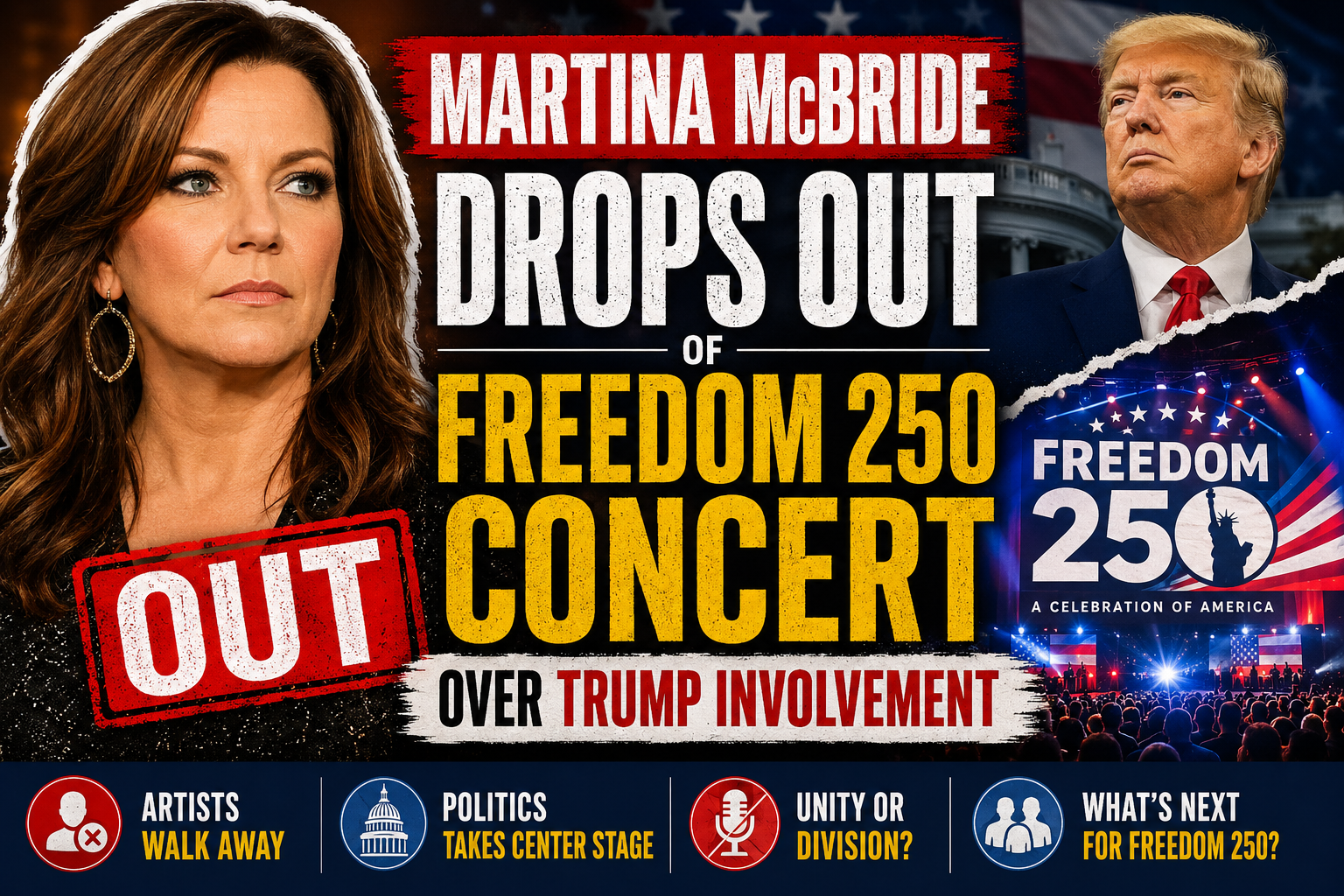
Country music star Martina McBride has officially withdrawn from the upcoming Freedom 250 concert after concerns emerged over the event’s political associations, particularly its reported connection to former President Donald Trump.
Her exit adds momentum to a growing wave of artist withdrawals, turning what was initially marketed as a nonpartisan national celebration into a politically charged controversy.
The Freedom 250 concert was intended to mark America’s 250th anniversary with a large-scale musical celebration, but the lineup changes have now shifted public attention toward political divisions rather than unity.
How the Situation Started
According to reports from individuals familiar with the event’s planning, artists—including McBride—were initially invited under the impression that Freedom 250 would be a strictly nonpartisan celebration of American music and culture.
The concept was presented as:
- A national anniversary concert
- Focused on unity and American heritage
- Free from political messaging or endorsements
However, as details about the organizers and political associations became clearer, several performers began reassessing their participation.
McBride ultimately decided to withdraw after concluding that the event’s framing did not match what she originally agreed to.
Why Martina McBride Pulled Out
McBride’s decision is being described by sources close to the situation as a matter of principle and transparency.
She reportedly felt that:
- The political context of the event had become more visible over time
- The branding of “nonpartisan” no longer matched the reality of the lineup and affiliations
- Continued participation could be interpreted as a political endorsement
Her withdrawal is not an isolated case, but part of a broader trend among artists reconsidering their involvement.
Trump’s Role in the Controversy
The involvement of former President Donald Trump has become the central issue surrounding the Freedom 250 concert.
Supporters of Trump argue that his association with the event elevates its patriotic significance and aligns with a celebration of American history and identity.
Critics, however, say his presence introduces unavoidable political symbolism into what was intended to be a unifying cultural milestone.
This disagreement has placed performers in a difficult position, forcing them to weigh artistic participation against public perception.
Growing List of Artist Withdrawals
McBride joins other musicians who have either stepped away or publicly distanced themselves from the event.
While the full lineup is still evolving, the pattern of withdrawals has created several consequences:
- Increased media scrutiny of the event
- Questions about transparency in artist invitations
- Uncertainty over the final roster of performers
- A shift in public narrative from celebration to controversy
What organizers originally promoted as a broad cultural showcase, the public now widely discusses as a politically sensitive event.
Freedom 250’s Changing Identity
Organizers designed the Freedom 250 concert to celebrate America’s upcoming 250th anniversary with music, storytelling, and cultural performances.
But as artists exit the lineup, the event’s identity is becoming less clear.
Key concerns now include:
- Can audiences still consider the concert nonpartisan?
- Whether the remaining performers will face similar backlash
- How organizers will rebuild trust with artists
- Whether the event will proceed with a significantly altered vision
The shift highlights how quickly cultural events can become politicized in today’s environment.
Entertainment and Political Pressure
The controversy reflects a larger trend in the entertainment industry, where performers increasingly navigate political implications in public appearances.
Artists today face pressures involving:
- Social media backlash
- Brand alignment concerns
- Political interpretation of participation
- Audience expectations and reputation management
As a result, decisions about performing at major events are no longer purely artistic—they are also reputational and political.
Divided Public Reaction
The public has divided sharply over McBride’s withdrawal.
Supporters of the decision argue:
- Artists have the right to avoid politically charged events
- Transparency about event affiliations is essential
- Participation should align with personal values
Critics argue:
- National celebrations should rise above politics
- Withdrawals unnecessarily politicize cultural events
- Artists are contributing to division instead of unity
The debate reflects broader cultural polarization in the United States.
Impact on the Event’s Future
Organizers of Freedom 250 now face mounting challenges as the event approaches.
They must address:
- Replacement of high-profile performers
- Restoration of confidence among participating artists
- Clarification of the event’s political positioning
- Public perception management
If withdrawals continue, the event may require significant restructuring before it can proceed.
Conclusion
Martina McBride’s decision to exit the Freedom 250 concert highlights the growing tension between cultural celebration and political association in modern America.
What began as a unifying national music event has turned into a focal point in the broader debate over politics in entertainment.
As more artists reconsider their participation, Freedom 250 now stands as a test case for whether large-scale cultural events can still remain truly nonpartisan in a deeply divided political climate.