
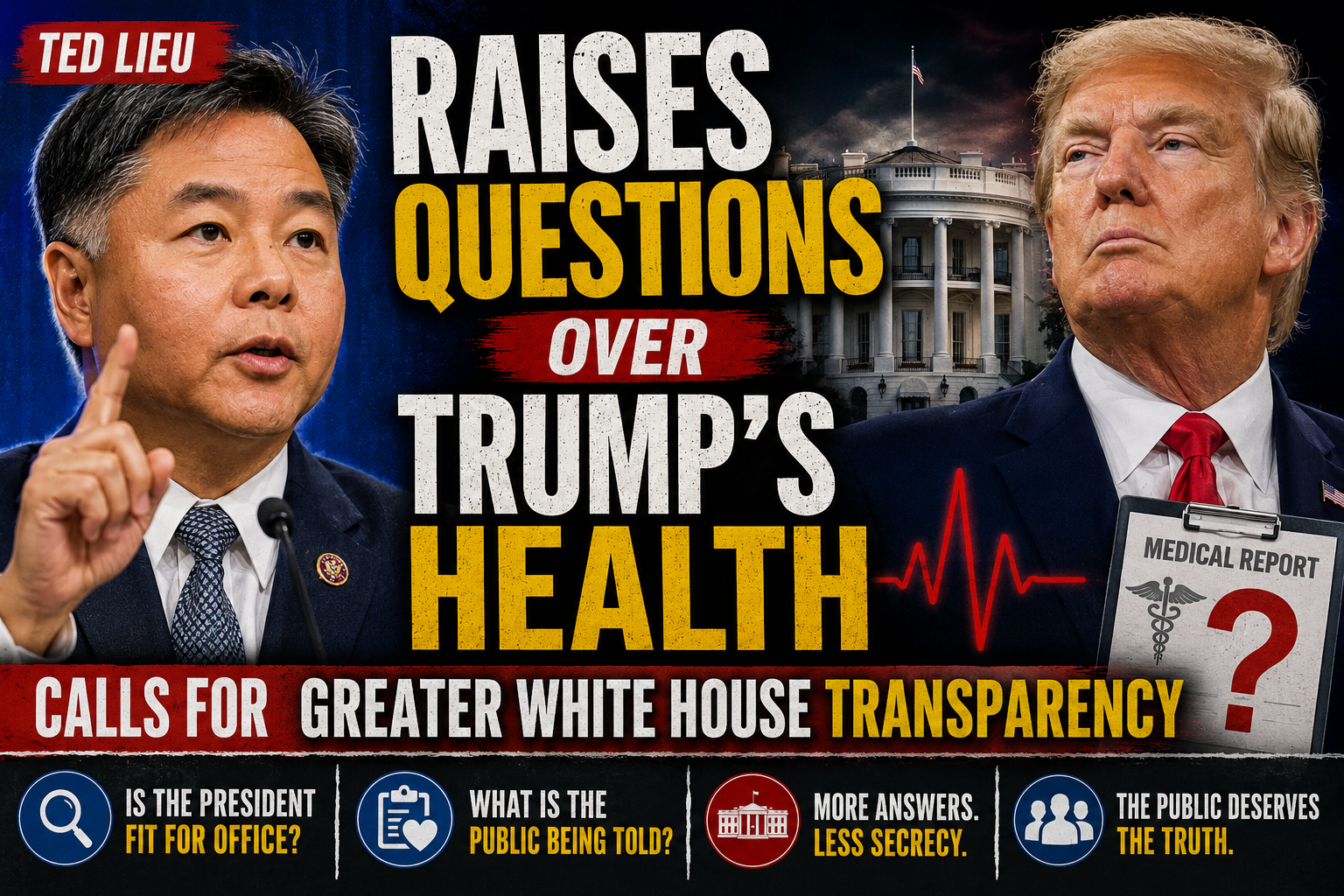
Democratic Congressman Ted Lieu has sparked renewed political debate after publicly questioning President Donald Trump’s health and urging the White House to provide more detailed transparency regarding his medical condition.
Lieu’s remarks have quickly become part of a broader national conversation about presidential fitness, cognitive health, and how much medical information should be disclosed to the public. The issue has drawn strong reactions from both supporters and critics of Trump, further intensifying an already polarized political climate.
At the center of the controversy is a familiar question in American politics: how far should transparency about a sitting president’s health go, and where should the line be drawn between legitimate oversight and political speculation?
Lieu’s Core Concerns
Lieu has argued that the American public deserves clearer answers regarding the president’s physical and cognitive health, particularly given the demands of the office.
In his public comments, he referenced several recent appearances in which he believes Trump appeared fatigued or less engaged than expected. He also raised questions about inconsistencies in public reporting surrounding medical evaluations and hospital-related visits.
According to Lieu, the concerns are not about partisan politics but about ensuring that the presidency remains fully accountable to the public it serves.
He has specifically called attention to:
- Public appearances where Trump appeared to struggle with energy levels
- Questions surrounding the transparency of medical evaluations
- Limited publicly available information on cognitive assessments
- The broader need for consistent presidential health disclosures
Lieu argues that without clear and consistent reporting, speculation fills the vacuum.
White House Health Transparency: A Longstanding Debate
Presidential health transparency has been a sensitive issue throughout U.S. history.
While presidents typically release periodic health summaries, the depth and detail of those reports vary significantly between administrations. Most include:
- Annual physical exam results
- Statements from White House physicians
- General assessments of fitness for office
However, critics of the current system argue that these summaries often lack specificity, particularly regarding neurological or cognitive evaluations.
Lieu’s concerns reflect growing calls among some lawmakers for more standardized disclosure requirements that would provide the public with clearer insight into a president’s overall health.
Political Reactions Split Along Party Lines
As expected, reactions to Lieu’s comments have broken sharply along partisan lines.
Democratic allies of Lieu argue:
Supporters of increased transparency say that the president’s health is a legitimate public concern and that voters have a right to know whether their leader is physically and mentally capable of handling the demands of office.
They also argue that:
- Transparency strengthens democratic accountability
- Clear reporting reduces misinformation and speculation
- Presidents hold uniquely demanding responsibilities requiring public trust
Republican responses:
Republican lawmakers and Trump allies have strongly rejected the claims, calling them politically motivated and based on a selective interpretation of public appearances.
They argue that:
- No official medical authority has raised concerns about Trump’s fitness
- Public behavior is not a reliable measure of a medical condition
- Similar claims have been used historically as political attacks
They also emphasize that Trump continues to carry out public duties and engagements without any formal indication of incapacity.
The Role of Public Perception in Modern Politics
In today’s media environment, perceptions of a political leader’s health often spread faster than verified medical information.
Observers frequently draw conclusions based on:
- Energy levels during speeches or rallies
- Travel schedules and workload
- Verbal slips or pauses in communication
- Media framing of public appearances
Medical experts, however, caution that these observations are not diagnostic and should not be used as substitutes for clinical evaluations.
Despite this, public perception often shapes political narratives, particularly during election cycles or periods of heightened scrutiny.
Why Presidential Health Is a Recurring Political Flashpoint
Concerns about presidential health are not unique to any single administration.
Historically, questions about a president’s physical or cognitive fitness have emerged in multiple eras, particularly when:
- Presidents serve at advanced ages
- Media coverage intensifies scrutiny of appearances
- Political competition increases polarization
- Health incidents or hospital visits occur
In such environments, even minor observations can quickly become politically amplified.
Lieu’s comments are the latest example of how health concerns can become intertwined with broader political battles.
Proposals for Greater Transparency
Lieu and other lawmakers who support reform argue that the current system of voluntary disclosure is insufficient for modern expectations of accountability.
Proposed reforms often include:
- More detailed annual presidential medical reports
- Standardized cognitive testing disclosures
- Independent medical review panels
- Clear requirements for reporting significant medical events
Supporters believe these measures would:
- Reduce speculation
- Strengthen public trust
- Provide consistency across administrations
Opponents, however, warn that such systems could:
- Politicize medical evaluations
- Raise privacy concerns
- Create incentives for political misuse of health data
Trump’s Continued Political Presence
Despite ongoing debates about health and fitness, Donald Trump remains an active and influential figure in American politics.
His continued public appearances, political messaging, and engagement with supporters remain central to the Republican Party’s national strategy.
For his supporters, this ongoing activity is presented as evidence that concerns about his health are overstated or politically driven.
For critics like Lieu, however, continued scrutiny is necessary given the stakes of presidential leadership.
The Broader Implications
Beyond the immediate political dispute, the debate highlights a larger structural issue in U.S. governance:
How should modern democracy handle transparency around the health of aging political leaders?
As presidents and candidates continue to serve later in life, questions about:
- Cognitive fitness
- Physical stamina
- Medical privacy
- Public accountability
are becoming increasingly prominent in national discourse.
Lieu’s comments reflect one side of a broader institutional conversation that is unlikely to disappear anytime soon.
Conclusion
Rep. Ted Lieu’s renewed calls for transparency regarding President Donald Trump’s health have reignited a long-running and deeply polarized debate in American politics.
While Lieu argues that the public deserves clearer and more consistent medical information, Trump’s supporters reject the concerns as speculative and politically motivated.
Ultimately, the dispute highlights a recurring challenge in modern democracy: balancing transparency, privacy, and political fairness when it comes to evaluating the health of the nation’s highest officeholder.