
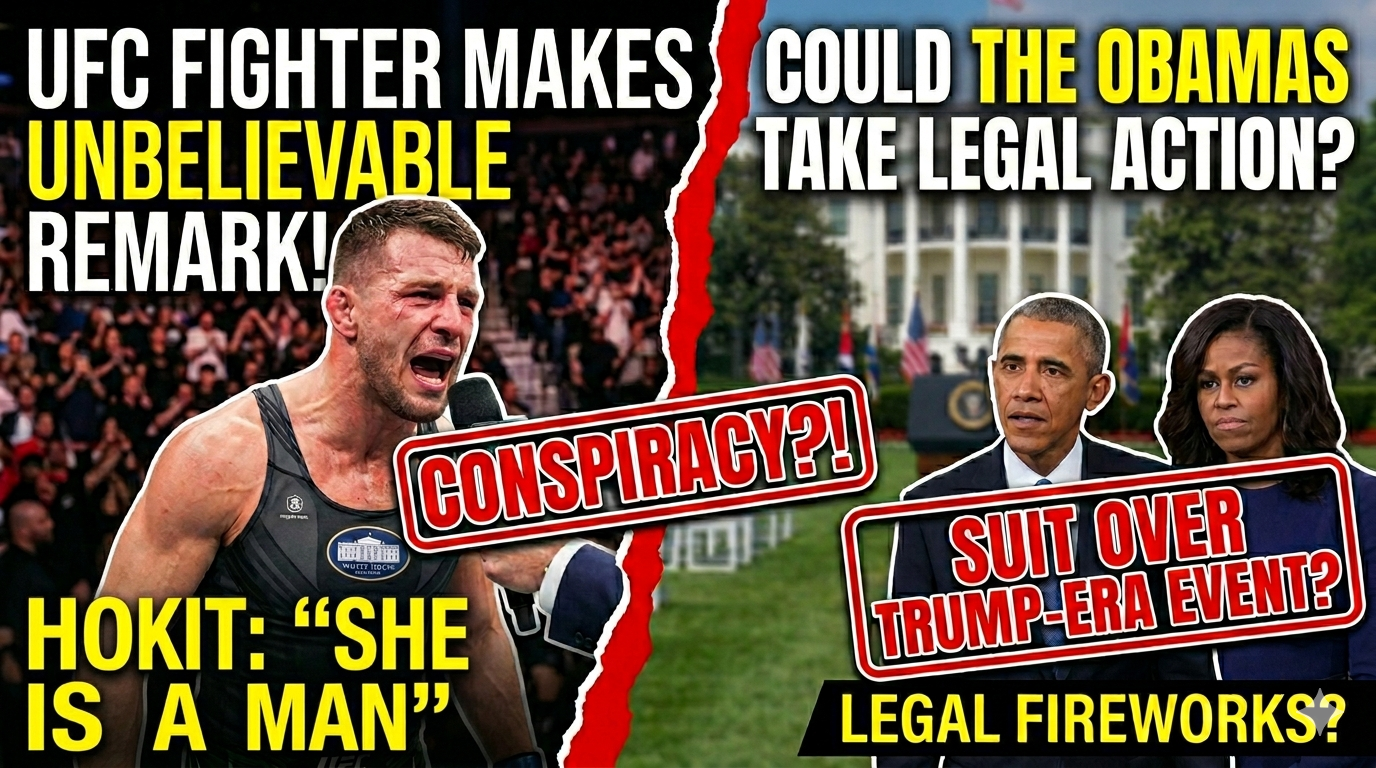
A controversial comment made during a UFC event on the White House lawn has sparked a nationwide debate involving politics, sports, free speech, and the limits of public discourse.
The controversy centers on UFC heavyweight fighter Josh Hokit, who used a post-fight interview to make a remark about former First Lady Michelle Obama that quickly generated headlines across the country. The statement immediately drew criticism from public figures, commentators, and social media users, while raising questions about whether there could be legal consequences.
As speculation spreads online, attention has shifted from the fight itself to the broader fallout surrounding the incident.
The Comment That Sparked the Storm
The incident occurred during UFC Freedom 250, an event held on the White House lawn as part of celebrations connected to America’s 250th anniversary.
After winning his fight, Hokit participated in a post-fight interview where he made a claim about Michelle Obama that has long circulated in conspiracy theory circles despite being repeatedly debunked. The remark quickly overshadowed his victory and became the dominant story coming out of the event.
News coverage that initially focused on the fights soon shifted toward the controversy.
Within hours, clips of the moment were spreading across social media.
A Long-Debunked Claim
The statement referenced a conspiracy theory that has circulated online for years.
Fact-checking organizations and news outlets have repeatedly found no evidence supporting the claim. Michelle Obama was born Michelle LaVaughn Robinson, and there is no factual basis for assertions that she is a man.
Because the claim has been repeatedly debunked, many critics viewed Hokit’s remarks not as a political statement but as the repetition of a false allegation.
That distinction has become central to the controversy.
Public Backlash Grows
Reaction was swift.
Commentators from across the political spectrum criticized the remark.
Former athletes, media personalities, and political figures condemned the statement as inappropriate, particularly given the venue where it occurred. Even some Trump supporters publicly argued that the comment crossed a line.
Social media quickly became flooded with reactions.
Some users defended Hokit’s right to speak freely.
Others argued that freedom of speech does not shield someone from criticism or potential reputational consequences.
The debate expanded well beyond sports.
Could There Be Legal Consequences?
One of the biggest questions emerging from the controversy is whether public figures can successfully pursue legal action over statements like these.
Under U.S. defamation law, public figures generally face a high legal standard.
To succeed, they typically must prove not only that a statement was false but also that it was made with “actual malice,” meaning knowledge that the statement was false or reckless disregard for the truth.
Legal experts often note that defamation cases involving celebrities, politicians, and former presidents can be particularly challenging.
As of now, public speculation about possible legal action remains just that—speculation. Any lawsuit would require formal filing and court proceedings before claims could be evaluated. There has been widespread online discussion about the possibility, but reports of legal action should be treated cautiously until officially confirmed.
UFC and White House Scrutiny
The controversy has also drawn attention to UFC itself.
Some observers questioned whether sports organizations bear responsibility for remarks made by athletes during official events.
Others argued that organizations cannot reasonably control every statement made during live interviews.
UFC leadership and associated figures found themselves fielding questions about the incident rather than discussing the athletic performances that took place that evening. Several public figures also called for a stronger condemnation of the remark.
The situation demonstrates how quickly a sporting event can become a political story.
The Role of Social Media
The speed at which the controversy spread illustrates the power of modern social media.
A brief comment lasting only a few seconds generated days of headlines, commentary, reaction videos, and opinion pieces.
Supporters and critics quickly formed opposing camps.
Some focused on free expression.
Others focused on misinformation.
The result was a familiar pattern in modern public discourse, where a single viral moment dominates national attention.
Why the Story Resonates
Part of the reason the incident attracted so much attention is that it touches multiple sensitive topics at once.
Politics.
Race.
Gender.
Celebrity culture.
Sports.
Public speech.
When those subjects intersect, controversies often grow rapidly.
The fact that the comment occurred during a nationally visible event only amplified the reaction.
The Bigger Picture
Beyond the immediate controversy, the incident reflects a broader challenge facing modern public discourse.
False claims can spread quickly online, particularly when attached to high-profile personalities.
At the same time, public figures often find themselves responding to narratives that have circulated for years despite repeated fact-checks and debunkings.
The debate, therefore, extends beyond one athlete or one comment.
It touches on questions about misinformation, accountability, and the responsibilities that come with public platforms.
Final Thoughts
Josh Hokit’s post-fight remark transformed what should have been a discussion about a major UFC victory into a national controversy.
The statement generated backlash, renewed scrutiny of long-debunked conspiracy theories, and fueled speculation about potential legal responses.
Whether any legal action ever materializes remains uncertain.
What is certain is that the incident has once again demonstrated how quickly a few words can dominate headlines, reshape public conversations, and draw national attention far beyond the world of sports.