
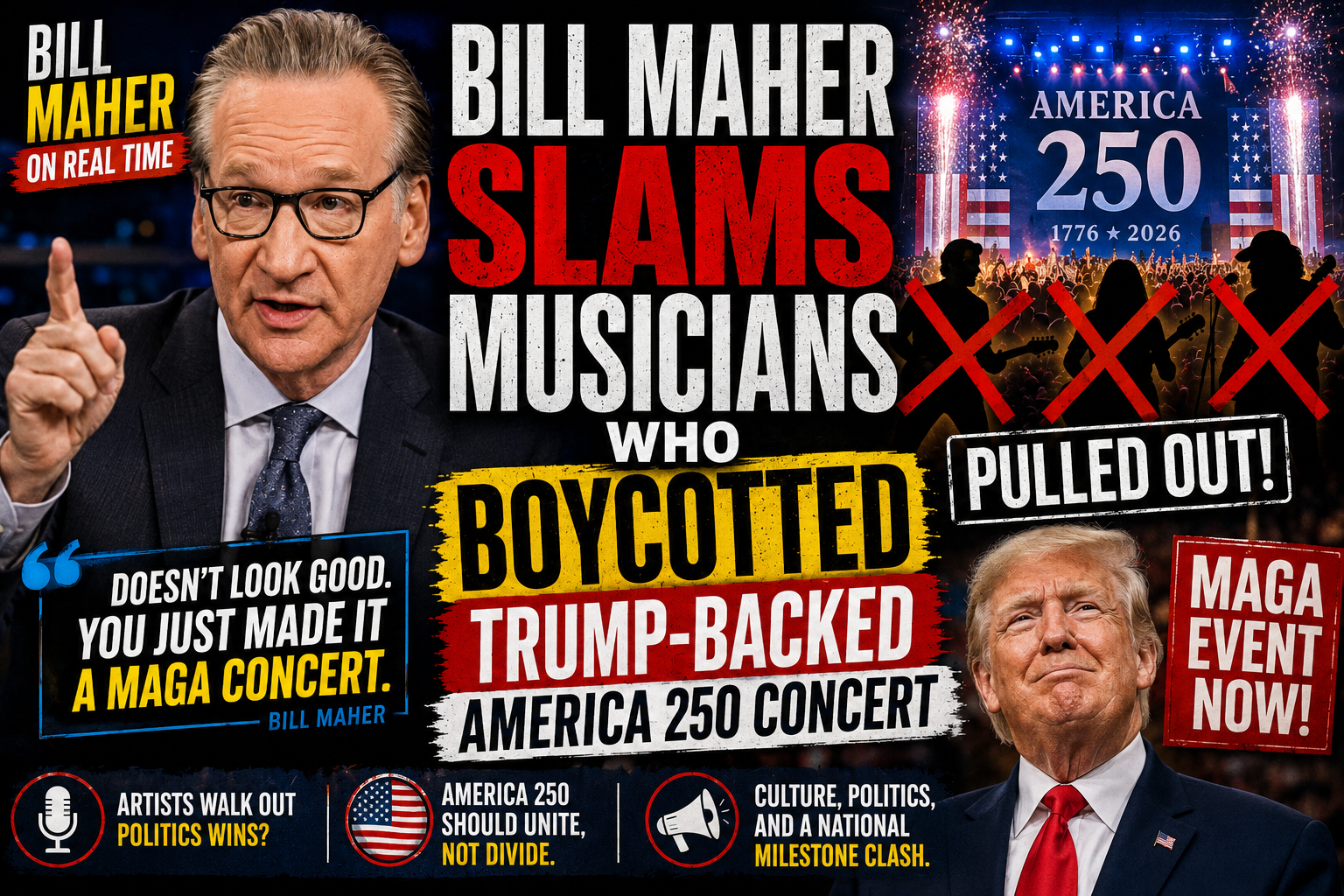
Comedian and political commentator Bill Maher is weighing in on the growing controversy surrounding musicians who withdrew from a Trump-linked concert celebrating America’s upcoming 250th anniversary.
During the June 5 broadcast of HBO’s Real Time, Maher criticized the decision by several artists to pull out of the event, arguing that the move may have unintentionally strengthened former President Donald Trump’s political messaging while weakening the cultural tone of the celebration.
The incident has now become part of a wider debate about the intersection of entertainment, politics, and national identity.
What Happened With the Concert?
The controversy centers around a planned concert tied to America’s 250th birthday celebrations, which reportedly had backing associated with former President Donald Trump.
Several musicians who were initially expected to participate later withdrew from the event, citing political concerns and discomfort with the association.
While no single unified explanation was given by all performers, the withdrawals collectively shifted the tone of the event before it even took place.
Instead of a mixed lineup of artists, the event increasingly became dominated by pro-Trump cultural figures.
Bill Maher’s Criticism
On Real Time, Maher argued that the musicians who walked away may have made a strategic mistake.
According to Maher, the withdrawals created a narrative that benefited Trump politically by reinforcing perceptions of cultural division.
He said the decision “doesn’t look good” politically and risks reinforcing criticism that certain public figures are unwilling to separate national celebrations from partisan politics.
Maher’s core argument was not necessarily about support for Trump, but about optics—specifically how the absence of mainstream artists changed public perception of the event.
“It Became a MAGA Event”
Maher suggested that the withdrawals unintentionally shifted the concert’s identity.
Instead of being a broad national celebration, he argued, the event became more narrowly associated with Trump and his supporters.
In his words, the lineup ended up feeling like a “MAGA rally,” with fewer voices representing a wider cultural spectrum.
Maher’s criticism focused on the idea that leaving the event allowed one political narrative to dominate the celebration.
The Larger Cultural Debate
The situation reflects a broader trend in American entertainment, where artists increasingly face pressure over participation in politically connected events.
Over the past decade, musicians, actors, and public figures have often been criticized for:
- Appearing at politically associated events
- Refusing participation in bipartisan or national celebrations
- Aligning with or distancing themselves from political figures
This has created a cultural environment where even non-political events can become politically charged.
The Trump-linked concert is simply the latest example of that dynamic.
Supporters of the Boycott
Those who support the musicians’ decision to withdraw argue that artists have the right to avoid events they believe are politically divisive.
From this perspective, participation could be interpreted as implicit endorsement of a political figure or agenda.
Supporters also argue that:
- Artists should not be pressured into political symbolism
- Cultural figures should maintain independence
- Participation can be seen as legitimizing political messaging
In this view, the withdrawals were a form of personal and professional boundary-setting.
Critics of the Boycott
On the other side, critics argue that withdrawing from a national celebration undermines unity.
They say events tied to national milestones should transcend political divisions, regardless of who is associated with them.
From this perspective, pulling out of the concert:
- Reduces opportunities for shared cultural experiences
- Deepens political polarization in entertainment
- Allows political narratives to dominate public celebrations
Maher’s comments align more closely with this viewpoint, emphasizing the importance of participation over protest in cultural events tied to national identity.
Trump’s Role in the Background
Although America’s 250th anniversary celebrations center on the concert, Trump’s involvement has made the event politically sensitive from the outset.
His association with the event has turned what might otherwise be a unifying national milestone into a contested cultural moment.
Supporters of Trump view the event as a patriotic celebration, while critics see it as politically symbolic.
This split has influenced both media coverage and artist participation.
Why This Moment Resonates
The controversy is not just about a single concert—it reflects a larger question in American culture:
Can national celebrations remain politically neutral in a deeply polarized environment?
Maher’s criticism suggests that withdrawing from such events may unintentionally deepen divisions rather than reduce them.
At the same time, the musicians who stepped away highlight concerns about political association and artistic independence.
Both perspectives reflect a country still negotiating the boundaries between culture and politics.
Conclusion
Bill Maher’s comments have added a new layer to the debate over the Trump-backed America 250 concert, framing the musicians’ withdrawal as a move that may have backfired politically.
While supporters of the boycott view it as a principled stand, critics argue that the boycott allowed one political narrative to dominate a national celebration.
As America approaches its 250th anniversary, the controversy underscores a larger reality: even events designed to unify can quickly become part of the nation’s political divide.