
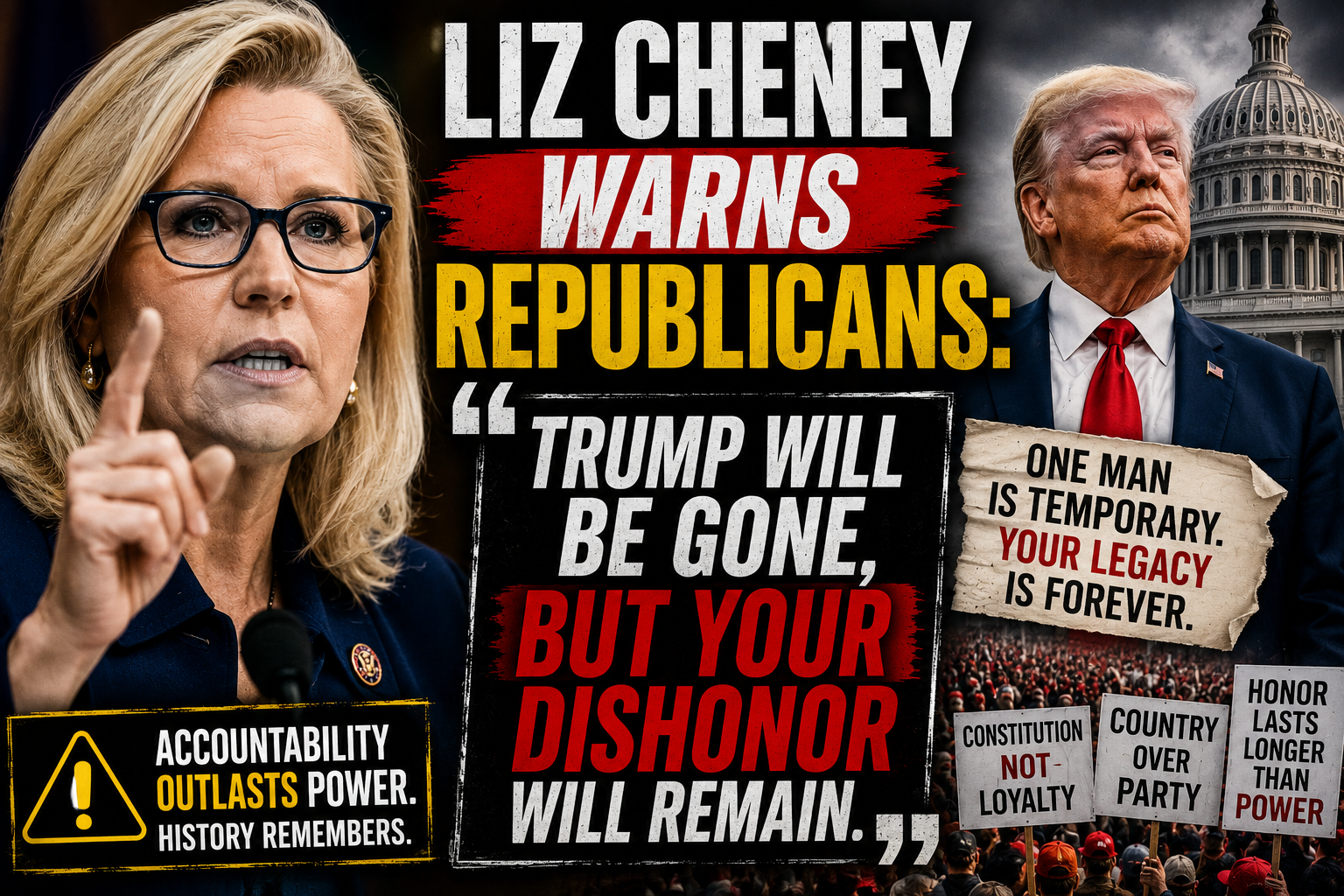
Former Congresswoman Liz Cheney has once again issued a sharp rebuke of her fellow Republicans, delivering a pointed message centered on accountability, political loyalty, and the long-term consequences of defending former President Donald Trump.
In a widely circulated statement, Cheney warned Republican lawmakers that their actions today will outlast any single political figure, including Trump himself. Her remarks have reignited debate inside the GOP over the party’s direction and its handling of Trump’s continued influence.
Cheney’s Statement
Cheney directly addressed members of her own party who continue to defend Trump amid ongoing political and legal controversies.
She said:
“There will come a day when Donald Trump is gone, but your dishonor will remain.”
The message was framed as a warning about historical judgment—suggesting that political decisions made in the present will be remembered long after current figures leave public life.
Her comments were widely shared across political media and social platforms, quickly becoming a flashpoint in the ongoing Republican Party divide.
A Message Aimed at Republicans
Cheney’s remarks were not directed at Trump alone, but specifically at Republican lawmakers who continue to support or defend him despite repeated controversies.
Her criticism reflects a broader argument she has made for years: that political allegiance should not override constitutional responsibility or ethical considerations.
She has consistently argued that elected officials have a duty to prioritize democratic institutions over party loyalty or individual political figures.
The Broader GOP Divide
The Republican Party remains deeply split over Trump’s role in its future.
On one side are Republicans who:
- Continue to strongly support Trump
- View him as the dominant figure in the party
- Argue that criticism of Trump weakens conservative unity
On the other side are Republicans like Cheney who:
- Believe Trump’s influence is damaging to democratic norms
- Advocate for a return to traditional conservative governance
- Warn that loyalty to Trump may carry long-term political consequences
Cheney’s statement reflects the ongoing tension between these two factions.
Why Cheney’s Words Carry Weight
Cheney is not an outside critic; she is a former Republican leadership figure who once served in House leadership.
Her willingness to publicly challenge Trump and his supporters has made her one of the most prominent internal critics of the modern GOP.
Because of her background, her statements often resonate beyond partisan commentary and are interpreted as part of a deeper ideological struggle within the party.
Political Loyalty vs. Historical Judgment
At the core of Cheney’s message is a warning about how history judges political behavior.
Her argument suggests that:
- Political decisions are not temporary
- Public accountability extends beyond election cycles
- Alignment with controversial figures can define a long-term legacy
Supporters of Cheney’s stance say she is emphasizing institutional integrity over political convenience.
Critics argue that her rhetoric deepens internal division within the Republican Party and misrepresents the motivations of Trump supporters.
Trump’s Continued Influence
Despite leaving office, Donald Trump remains a central figure in American politics.
His influence on the Republican Party includes:
- Endorsements in primary elections
- Shaping party messaging and policy direction
- Maintaining a strong base of voter support
- Continuing involvement in national political discourse
Because of this influence, internal GOP debates often revolve around how closely aligned the party should remain with him.
Cheney’s comments directly challenge that alignment.
Reactions to the Statement
The reaction to Cheney’s remarks has been sharply divided:
Supporters say:
- She is speaking truth to power
- Republicans must be held accountable for their actions
- Political courage requires challenging party leadership when necessary
Critics say:
- Her rhetoric is overly divisive
- It ignores the views of millions of Trump supporters
- It weakens party unity during critical political periods
The divide reflects the broader polarization in American politics.
The Bigger Picture
Cheney’s warning is not just about one political figure; it reflects a larger question about how democracies handle internal conflict within major political parties.
The tension between loyalty, ideology, and institutional responsibility continues to shape:
- Congressional decision-making
- Election strategies
- Party identity
- Public trust in political institutions
As the Republican Party continues to evolve, these internal disagreements are likely to remain central to its future direction.
Conclusion
Liz Cheney’s statement underscores the ongoing struggle within the Republican Party over Donald Trump’s legacy and influence.
Her warning, that Trump will eventually leave, but political actions taken in his defense will remain, captures a deeper debate about accountability, loyalty, and historical judgment.
Whether viewers see her message as a principled stand or a divisive critique, it reflects a party still grappling with its identity in a post-Trump political landscape.