
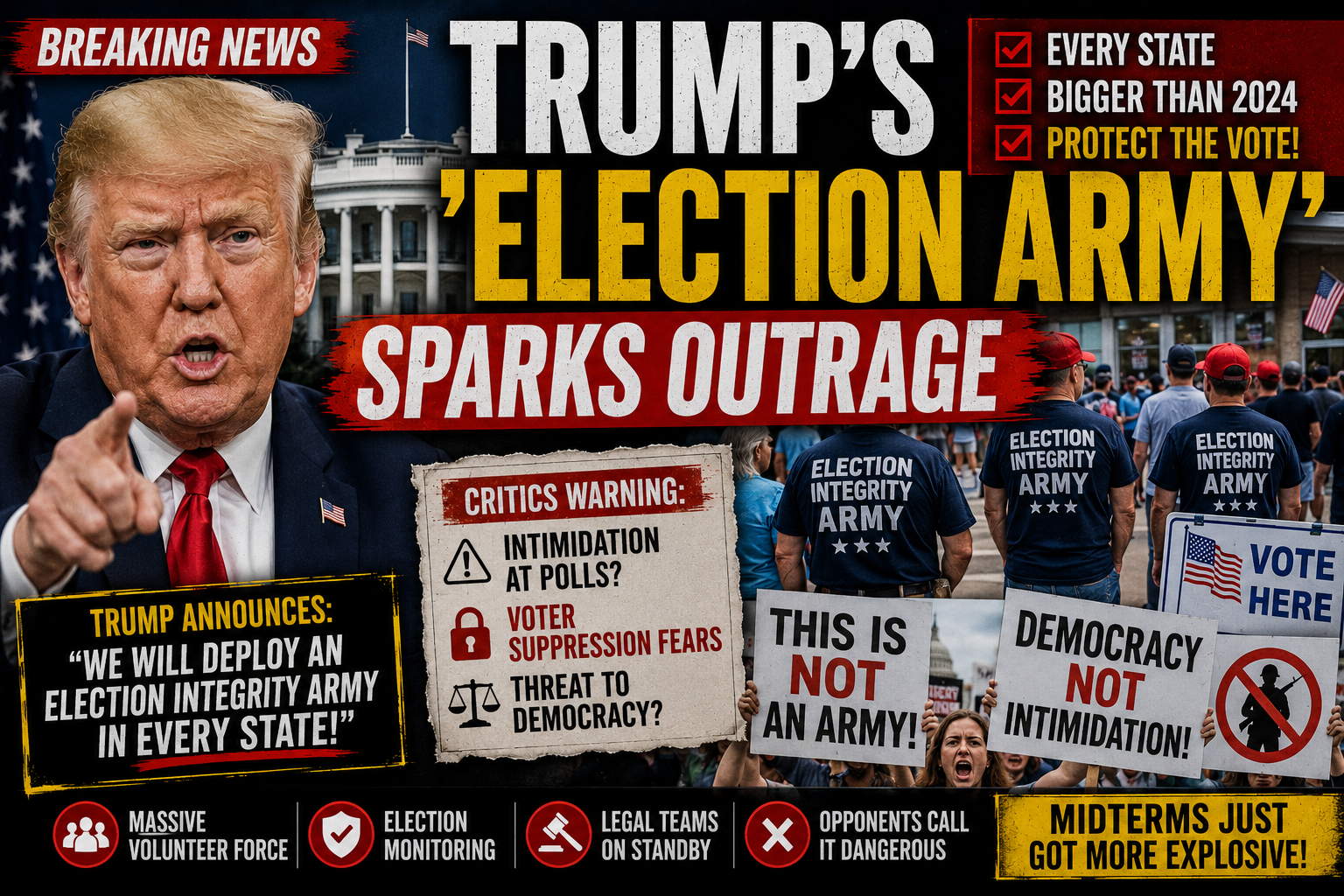
President Donald Trump has once again found himself at the center of a national controversy after announcing plans to deploy what he calls an “Election Integrity Army” in every state during the upcoming midterm elections.
The statement immediately triggered fierce reactions from across the political spectrum.
Supporters argue the initiative is designed to protect election integrity and ensure confidence in the voting process.
Critics warn the language evokes intimidation, raises concerns about voter suppression, and could further deepen political divisions in an already polarized nation.
The debate has quickly become one of the most talked-about election stories in America.
And as November approaches, it is unlikely to fade anytime soon.
What Trump Actually Said
The controversy began when Trump announced that Republicans would once again deploy an “Election Integrity Army” across the country, similar to efforts used during the 2024 election cycle. He described the upcoming operation as being “much bigger and stronger” than before.
Trump credited previous election-monitoring efforts with helping Republicans protect what he described as the “sanctity of each legal vote.” He argued that expanded monitoring would be necessary for future elections as well.
Importantly, Trump’s comments referred to an “Election Integrity Army,” not a literal deployment of the U.S. military. Reports indicate the effort is expected to involve volunteers, poll watchers, and election-related legal teams similar to programs previously organized by the Republican National Committee.
Why The Word “Army” Triggered Immediate Backlash
Much of the controversy stems from the language itself.
The word “army” carries powerful political and historical associations.
For supporters, the phrase is largely symbolic and refers to a large network of volunteers working to monitor elections.
For critics, however, the term creates an image of organized political forces being deployed around polling places.
That distinction has become central to the debate.
Democrats, voting-rights organizations, and election watchdog groups argue that such rhetoric risks undermining public confidence in elections and could intimidate some voters.
Republicans counter that election observation is a legal and longstanding part of the democratic process.
Election Integrity Remains One of Trump’s Core Issues
Election security has remained one of Trump’s most consistent political themes.
Since entering politics, Trump has repeatedly argued that America’s election system requires stronger safeguards.
Supporters believe stricter oversight helps protect public trust.
They point to concerns involving voter registration, ballot handling, and election administration.
Trump’s latest announcement reflects that ongoing focus.
For many of his supporters, election monitoring is not controversial.
They see it as a necessary component of a transparent democratic process.
Critics Fear Escalation
Opponents see the situation differently.
Several election experts have warned that aggressive election-monitoring campaigns can create confusion or fear among voters if not carefully managed.
Civil rights advocates argue that election observers must operate within clear legal boundaries.
They worry that inflammatory rhetoric may encourage confrontational behavior at polling locations.
Some critics also argue that repeated claims questioning election legitimacy can weaken confidence in democratic institutions.
That concern has become increasingly prominent since the 2020 election cycle.
The Legal Reality
Despite some viral social media posts suggesting military involvement, federal law places significant restrictions on military participation in elections.
The U.S. military does not oversee elections.
Election administration is primarily handled by state and local governments.
Federal law and state regulations also govern who can serve as poll watchers and how they may interact with voters.
As a result, any large-scale election monitoring effort would still need to comply with existing election laws.
Legal experts note that volunteer observers and official military personnel are entirely different categories.
Democrats Launch Their Own Election Initiatives
Trump’s announcement came amid growing election-preparation efforts from Democrats as well.
Party leaders have established election protection initiatives aimed at monitoring voting access, addressing legal disputes, and responding to concerns about voter suppression.
Both parties increasingly view election administration as a major political battleground.
As a result, election-related legal teams, volunteer networks, and monitoring operations have expanded significantly in recent years.
The competition between these efforts is expected to intensify as election day approaches.
Social Media Fuels The Controversy
The phrase “army in every state” spread rapidly online.
Within hours, social media users were sharing clips, screenshots, and interpretations of Trump’s comments.
Some posts portrayed the statement as evidence of an unprecedented attempt to influence elections.
Others argued that critics were deliberately misrepresenting a volunteer election-monitoring program.
As often happens in today’s media environment, competing narratives emerged almost immediately.
The original statement became less important than the arguments surrounding it.
The Bigger Political Question
At the heart of the controversy lies a larger question.
How should Americans balance election security with voter access?
Most voters support fair elections.
Most voters also support preventing fraud.
The challenge is determining where the appropriate balance exists.
Supporters of Trump’s proposal argue that robust monitoring strengthens trust in election outcomes.
Critics argue that excessive monitoring risks discouraging participation and creating unnecessary tension.
Neither side appears willing to compromise on the issue.
What Happens Next?
The practical impact of Trump’s announcement remains unclear.
Republican officials have not released detailed plans regarding the size, structure, or operations of the proposed Election Integrity Army.
However, election experts expect expanded poll-watching programs, legal teams, and volunteer recruitment efforts ahead of the midterms.
The political reaction, meanwhile, is already underway.
Supporters are praising the move.
Critics are condemning it.
And the debate is likely to continue through election season.
Final Thoughts
Donald Trump’s promise to deploy an “Election Integrity Army” nationwide has reignited one of America’s most contentious political debates.
Supporters view the initiative as a legitimate effort to protect election integrity.
Critics see troubling rhetoric that could increase tensions surrounding voting.
Regardless of where one stands politically, the controversy highlights a reality that continues to shape American politics.
Confidence in elections has become one of the most fiercely contested issues in the country.
And as the next election approaches, that battle shows no signs of slowing down.