
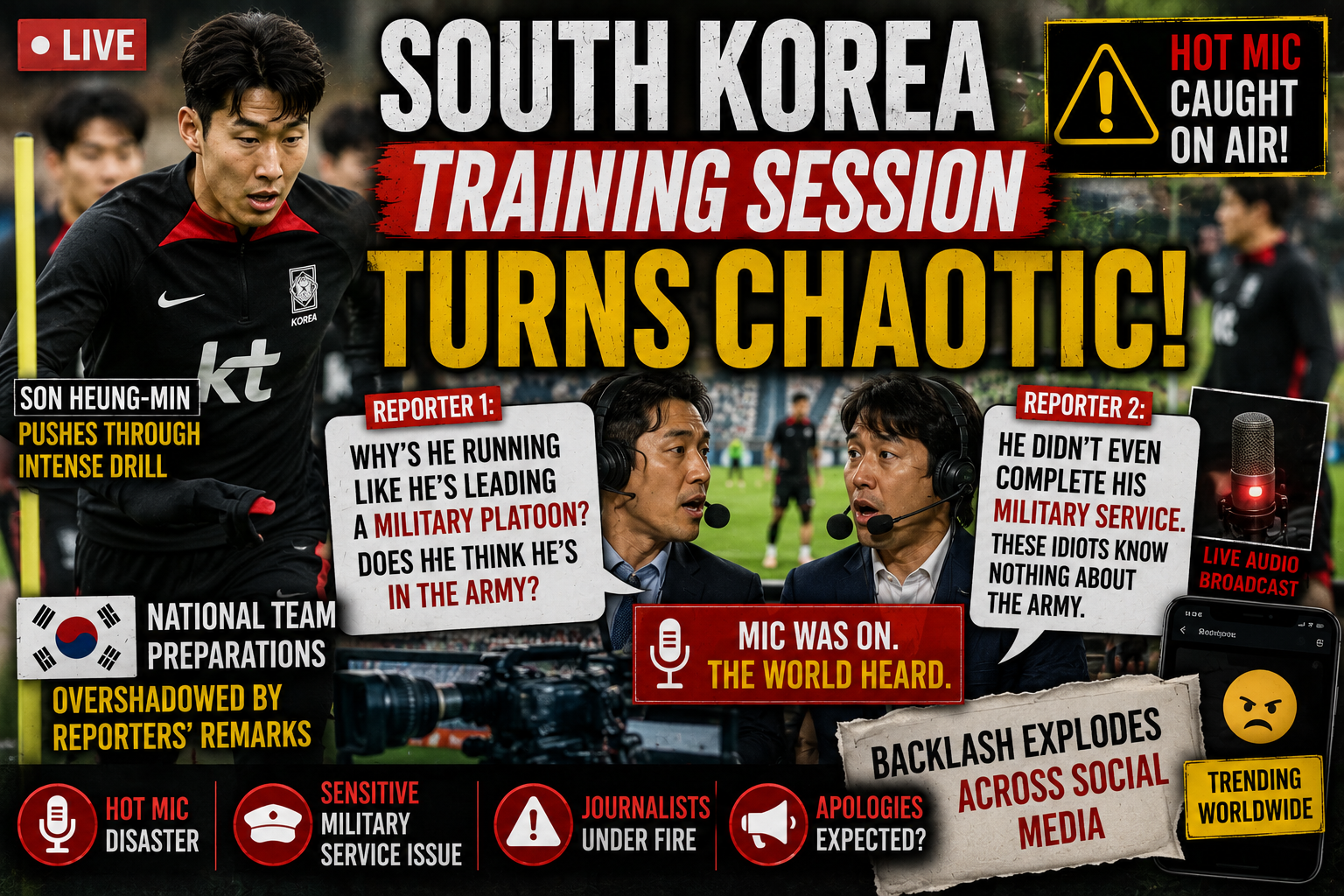
What was supposed to be a routine training session for South Korea’s national football team has suddenly become a major media controversy after two reporters were caught making private remarks during a live broadcast.
The incident occurred while journalists and cameras were covering preparations involving South Korean captain Son Heung-min, one of the country’s most celebrated athletes.
As viewers watched Son participate in demanding physical drills, an off-air conversation between two reporters was accidentally transmitted to the audience because their microphones remained active.
Within minutes, the comments spread across social media platforms, sparking criticism, debate, and questions about professionalism in sports journalism.
What began as an ordinary training session quickly turned into a public relations nightmare.
The Comment That Started It All
According to clips that rapidly circulated online, one reporter appeared to joke about Son’s training intensity.
Watching the football star complete a demanding running exercise, the reporter reportedly remarked:
“Why’s he running like he’s leading a military platoon? Does he think he’s in the army?”
On its own, the comment may have passed unnoticed.
However, the response from the second reporter generated significantly more attention.
The reply referenced South Korea’s highly sensitive issue of mandatory military service.
According to reports, the second journalist responded:
“He didn’t even complete his military service. These idiots know nothing about the army.”
The conversation was never intended for public consumption.
Unfortunately for the journalists involved, their microphones were still live.
The entire exchange reached viewers.
Why Military Service Is Such a Sensitive Topic
To understand the reaction, it is important to understand the role military service plays in South Korean society.
Military service is mandatory for most able-bodied South Korean men.
Because the country technically remains in a state of conflict with North Korea following the Korean War armistice, national defense occupies a significant place in public life.
Questions about military exemptions often generate intense public debate.
Celebrities, athletes, entertainers, and public figures have frequently faced scrutiny regarding military obligations.
As a result, even casual comments about military service can quickly become controversial.
That reality helps explain why the reporters’ remarks generated such a strong response.
The Son Heung-min Military Exemption Story
The controversy also revived discussion surrounding Son Heung-min’s well-known military exemption.
Son did not completely avoid military responsibilities.
Instead, he received a special exemption after helping South Korea win the gold medal at the 2018 Asian Games.
Under South Korean law, certain athletes who achieve major international accomplishments may qualify for alternative service arrangements.
Although exempted from full-length mandatory service, Son still completed several weeks of basic military training.
Images from his training period were widely published and received significant attention at the time.
Because the issue was heavily covered by South Korean media, many viewers immediately recognized inaccuracies or oversimplifications in the reporters’ conversation.
Social Media Reacts Instantly
As is often the case today, the controversy exploded online.
Clips of the broadcast rapidly spread across social media platforms.
Some users criticized the journalists for making uninformed comments about one of the country’s most recognizable sports figures.
Others focused on the professionalism issue, questioning how experienced broadcasters could allow private conversations to be transmitted live.
The phrase “hot mic” quickly became associated with the incident.
Within hours, sports forums, news websites, and social media accounts were discussing the embarrassing mistake.
The story soon reached audiences far beyond South Korea.
A Lesson in Live Broadcasting
Hot microphone incidents have long been one of broadcasting’s greatest dangers.
Throughout television history, politicians, journalists, athletes, and celebrities have all found themselves embarrassed by comments accidentally captured by live microphones.
The problem is simple.
People often behave differently when they believe they are off the record.
The moment a microphone remains active unexpectedly, private conversations can instantly become public.
For broadcasters, it represents a constant risk.
One brief mistake can overshadow an entire event.
That is exactly what happened during South Korea’s training session.
Questions About Professionalism
Beyond the content of the remarks themselves, the incident has raised broader questions about professional conduct in sports journalism.
Many viewers expect reporters covering national teams to maintain a high degree of professionalism.
Critics argue that making sarcastic remarks about athletes during official coverage undermines that expectation.
Others note that journalists, like everyone else, sometimes engage in casual conversations when they believe they are not broadcasting.
The difference is that reporters operate in an environment where even private comments can become public.
That reality creates unique professional responsibilities.
Son Heung-min Remains One of Asia’s Biggest Sports Stars
Part of the reason the story gained so much attention is that it involved Son Heung-min.
The football star is not simply another player.
He is widely regarded as one of the greatest Asian footballers of his generation.
His achievements in European football have made him a national icon in South Korea and a respected figure throughout the global sports community.
As captain of South Korea’s national team, Son carries enormous public visibility.
Any controversy involving him is almost guaranteed to attract significant media attention.
The hot mic incident was no exception.
The Pressure of Modern Media
The situation also highlights the pressures facing journalists in the digital age.
In previous decades, a brief broadcasting mistake might have been forgotten within hours.
Today, every moment can be clipped, shared, replayed, and analyzed indefinitely.
Social media platforms ensure that even minor errors can reach millions of people worldwide.
As a result, broadcasters face constant pressure to remain aware of cameras, microphones, and recording devices.
One careless moment can become an international story.
Could There Be Consequences?
At the time of writing, it remains unclear whether the reporters involved will face disciplinary action.
Media organizations often review such incidents internally before determining whether any formal response is necessary.
Possible outcomes could range from private warnings to public apologies.
Some observers believe the incident will ultimately be remembered as an embarrassing mistake rather than a career-ending scandal.
Others argue that comments involving sensitive topics such as military service warrant closer examination.
Regardless of the outcome, the episode has already become a cautionary tale.
Final Thoughts
The hot mic incident at South Korea’s national team training session serves as a reminder of how quickly private remarks can become public controversies.
A conversation that was never intended for viewers suddenly became headline news.
The combination of an internationally famous athlete, sensitive military service issues, and a live broadcasting error created the perfect recipe for a viral story.
For the reporters involved, it was undoubtedly an embarrassing moment.
For viewers, it offered a rare glimpse behind the scenes of sports coverage.
And for broadcasters everywhere, it reinforced an old lesson that remains just as relevant today:
Always assume the microphone is on.