
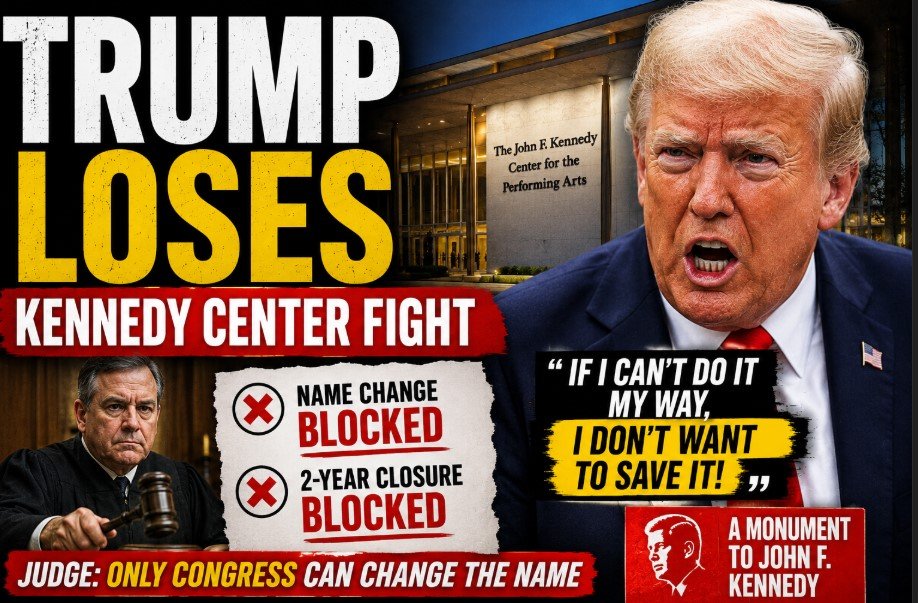
Trump Loses Kennedy Center Fight
A dramatic clash between President Donald Trump and the federal judiciary has erupted over one of America’s most iconic cultural institutions.
The controversy centers on the John F. Kennedy Center for the Performing Arts in Washington, D.C., where a federal judge has blocked efforts to rename the institution and halted plans for a sweeping renovation project championed by the Trump administration.
The ruling has triggered a furious response from Trump, who accused political opponents of sabotaging efforts to revitalize a struggling national landmark.
Critics, however, argue the court simply upheld the law and prevented what they view as an unprecedented attempt to reshape a historic institution for political purposes.
The battle has quickly evolved into far more than a dispute over a building.
It has become another front in the broader war over executive power, cultural influence, and the limits of presidential authority.
The Decision That Sparked the Firestorm
The dispute exploded after U.S. District Judge Christopher Cooper ruled that the Kennedy Center’s board of trustees acted improperly when it approved a proposal to rename the institution the “Trump Kennedy Center.”
According to the court, federal law explicitly identifies the facility as a national memorial honoring President John F. Kennedy.
Because Congress established that designation through legislation, the judge concluded that only Congress possesses the authority to change the institution’s name.
The ruling effectively stopped the renaming effort before it could move forward.
For Trump supporters, the decision represented another example of activist judges interfering with executive leadership.
For critics, it represented a straightforward application of federal law.
Why the Kennedy Center Matters
The Kennedy Center is not just another government building.
Located along the Potomac River in Washington, it serves as America’s national cultural center and stands as one of the country’s most recognizable performing arts venues.
Every year, the institution hosts thousands of performances ranging from theater and opera to concerts, dance productions, and nationally televised events.
Perhaps most famously, it serves as the home of the annual Kennedy Center Honors, one of the nation’s highest cultural recognitions.
Because of its symbolic importance, any attempt to alter its identity inevitably attracts attention.
The idea of renaming such a landmark after a sitting president immediately generated controversy.
Trump’s Vision for the Center
Supporters of the administration argued that the proposed changes were part of a broader effort to modernize and strengthen the institution.
According to proponents, the Kennedy Center requires significant upgrades to remain competitive with world-class cultural venues.
The administration reportedly supported an ambitious renovation program involving extensive repairs, infrastructure improvements, and modernization projects.
Supporters claimed the plan would secure the center’s future for decades.
They argued that years of deferred maintenance had left the institution vulnerable to growing operational challenges.
From their perspective, bold action was necessary.
The Renovation Plan Hits Trouble
The controversy deepened when Judge Cooper also blocked plans to temporarily close the Kennedy Center for a large-scale renovation effort.
The court found that trustees lacked sufficient information to justify a complete shutdown of the facility.
According to the ruling, decision-makers had not adequately demonstrated that such a dramatic measure was necessary.
That finding frustrated administration officials who argued that major repairs often require significant disruptions.
Supporters of the closure viewed it as a short-term inconvenience that would produce long-term benefits.
Opponents worried that the plan lacked transparency and could unnecessarily disrupt cultural programming.
The judge ultimately sided with caution.
Trump’s Furious Response
Trump did not hide his frustration.
Following the ruling, he reportedly blasted the decision and questioned why he should remain involved in efforts to rescue the institution if he was denied authority to oversee the transformation.
The president argued that opponents were blocking meaningful reform while simultaneously criticizing the center’s condition.
According to Trump, those resisting his plans are more interested in political confrontation than cultural improvement.
His comments immediately ignited another wave of debate.
Supporters praised his willingness to challenge what they see as bureaucratic obstruction.
Critics accused him of treating a national cultural institution as a personal project.
A Larger Battle Over Presidential Power
The Kennedy Center dispute reflects a much broader conflict playing out across Washington.
Throughout his political career, Trump has frequently pushed the boundaries of executive authority.
Supporters view this approach as decisive leadership.
Critics argue it sometimes conflicts with established legal limits.
The Kennedy Center ruling serves as another example of courts acting as a check on presidential initiatives.
Federal judges have repeatedly found themselves at the center of major political controversies involving immigration, executive orders, agency regulations, and administrative decisions.
This latest case adds cultural institutions to that growing list.
The Symbolism of John F. Kennedy
Part of the controversy stems from the unique status of President John F. Kennedy himself.
More than six decades after his assassination, Kennedy remains one of the most iconic figures in American political history.
The Kennedy Center was specifically created as a living memorial to his legacy.
Because of that history, many observers viewed efforts to alter the institution’s name as particularly sensitive.
Critics argued that memorials dedicated to historical presidents should remain focused on their original purpose rather than becoming vehicles for contemporary political branding.
Supporters countered that honoring current achievements does not diminish past contributions.
The disagreement reflects deeper questions about how America preserves historical memory.
The Culture War Reaches the Arts
The dispute also highlights how America’s political culture wars increasingly extend into artistic and cultural spaces.
For years, conservatives and progressives have debated the role of government-supported arts institutions.
Questions about funding, programming, leadership, and representation frequently generate controversy.
The Kennedy Center has occasionally found itself at the center of those debates.
Trump’s involvement has intensified those discussions.
Supporters argue that cultural institutions have become politically one-sided and require reform.
Critics see attempts at political intervention as threats to artistic independence.
The current conflict reflects those competing perspectives.
Public Opinion Remains Divided
Reaction to the ruling has largely followed familiar political lines.
Trump supporters accuse the judiciary of blocking necessary reforms and interfering with elected leadership.
They argue that bureaucratic resistance prevents meaningful improvements to government institutions.
Opponents celebrate the decision as a victory for constitutional limits and institutional independence.
They argue that no president should possess unilateral authority to rename national monuments or fundamentally reshape cultural landmarks without congressional approval.
As with many modern political disputes, both sides view the controversy through very different lenses.
What Happens Next?
The future of the Kennedy Center remains uncertain.
The administration could pursue appeals.
Congress could become involved.
Trustees may reconsider portions of the renovation proposal.
Additional legal challenges could emerge.
For now, however, the court’s decision stands as a significant setback for the administration’s plans.
The ruling preserves the Kennedy Center’s existing name and temporarily blocks efforts to move forward with the larger transformation project.
Whether that outcome remains permanent remains to be seen.
Final Thoughts
The Kennedy Center battle is about far more than architecture, renovations, or even a name.
It is a conflict involving executive authority, judicial oversight, historical legacy, and cultural influence.
Supporters see a president trying to modernize an important national institution.
Critics see an attempt to exert political control over a historic cultural landmark.
The court has delivered its initial answer.
But given the stakes, the personalities involved, and the broader political climate, this fight is almost certainly far from over.
The Kennedy Center may have been built to celebrate the arts.
Today, it has become the stage for one of Washington’s newest political dramas.