
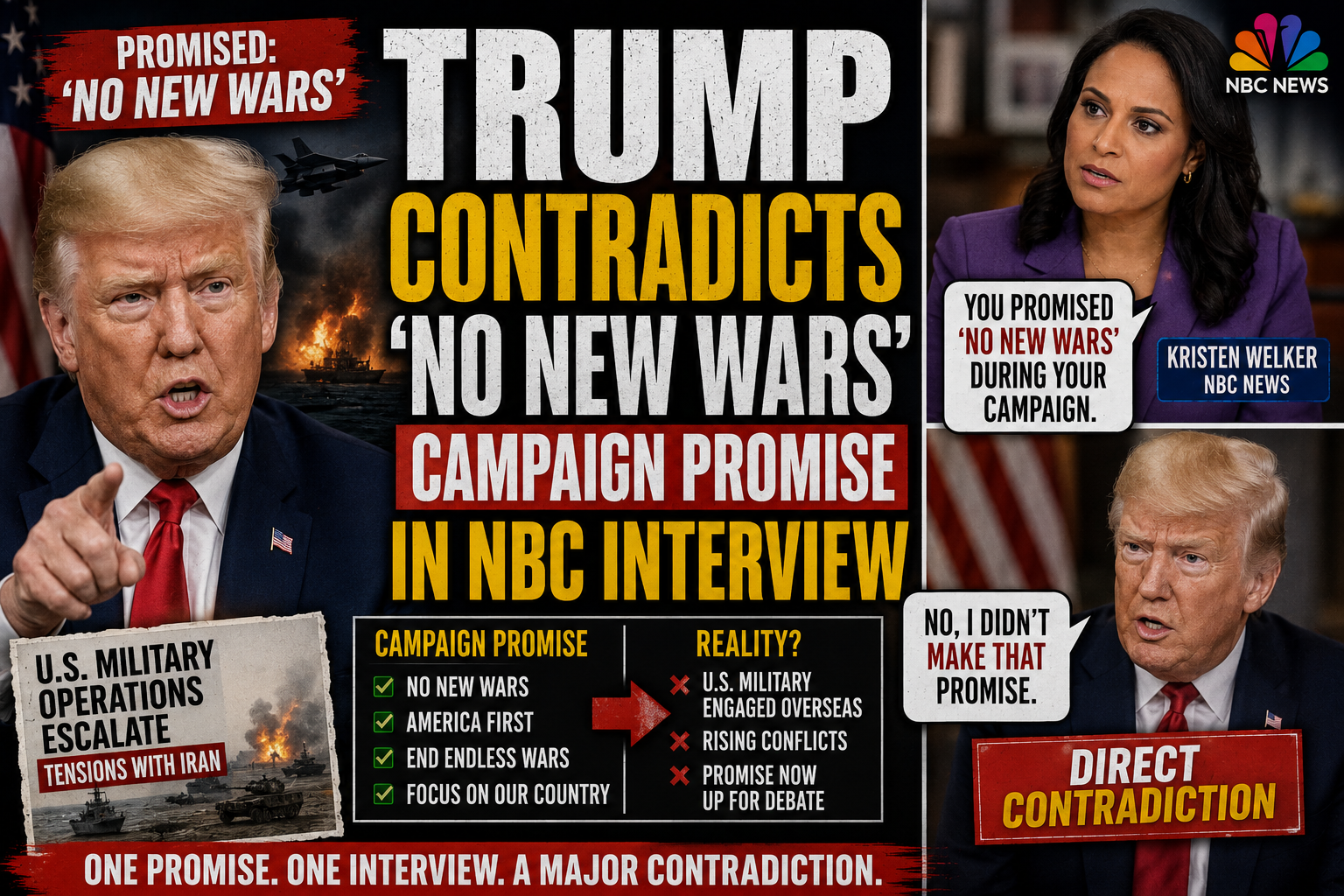
President Donald Trump is facing renewed political scrutiny after directly contradicting one of his most repeated campaign promises during a recent NBC interview with journalist Kristen Welker.
The exchange centered on Trump’s widely promoted “no new wars” pledge, a cornerstone of his 2024 campaign messaging. However, in the interview, Trump pushed back against the characterization that he had guaranteed the United States would avoid entering new military conflicts.
The contradiction has sparked debate across political circles, particularly as the United States is currently involved in heightened military tensions involving Iran.
The Interview Exchange
During the NBC interview, host Kristen Welker challenged Trump on his past statements, pointing out that he had repeatedly emphasized a commitment to keeping America out of new wars during his campaign.
Welker referenced multiple instances where Trump framed his foreign policy approach around avoiding military entanglements and prioritizing domestic stability over foreign intervention.
Trump responded by denying that he ever made an absolute promise, suggesting that his statements were being interpreted too strictly or taken out of context.
The exchange quickly became one of the most discussed moments from the interview due to the direct contradiction between campaign messaging and his current position.
The “No New Wars” Campaign Message
During the 2024 presidential campaign, the “no new wars” slogan was a central pillar of Trump’s foreign policy platform.
The message was widely used in:
- Campaign rallies
- Political advertisements
- Public speeches
- Social media messaging
It was framed as part of a broader “America First” doctrine, emphasizing:
- Reduced foreign military involvement
- Focus on domestic economic priorities
- Avoidance of prolonged overseas conflicts
- Strengthening national borders and security
Supporters viewed it as a commitment to restraint in foreign policy, contrasting it with previous administrations.
Why the Contradiction Matters Now
The significance of Trump’s statement has increased due to current geopolitical tensions involving the United States and Iran.
With American forces reportedly engaged in active military operations or heightened conflict readiness, critics argue that the situation directly conflicts with the expectations created during the campaign.
This has led to renewed questions about:
- The meaning of “no new wars” in practice
- Whether campaign promises were symbolic or literal
- How foreign policy decisions align with voter expectations
- The transparency of presidential messaging on military engagement
Political Reactions Divide Sharply
As expected, the interview response has triggered sharply divided reactions across the political spectrum.
Critics argue:
Opponents of Trump say the contradiction highlights a broader pattern of shifting messaging after taking office. They argue that:
- Voters were given a clear anti-war expectation
- The current military posture contradicts that promise
- Language during campaigns should carry accountability
- Foreign policy consistency is essential for trust in leadership
Some also say the reversal undermines public confidence in political commitments.
Supporters argue:
Trump’s allies reject the idea that he made an absolute guarantee, insisting that his campaign messaging was focused on reducing unnecessary wars rather than eliminating all military engagement.
They argue that:
- Presidents cannot predict global events
- National security decisions require flexibility
- The phrase “no new wars” was political messaging, not a legal pledge
- Current actions are necessary responses to evolving threats
This defense frames the issue as one of interpretation rather than contradiction.
The Role of Presidential Language
Political analysts note that phrases like “no new wars” often function as broad strategic messaging rather than precise policy commitments.
In practice, foreign policy decisions are shaped by:
- International crises
- Military intelligence assessments
- Alliances and treaty obligations
- Rapidly changing global threats
This creates tension between campaign rhetoric and real-world governance, where circumstances can shift quickly and unexpectedly.
Media Focus and Public Perception
The NBC interview has amplified attention on how political promises are communicated and interpreted.
In modern political media environments:
- Short slogans often define entire policy platforms
- Debates over wording can become major political controversies
- Public expectations are shaped by repeated messaging rather than detailed policy documents
This makes any perceived inconsistency highly visible and politically consequential.
Foreign Policy Under Scrutiny
The renewed focus on Trump’s campaign messaging comes at a time when U.S. foreign policy decisions are already under intense global scrutiny.
Key concerns raised by analysts include:
- Escalation risks in volatile regions
- Long-term military commitments
- Coordination with allies
- Domestic political support for foreign operations
These issues tend to become more politically charged when they appear to conflict with prior campaign promises.
Conclusion
President Donald Trump’s denial that he guaranteed a “no new wars” policy during his campaign has reignited debate over political messaging, accountability, and foreign policy expectations.
While critics see the statement as a clear contradiction of a core campaign promise, supporters argue it reflects the complexity of governing in a rapidly changing global environment.
As U.S. military involvement abroad continues to draw attention, the gap between campaign rhetoric and governing reality is once again at the center of national political discussion.