
The internet never forgets.
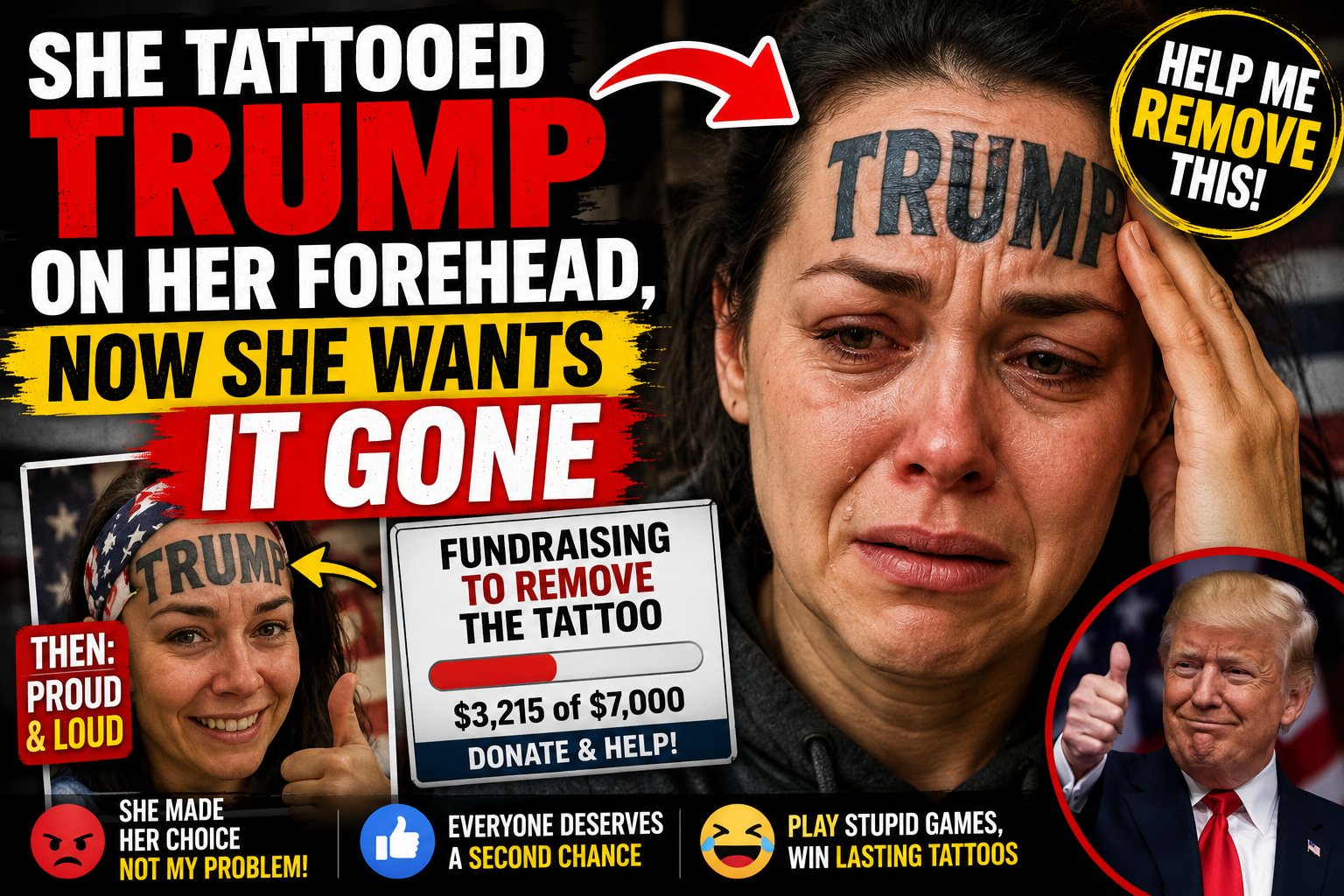
That reality is becoming painfully clear for a woman who once went viral after tattooing the name “Trump” across her forehead and proudly sharing the result online.
At the time, the tattoo sparked outrage, laughter, admiration, criticism, and countless memes. Supporters called it dedication. Critics called it extreme. Nearly everyone had an opinion.
Now, years later, the woman is back in the headlines for a very different reason.
She wants the tattoo removed.
And she’s asking the public to help pay for it.
The story has reignited debate about politics, personal responsibility, internet fame, and what happens when life-changing decisions collide with changing circumstances.
The Tattoo That Shocked the Internet
When photos of the forehead tattoo first appeared online, reactions were immediate.
Social media exploded.
Some users praised her loyalty and commitment.
Others questioned why anyone would permanently place a politician’s name on one of the most visible parts of their body.
The images quickly spread across Facebook, X, Instagram, TikTok, and countless news websites.
For a brief period, the woman became an internet sensation.
People who had never heard her name suddenly knew exactly who she was.
The tattoo transformed her into a viral story.
But viral fame rarely lasts forever.
The Problem With Permanent Decisions
One lesson that emerges from stories like this is that permanent decisions often outlive temporary emotions.
Political campaigns come and go.
Presidents leave office.
Public opinion shifts.
Life circumstances change.
Tattoos, however, tend to stick around.
That reality has fueled much of the conversation surrounding the woman’s request for financial assistance.
Many people see the situation as a cautionary tale about making irreversible choices during highly emotional political moments.
What feels meaningful today may feel very different years later.
Why She’s Asking for Donations
According to reports, the woman is seeking public support to cover the cost of tattoo removal procedures.
Laser removal treatments can be expensive, especially for large, highly visible tattoos.
Multiple sessions are often required.
The process can take months or even years.
For many people, the cost becomes a major obstacle.
Supporters of the fundraiser argue that everyone deserves a second chance and the opportunity to move on from past decisions.
Critics disagree.
They believe taxpayers, donors, and strangers should not be expected to finance the consequences of personal choices.
That disagreement has become a major part of the story.
Social Media Reacts
As expected, the internet has not been kind.
Some users expressed sympathy.
Others responded with mockery.
Many questioned why someone who willingly chose the tattoo should expect financial help removing it.
Memes quickly began circulating once again.
Political commentators from both sides jumped into the debate.
Supporters of Trump accused critics of using the story to attack conservatives.
Trump opponents pointed to the situation as evidence of excessive political devotion.
The result has been another social media firestorm.
The Rise of Political Identity
The story reflects a broader trend that has become increasingly visible in modern society.
Politics is no longer just something people discuss during elections.
For many Americans, political affiliation has become part of personal identity.
It influences friendships, shapes social circles, and affects purchasing decisions.
In some cases, it even appears on people’s bodies.
The Trump forehead tattoo may be an extreme example, but it highlights how deeply politics has become woven into everyday life.
For millions of people, politics is no longer simply about policy.
It is about identity.
Why Stories Like This Go Viral
There is a reason stories like this attract so much attention.
They combine several ingredients that social media loves.
Politics.
Personal drama.
Regret.
Controversy.
Transformation.
People are naturally drawn to stories involving dramatic life changes.
The contrast between proudly displaying a tattoo and later trying to remove it creates a narrative that audiences immediately understand.
It is simple.
It is emotional.
And it sparks strong opinions.
That combination almost guarantees viral attention.
The Debate Over Personal Responsibility
At the center of the controversy is a question many people are asking.
Who should pay?
Some believe individuals should bear the consequences of their own decisions.
From that perspective, fundraising for tattoo removal shifts responsibility away from the person who made the choice.
Others argue that crowdfunding exists specifically to help people solve problems, regardless of how those problems originated.
If people want to donate voluntarily, they say, there is nothing wrong with asking.
Neither side appears likely to convince the other.
The Internet’s Long Memory
One of the challenges facing anyone who becomes famous online is that digital footprints are difficult to erase.
Photos remain searchable.
Videos continue circulating.
Screenshots last forever.
Even if the tattoo disappears, the internet may continue associating the woman with it for years.
That reality highlights one of the hidden costs of viral fame.
Attention arrives quickly.
But it rarely leaves completely.
A Sign of America’s Political Divide?
Some observers believe the story represents something larger than a tattoo.
They see it as a reflection of America’s increasingly polarized political culture.
Supporters and critics of political figures often view each other through deeply emotional lenses.
Political loyalty can sometimes resemble sports fandom, celebrity culture, or tribal identity.
The stronger those emotional connections become, the more likely people are to make dramatic statements of support.
The forehead tattoo became one of the most visible examples of that phenomenon.
Final Thoughts
The woman who once went viral for tattooing “Trump” across her forehead is now trying to turn the page.
Whether the public chooses to help fund that effort remains to be seen.
What is certain is that her story has once again captured national attention.
For some people, it is a lesson about personal responsibility.
For others, it is a reminder that people change.
And for many, it is simply another example of how politics has become deeply intertwined with personal identity in modern America.
The tattoo may eventually disappear.
The debate surrounding it probably won’t.