
Politicians love making promises.
Especially promises that sound impossible to oppose.
Free healthcare.
No premiums, copays, or eligibility requirements, and no one left behind.
On paper, it sounds like a dream.
And that is precisely why Mexico’s latest healthcare announcement is generating headlines around the world.
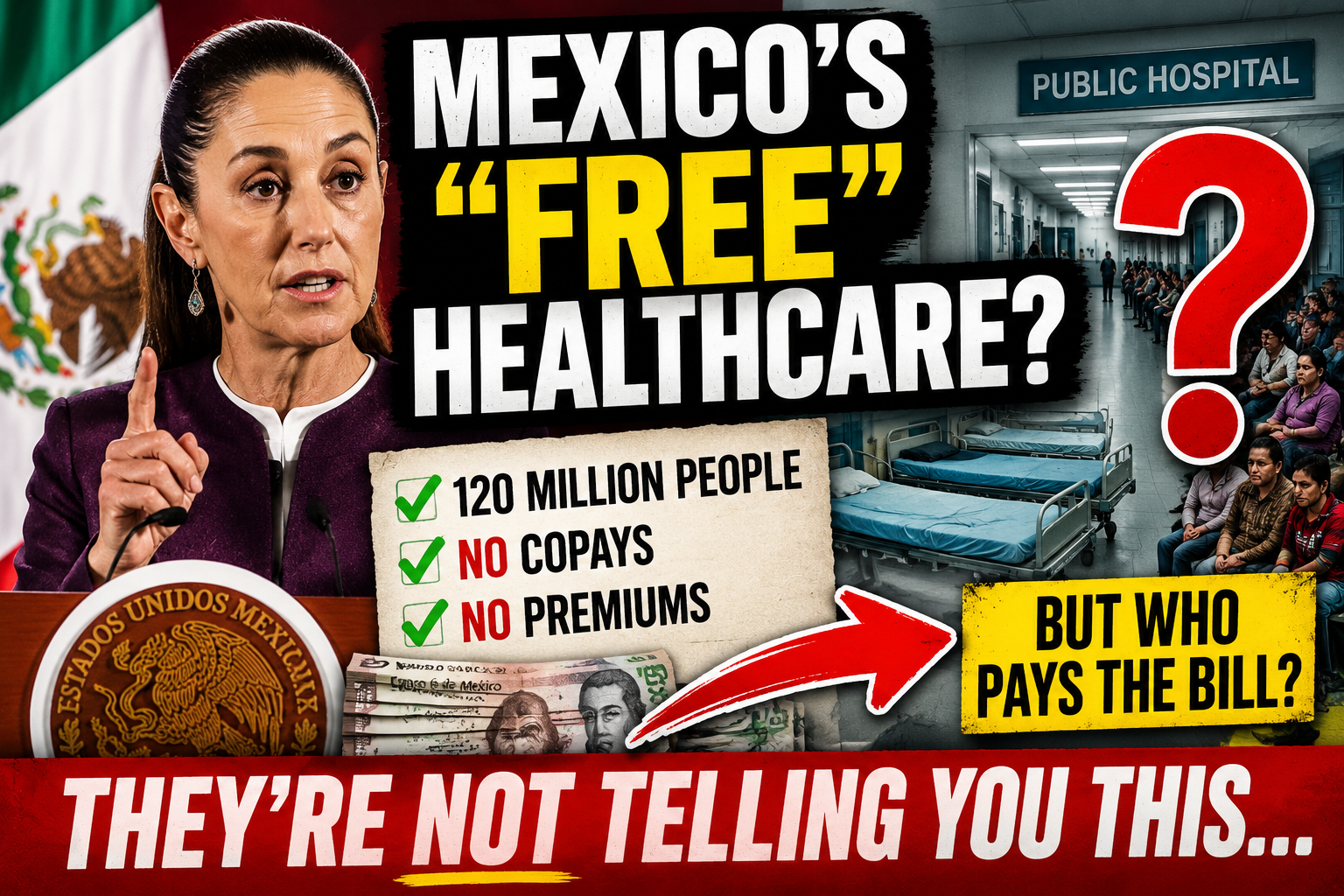
President Claudia Sheinbaum recently signed legislation aimed at expanding healthcare access across Mexico, promising what many supporters are calling a historic step toward universal healthcare.
Supporters are celebrating.
Critics are asking questions.
Many questions.
Because while the headlines focus on what citizens are being promised, far less attention is being paid to how those promises will actually be funded.
And that may be the most important part of the entire story.
The Promise Sounds Amazing
Let’s be honest.
If you ask almost anyone whether healthcare should be affordable and accessible, most people will say yes.
That is not controversial.
Healthcare costs are a major issue in countries around the world.
Medical debt destroys families.
Unexpected illnesses create financial disasters.
People often delay treatment because they cannot afford it.
Politicians know this.
That is why healthcare promises are among the most powerful tools in politics.
The idea behind Mexico’s new healthcare initiative is simple.
Expand access.
Reduce barriers.
Provide medical care regardless of income or employment status.
Supporters argue that healthcare is a right, not a privilege.
Many believe Mexico is taking an important step toward improving the lives of millions.
But critics argue that promises are easy.
Funding is harder.
The Question Nobody Wants to Ask
Who pays?
Every government program eventually runs into the same reality.
Resources are finite.
Money has to come from somewhere.
Doctors must be paid.
Hospitals must be maintained.
Equipment must be purchased.
Medication must be supplied.
Administrative systems must be funded.
Healthcare is not free.
Someone always pays.
The debate is simply over who.
Taxpayers.
Businesses.
Borrowers.
Future generations.
Or some combination of all three.
That is where concerns about Mexico’s healthcare plan begin.
A Law Is Not a Healthcare System
One of the most overlooked details is that signing a law and building a functioning healthcare system are not the same thing.
Passing legislation generates headlines.
Creating infrastructure takes years.
Hospitals cannot appear overnight.
Medical staff cannot be trained instantly.
Supply chains cannot be rebuilt with a signature.
Even supporters acknowledge that implementation will be the true test.
History is filled with ambitious government programs that looked impressive during announcements but struggled during execution.
The challenge is rarely creating promises.
The challenge is delivering results.
Critics Say the Numbers Don’t Add Up
Some economists and policy analysts have raised concerns about whether Mexico’s current healthcare spending can support the promises being made.
They argue that universal healthcare systems require enormous and sustained investment.
Not for months.
Not for a single election cycle.
But for decades.
Critics warn that underfunded systems can create new problems instead of solving old ones.
Long waiting lists.
Staff shortages.
Medicine shortages.
Hospital overcrowding.
Delayed treatments.
Those concerns are not unique to Mexico.
Countries around the world continue debating how to balance healthcare access with financial sustainability.
Why Americans Are Paying Attention
This story is attracting attention far beyond Mexico.
The reason is simple.
Healthcare remains one of the most divisive political issues in the United States.
Every proposal for universal healthcare immediately triggers fierce debate.
Supporters point to countries with government-funded healthcare systems and argue America should move in a similar direction.
Critics argue that such systems often struggle with costs, efficiency, or access.
That means developments in other countries quickly become political ammunition.
If Mexico’s program succeeds, advocates will point to it as evidence that broader healthcare coverage is achievable.
If it struggles, opponents will use it as a warning.
Either way, the political implications extend beyond Mexico’s borders.
The Political Sales Pitch
Healthcare proposals often follow a familiar pattern.
The benefits receive most of the attention.
The costs are far less.
Politicians naturally focus on what voters gain.
Critics naturally focus on what taxpayers lose.
Both sides accuse the other of ignoring important facts.
The result is a debate driven more by emotion than economics.
Healthcare is deeply personal.
Everyone gets sick.
Everyone knows someone who has struggled with medical costs.
That emotional connection makes healthcare one of the most powerful political issues in modern society.
What Happens Next?
The real test begins when implementation starts.
Announcements are easy.
Results are harder.
Supporters believe Mexico is taking a bold step toward greater healthcare access.
Critics believe the promises exceed the available resources.
Both sides will be watching closely.
So will policymakers in other countries.
Because success or failure will influence future healthcare debates far beyond Mexico.
The Bigger Issue
This story is not really about Mexico.
It is a question every country faces.
How much should the government provide?
How much can taxpayers afford?
And where is the line between political promises and economic reality?
Those questions are not going away.
They exist in Mexico.
They exist in the United States.
Furthermore, they exist almost everywhere.
The details may differ.
The debate remains the same.
Final Thoughts
Mexico’s healthcare reform has already won the battle for attention.
The promises are ambitious.
The headlines are powerful.
The politics are obvious.
But history suggests that passing legislation is only the beginning.
The real challenge starts when governments must turn promises into functioning systems.
Supporters see a major step forward.
Critics see warning signs.
The truth will likely depend on what happens after the headlines fade.
Announcing universal healthcare is easy.
Delivering it is the hard part.