
President Donald Trump is facing a political reality that few presidents ever want to see.
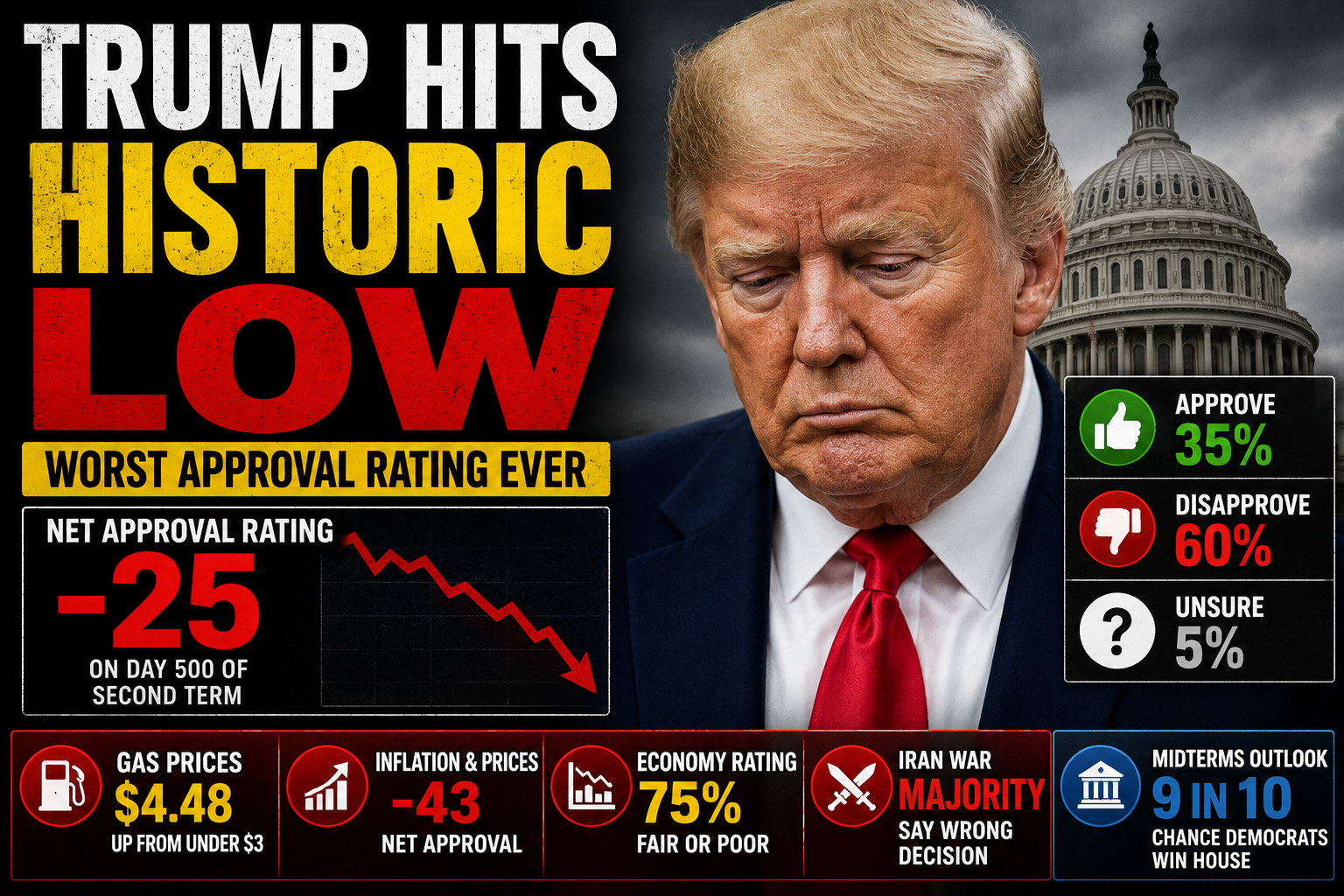
According to The Economist’s approval tracker, Trump has reached the lowest net approval rating recorded in the 17-year history of the publication’s presidential approval database. On the 500th day of his second term, Trump’s net approval rating reportedly fell to -25, marking a significant political milestone as Republicans prepare for the 2026 midterm elections.
The numbers are already fueling intense debate among political analysts, campaign strategists, and voters across the country.
Supporters argue the polls fail to capture Trump’s true support.
Critics see the numbers as evidence that growing economic concerns, inflation, and foreign policy controversies are taking a toll.
Regardless of political affiliation, one thing is clear.
The latest polling has Washington paying close attention.
The Numbers Behind the Headlines
The Economist’s tracker, based on YouGov polling data, shows that 35 percent of Americans approve of Trump’s job performance while 60 percent disapprove.
Five percent remain undecided.
That produces a net approval rating of negative 25, the lowest figure recorded for Trump during his second term and the lowest net rating recorded in the history of the tracker.
While presidential approval ratings naturally fluctuate over time, political observers note that crossing certain thresholds can influence fundraising, campaign enthusiasm, and voter turnout.
Polls do not determine election outcomes.
But they often shape political narratives.
And right now, the narrative is not favorable for the White House.
Inflation Remains the Biggest Problem
Among all the issues facing the administration, inflation continues to generate the strongest voter frustration.
According to the polling data, Trump’s net approval rating on inflation and prices now stands at -43.
That figure is substantially worse than his overall approval rating.
For many Americans, the economy remains the issue that matters most.
Voters may disagree on foreign policy, immigration, or social issues.
But nearly everyone notices higher prices.
When groceries cost more.
When utility bills rise.
When gasoline becomes more expensive.
Public frustration tends to follow.
That reality is becoming increasingly difficult for the administration to ignore.
Gas Prices Become a Political Weapon
One of the most frequently cited complaints involves fuel prices.
According to recent reports, the national average price of gasoline has climbed significantly since the beginning of the Iran conflict.
Critics argue that geopolitical instability and military involvement have contributed to higher energy costs.
Supporters of the administration point out that global oil markets are influenced by numerous factors beyond presidential control.
Nevertheless, voters often hold presidents responsible for economic conditions regardless of the underlying causes.
That dynamic has been true for decades.
And Trump appears to be experiencing it firsthand.
Americans Are Losing Confidence in the Economy
Perhaps the most troubling statistic for the White House involves public sentiment.
Roughly three-quarters of Americans reportedly describe the economy as either “fair” or “poor.”
Even more concerning, a majority say conditions are getting worse rather than improving.
Economic perception can sometimes matter more than economic statistics.
A government may point to growth figures, unemployment numbers, or market performance.
But if ordinary voters feel financially strained, political damage often follows.
History shows that voters typically reward optimism and punish economic anxiety.
At the moment, anxiety appears to be winning.
The Iran War Debate Continues
Foreign policy has also emerged as a growing challenge.
Polling indicates that a majority of Americans now believe military action against Iran was the wrong decision in hindsight.
That finding represents a significant political problem.
Presidents often experience temporary surges in support during military operations.
But those gains can disappear if conflicts become prolonged, expensive, or unpopular.
The administration continues defending its actions, arguing that national security required a strong response.
Critics remain unconvinced.
As casualties, costs, and geopolitical risks continue dominating headlines, public opinion appears increasingly skeptical.
Democrats Smell Opportunity
Not surprisingly, Democrats are viewing the latest polling numbers as a potential opportunity.
Political forecasting models suggest that control of the House of Representatives could be highly competitive in the upcoming midterm elections.
Some projections now give Democrats a strong chance of regaining the chamber.
The Senate remains considerably closer.
But even there, Republicans face mounting pressure.
Midterm elections are often viewed as referendums on the sitting president.
When approval ratings decline, congressional candidates from the president’s party frequently face additional challenges.
That possibility has Republicans paying close attention to every new poll.
Trump Still Has Strongholds
Despite the negative national numbers, Trump continues to maintain significant support in certain parts of the country.
Polling suggests he remains popular in deeply conservative states such as Wyoming, Idaho, West Virginia, and North Dakota.
Those states have long formed part of Trump’s political foundation.
Supporters argue that national polling often fails to account for enthusiasm among core voters.
They point to previous elections where Trump outperformed expectations and overcame unfavorable media coverage.
For loyal supporters, today’s polls are simply another example of what they view as establishment skepticism.
Supporters Dismiss the Polls
Many Trump supporters remain unconcerned.
They argue that approval ratings have never accurately reflected Trump’s political strength.
They note that he has repeatedly survived controversies, investigations, impeachment efforts, and unfavorable headlines.
From their perspective, polls come and go.
Election Day is what matters.
Supporters also point out that polling organizations have faced criticism in previous election cycles for underestimating support among certain voter groups.
That skepticism remains widespread within Trump’s political base.
Why These Numbers Matter
Even if polls are imperfect, they still influence politics.
Donors watch them.
Campaign strategists watch them.
Candidates watch them.
Media organizations certainly watch them.
Approval ratings can affect fundraising decisions, campaign messaging, legislative priorities, and voter enthusiasm.
They help shape the political environment heading into major elections.
That is why both parties are paying close attention to Trump’s current standing.
The numbers may not predict the future.
But they provide an important snapshot of the present.
The Road to November
The biggest question now is whether these trends continue.
Political fortunes can change quickly.
Economic conditions can improve.
International conflicts can evolve.
Unexpected events can completely reshape voter priorities.
Trump has spent much of his political career defying conventional expectations.
His supporters believe he can do so again.
His opponents believe the latest numbers signal deeper problems that may be difficult to reverse.
The truth will likely become clearer as the country moves closer to the midterm elections.
Final Thoughts
Donald Trump has reached a significant milestone in his second presidency, but not the kind most presidents hope to celebrate.
The latest approval numbers suggest growing public frustration over inflation, economic uncertainty, and foreign policy decisions.
Supporters remain confident.
Critics see warning signs.
Political analysts are watching closely.
As November approaches, one question looms over Washington.
Are these merely temporary setbacks, or the beginning of a much larger political challenge for the Trump administration?
The answer could determine the balance of power in Congress and shape the remainder of Trump’s second term.