
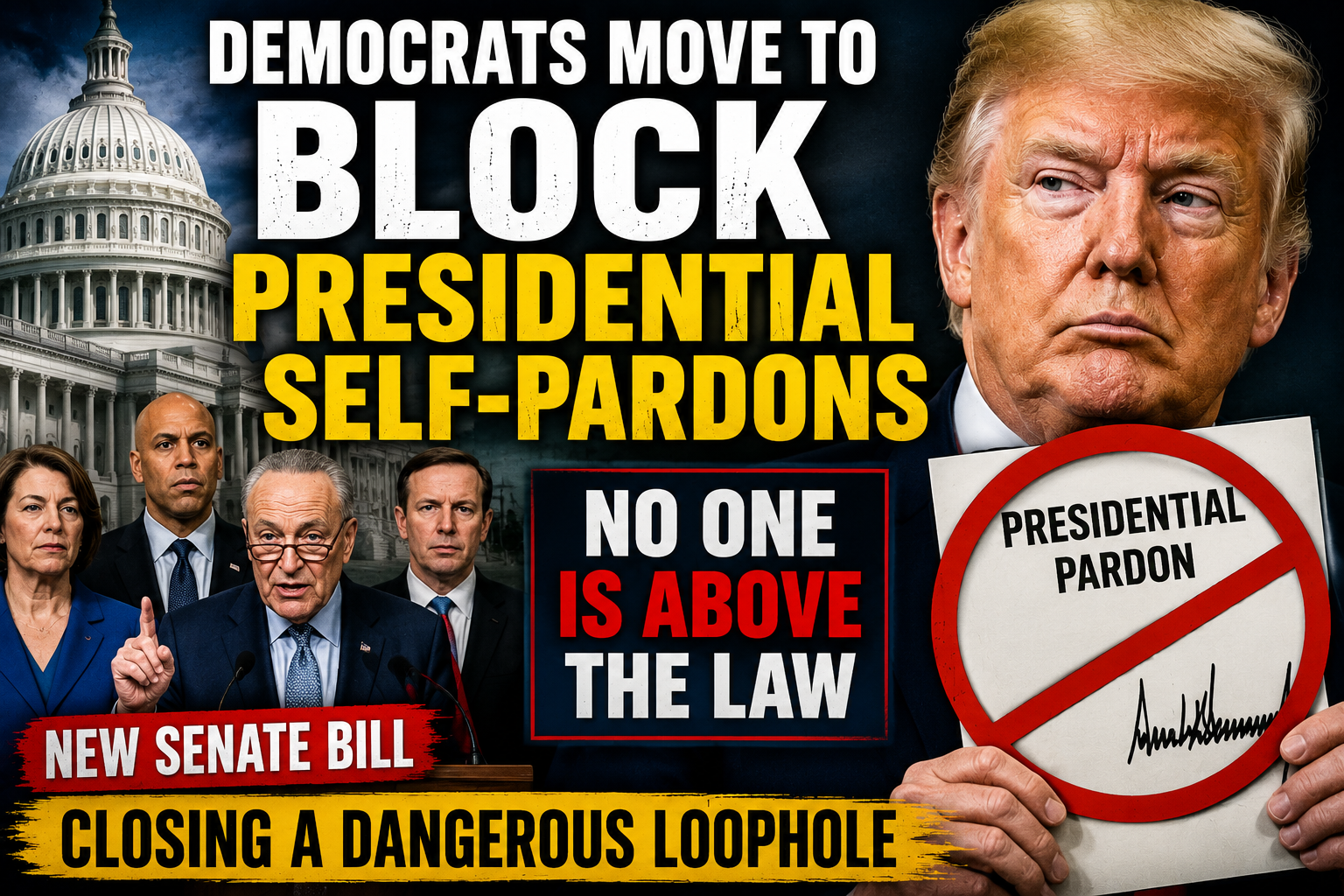
A new political battle is brewing in Washington, and at the center of it is a question that has never been fully tested in American history:
Can a president pardon himself?
Senate Democrats are attempting to ensure the answer is no.
Lawmakers have introduced legislation that would explicitly prohibit presidents from issuing self-pardons in corruption-related cases, arguing that such a power would undermine the rule of law and place presidents above accountability.
Supporters say the proposal closes a dangerous loophole.
Critics argue it is another politically motivated effort aimed at Donald Trump.
Either way, the debate is likely to intensify as the bill moves through Congress.
The Question That Won’t Go Away
For decades, constitutional scholars have debated whether a president possesses the authority to pardon himself.
The Constitution grants presidents broad pardon powers, but it never specifically addresses self-pardons.
That ambiguity has fueled legal arguments for years.
No president has successfully tested the issue in court.
As a result, the question remains unresolved.
The new legislation seeks to eliminate that uncertainty altogether.
Why Democrats Say Action Is Needed
Supporters of the bill argue that allowing presidents to pardon themselves would fundamentally conflict with the principle that no individual is above the law.
They contend that the justice system depends on accountability applying equally to everyone, including the nation’s highest officeholder.
According to advocates, a self-pardon could create a situation where a president uses executive authority to avoid legal consequences for personal misconduct.
They argue that such a possibility threatens public trust in democratic institutions.
For that reason, they believe Congress should act before the issue ever reaches a courtroom.
Critics See Politics
Opponents of the proposal have raised different concerns.
Many Republicans argue that the legislation is less about constitutional reform and more about political messaging.
Some conservatives claim the bill is designed to keep Trump at the center of political debate.
Others argue that lawmakers should focus on economic issues, border security, or government spending rather than hypothetical constitutional disputes.
To them, the proposal appears aimed at a specific political figure rather than addressing an immediate national crisis.
The Shadow of Trump
Although the legislation does not mention Trump by name, few observers doubt that he is part of the conversation.
Questions surrounding presidential immunity, executive authority, and legal accountability have become major topics during the Trump era.
Both supporters and critics of the president have frequently debated the limits of presidential power.
That debate has only intensified as legal challenges involving current and former presidents continue attracting national attention.
As a result, any discussion about self-pardons immediately becomes connected to Trump.
What Constitutional Experts Say
Legal scholars remain divided on the issue.
Some argue that the Constitution’s pardon clause is broad enough to permit self-pardons because it contains very few explicit limitations.
Others maintain that such an interpretation would violate a fundamental legal principle dating back centuries: no person should be the judge in his own case.
That disagreement helps explain why the question has never been definitively settled.
Without a court ruling or constitutional amendment, uncertainty remains.
The proposed legislation is an attempt to provide clarity before a future crisis emerges.
A Bigger Debate About Executive Power
The self-pardon controversy is really part of a larger discussion about presidential authority.
Over the years, presidents from both parties have expanded the use of executive power.
Each administration often defends actions that the opposing party later criticizes.
The result is a cycle in which presidential authority continues growing while political battles over its limits become more intense.
The self-pardon debate reflects those broader concerns.
At stake is not simply one legal question but the future balance between power and accountability.
Could the Bill Pass?
Passing the legislation may prove difficult.
Congress remains deeply divided, and any proposal touching on presidential powers is likely to face intense scrutiny.
Even if lawmakers approve the measure, constitutional questions could still arise regarding whether Congress can restrict powers granted by the Constitution itself.
That means the issue could eventually end up before the courts regardless of what happens in Congress.
For now, however, the proposal has succeeded in drawing national attention.
Public Opinion Could Matter
The success of the legislation may ultimately depend on public sentiment.
Many Americans support the idea that elected officials should face the same legal standards as everyone else.
Others worry about Congress using legislation to target political opponents.
How voters view the proposal could influence lawmakers deciding whether to support it.
As with many issues in modern politics, public perception may be just as important as legal arguments.
Final Thoughts
The new Democratic proposal has reopened one of the most fascinating constitutional debates in modern American politics.
Should a president have the power to pardon himself?
Supporters of the legislation say absolutely not.
Critics argue the effort is politically motivated and unnecessary.
Regardless of where the debate leads, it highlights a fundamental question about the limits of presidential authority.
And in today’s political climate, few questions generate more controversy than that.