
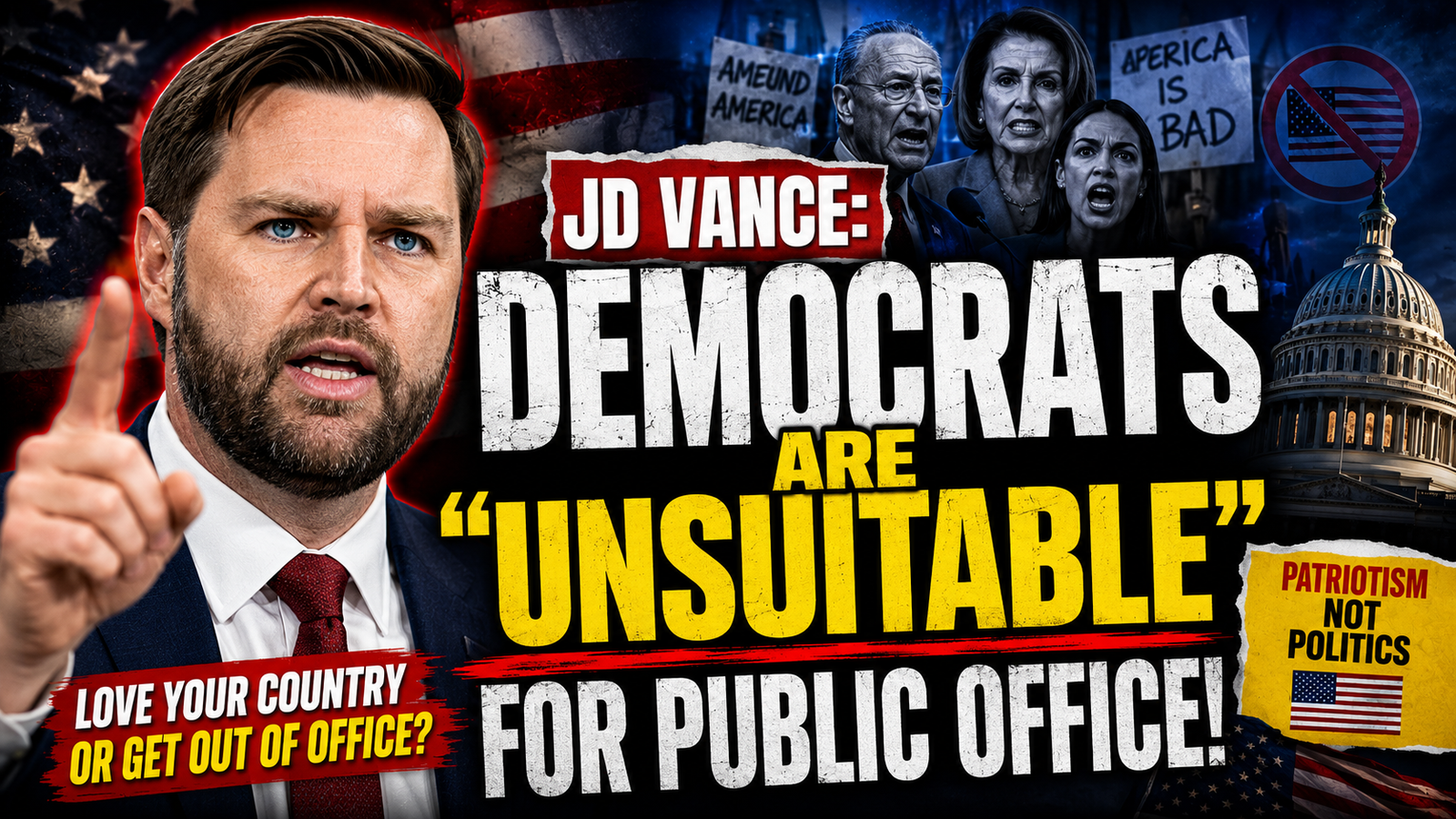
JD Vance Says Democrats Are “Unsuitable” for Public Office
Vice President JD Vance is once again at the center of a political controversy after arguing that many Democrats have become so critical of the United States that they are no longer suitable to hold public office.
The remarks immediately generated strong reactions from both sides of the political spectrum, adding another chapter to the increasingly heated political battle between Republicans and Democrats.
Supporters of Vance praised the comments as a defense of patriotism and national pride.
Critics accused the vice president of questioning the legitimacy of political opponents and deepening America’s already severe political divisions.
As clips of his remarks spread across social media and cable news programs, the debate quickly expanded beyond a single statement.
The controversy has become part of a larger national conversation about patriotism, political disagreement, and what qualities Americans should expect from elected leaders.
The Comments That Sparked the Debate
According to reports, Vance argued that many Democrats spend so much time criticizing the country that they appear ungrateful for the opportunities and freedoms America provides.
The vice president suggested that this attitude raises questions about whether such individuals should be entrusted with positions of public leadership.
His supporters interpreted the remarks as a criticism of political ideology rather than individual citizens.
Critics viewed them differently.
Many argued that questioning whether political opponents are fit to serve in government crosses an important line in democratic discourse.
The disagreement quickly became a major topic of discussion online.
Vance’s Rise in National Politics
Since becoming vice president, Vance has emerged as one of the Republican Party’s most prominent voices.
The former senator built his political reputation by criticizing what he describes as elite institutions that have become disconnected from ordinary Americans.
Throughout his political career, Vance has frequently emphasized themes involving patriotism, national identity, economic opportunity, and cultural values.
Supporters see him as a strong advocate for working-class Americans.
Critics often describe him as one of the administration’s most aggressive partisan voices.
His latest comments fit into that broader political style.
The Debate Over Patriotism
At the heart of the controversy is a long-running American debate about patriotism.
What does it mean to love one’s country?
Can criticism of government policies coexist with patriotism?
Or does constant criticism reflect a lack of appreciation for the nation itself?
Supporters of Vance argue that public officials should demonstrate pride in the country they seek to govern.
From their perspective, leaders who consistently portray America negatively risk undermining public confidence and national unity.
Critics reject that argument.
They contend that criticizing government policies is often an expression of patriotism rather than opposition to the country.
Many argue that democratic societies depend on open criticism and accountability.
Democrats Push Back
Democratic leaders and commentators quickly responded to Vance’s remarks.
Many argued that questioning the suitability of political opponents based on their views sets a dangerous precedent.
They noted that disagreement has always been part of American democracy.
From their perspective, patriotism does not require unconditional support for government policies or political leaders.
Instead, they argue that citizens and elected officials have a responsibility to challenge policies they believe are harmful or ineffective.
Several Democratic figures accused Vance of attempting to frame ordinary political disagreement as disloyalty.
Republicans Rally Behind Vance
At the same time, many Republicans defended the vice president.
Conservative commentators argued that Vance was expressing concerns shared by many voters who feel that some political leaders focus excessively on America’s shortcomings while ignoring its achievements.
Supporters pointed to issues such as economic opportunity, constitutional freedoms, and global influence as reasons for national pride.
They argued that elected officials should acknowledge those strengths rather than constantly emphasize problems.
For many conservatives, Vance’s comments resonated with broader concerns about national identity and civic culture.
Social Media Erupts
As expected, social media platforms quickly became battlegrounds.
Supporters shared clips of Vance’s remarks and praised him for speaking directly about patriotism.
Critics responded with accusations that he was attempting to delegitimize political opposition.
Hashtags, opinion videos, and political commentary flooded online discussions.
Millions of users engaged with the controversy within hours.
The intense reaction demonstrated how quickly political statements can dominate public conversation in today’s media environment.
A Reflection of Political Polarization
The dispute also highlights the broader state of American politics.
Political polarization remains near historic highs.
Americans increasingly consume different media sources and often interpret the same events in dramatically different ways.
As a result, statements that one group views as common sense may be viewed by another as offensive or dangerous.
This reality helps explain why comments about patriotism, loyalty, and public service frequently generate such strong reactions.
The debate is often about more than the specific words being used.
It reflects deeper disagreements about national identity and political values.
Looking Toward Future Elections
The controversy arises as both political parties are already looking ahead to future election cycles.
Republicans continue emphasizing themes involving patriotism, national unity, and cultural identity.
Democrats remain focused on issues such as civil rights, economic policy, healthcare, and government accountability.
Comments like Vance’s are likely to play a role in shaping those future debates.
Political strategists from both parties recognize that questions involving patriotism and national identity can strongly influence voter perceptions.
As a result, similar arguments are likely to continue appearing in campaign speeches and political messaging.
Why This Story Matters
Beyond the immediate controversy, the debate touches on a fundamental question:
What qualities should Americans expect from their elected leaders?
Should public officials primarily celebrate the country’s achievements?
Or should they focus on identifying problems and advocating change?
Most Americans probably believe both responsibilities matter.
The challenge lies in determining where criticism ends and where national unity begins.
That debate has existed throughout American history and remains unresolved today.
Final Thoughts
JD Vance’s comments about Democrats being “unsuitable” for public office have sparked another fierce political debate at a time when the nation remains deeply divided.
Supporters view the remarks as a defense of patriotism and national pride.
Critics see them as an attack on legitimate political opposition.
Regardless of where voters stand, the controversy underscores the growing importance of questions involving patriotism, identity, and political discourse.
As future elections approach, those issues are likely to remain at the center of America’s political conversation.
For now, Vance’s remarks have once again demonstrated how a single statement can ignite a nationwide debate and dominate headlines across the country.