
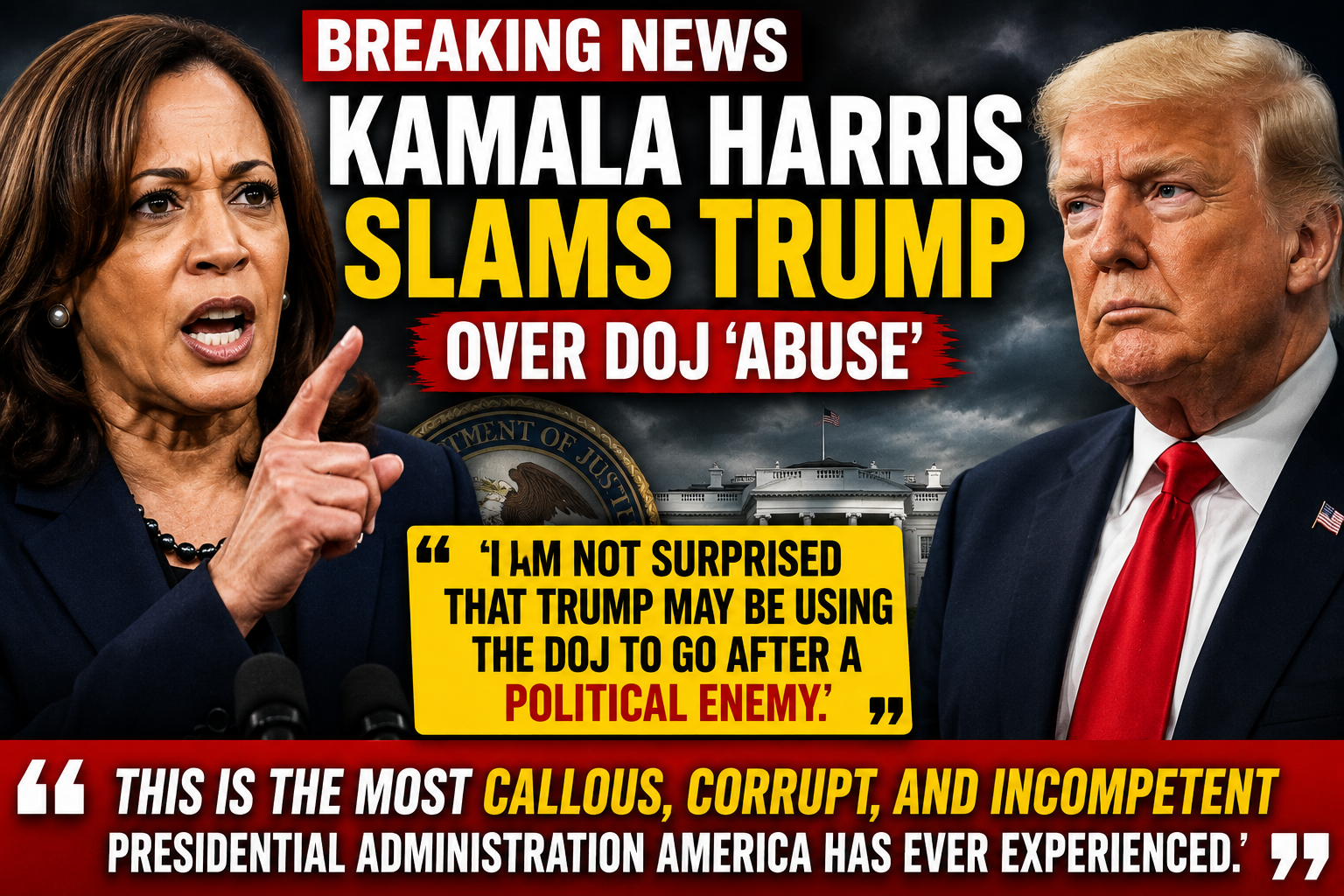
Former Vice President Kamala Harris has once again stepped into the national spotlight with a blistering attack on President Donald Trump, accusing his administration of using the federal government to target political opponents.
The remarks, which quickly spread across social media and political news outlets, came as questions continue to swirl around ongoing investigations, Department of Justice actions, and the increasingly hostile relationship between the Trump administration and its critics.
Harris did not hold back.
“I am not surprised that Trump may be using the DOJ to go after a political enemy,” she said. “This is the most callous, corrupt, and incompetent presidential administration America has ever experienced.”
The statement immediately sparked fierce reactions from both supporters and opponents of the former vice president.
For Democrats, the comments reflected growing concerns about executive power and political retaliation.
For Republicans, the remarks were viewed as another example of partisan rhetoric from a politician who remains one of Trump’s most vocal critics.
Either way, Harris’s comments have reignited a national debate about the role of the Justice Department, presidential power, and the future of American politics.
Harris Returns to the Political Spotlight
The comments arrive at a time when Kamala Harris is increasingly returning to the center of national political conversations.
After losing the 2024 presidential election to Donald Trump, Harris spent much of 2025 and early 2026 maintaining a relatively lower profile while Democrats reassessed their strategy following significant electoral setbacks.
That changed when Harris publicly acknowledged she is considering a run for president in 2028.
Her announcement immediately placed her among the most closely watched figures in the Democratic Party.
Political analysts believe Harris faces a difficult path should she seek the nomination.
While she remains one of the most recognizable Democrats in the country, polling has shown mixed enthusiasm among Democratic primary voters.
Many party strategists have openly discussed whether Democrats should embrace a new generation of leadership or return to familiar national figures.
Against that backdrop, Harris’s criticism of Trump is likely to be viewed through the lens of a potential future presidential campaign.
The DOJ Controversy
At the heart of Harris’s remarks is a broader debate about the independence of the Department of Justice.
Throughout American history, both political parties have accused administrations of improperly influencing federal investigations.
Questions about whether the Justice Department can remain independent from political pressure have long been a source of controversy.
Harris suggested that recent actions raise concerns about the possibility of political motivations behind certain investigations.
Supporters argue that such concerns deserve serious scrutiny.
Critics, however, argue that allegations should be supported by evidence rather than speculation.
The disagreement reflects a larger divide over how Americans view federal institutions and political accountability.
Trump’s Supporters Push Back
Trump supporters quickly rejected Harris’s characterization of the administration.
Many argued that federal investigations and legal actions should not automatically be viewed as political simply because they involve prominent public figures.
Others accused Harris of attempting to energize Democratic voters by portraying routine government actions as politically motivated.
Some conservative commentators pointed to previous investigations involving Trump himself, arguing that Democrats supported aggressive legal scrutiny when Trump was the target.
From their perspective, Harris’s comments represent a double standard.
The exchange highlights how differently Americans often interpret the same events depending on their political perspectives.
Democrats Rally Behind Harris
Many Democrats defended Harris’s remarks and argued that concerns about government power should never be dismissed.
Supporters believe that questioning the actions of powerful institutions is a necessary part of democratic accountability.
Several Democratic activists praised Harris for speaking forcefully about issues they believe deserve greater public attention.
Others noted that criticism of presidential administrations is a normal part of American politics regardless of which party holds power.
For Harris’s supporters, the comments demonstrated a willingness to confront controversial issues directly rather than avoid political conflict.
The 2028 Election Is Already Taking Shape
Although the next presidential election remains years away, political maneuvering is already underway.
Harris is widely viewed as a potential contender for the Democratic nomination, but she is far from the only candidate attracting attention.
Several governors and national Democratic figures are reportedly considering presidential campaigns of their own.
As a result, every major public statement by Harris now carries additional political significance.
Observers will closely watch whether she continues positioning herself as one of Trump’s most aggressive critics.
That strategy could energize parts of the Democratic base while also creating challenges among voters seeking a different direction.
A Deeply Divided Political Climate
The reaction to Harris’s comments underscores the extent of political polarization in the United States.
For some Americans, her remarks reflected legitimate concerns about government accountability.
For others, they represented partisan attacks designed to generate headlines.
This division has become increasingly common in modern politics.
Major events are often interpreted in dramatically different ways depending on political affiliation.
The result is a political environment where consensus becomes increasingly difficult to achieve.
Social Media Erupts
Within hours of Harris’s comments becoming public, social media platforms were flooded with reactions.
Supporters shared clips of her remarks and praised her willingness to challenge Trump directly.
Critics responded with their own attacks, accusing Harris of exaggeration and political opportunism.
Political influencers, journalists, activists, and commentators quickly joined the conversation.
The debate generated millions of views and thousands of comments across multiple platforms.
As often happens in modern politics, the online reaction became a story of its own.
Why This Story Matters
Beyond the immediate controversy, Harris’s remarks highlight larger questions about trust in government institutions.
Americans continue debating the proper limits of presidential authority, the independence of federal agencies, and the role of political accountability.
These questions are likely to remain central issues heading into future election cycles.
Whether voters agree with Harris or disagree with her, the comments tap into concerns that resonate across the political spectrum.
Questions about power, fairness, and government accountability rarely disappear from public debate.
Final Thoughts
Kamala Harris’s sharp criticism of the Trump administration has once again placed her at the center of the national political conversation.
Her accusations regarding the Department of Justice and her description of the administration as “callous, corrupt, and incompetent” have generated intense reactions from both sides of the political aisle.
Supporters view her comments as a necessary warning.
Critics see them as partisan rhetoric.
What is clear is that Harris remains one of the Democratic Party’s most prominent voices, and as speculation about 2028 grows, every statement she makes will receive close scrutiny.
The political battle between Trump and his critics may be entering a new phase, but the divisions that define American politics remain as strong as ever.