
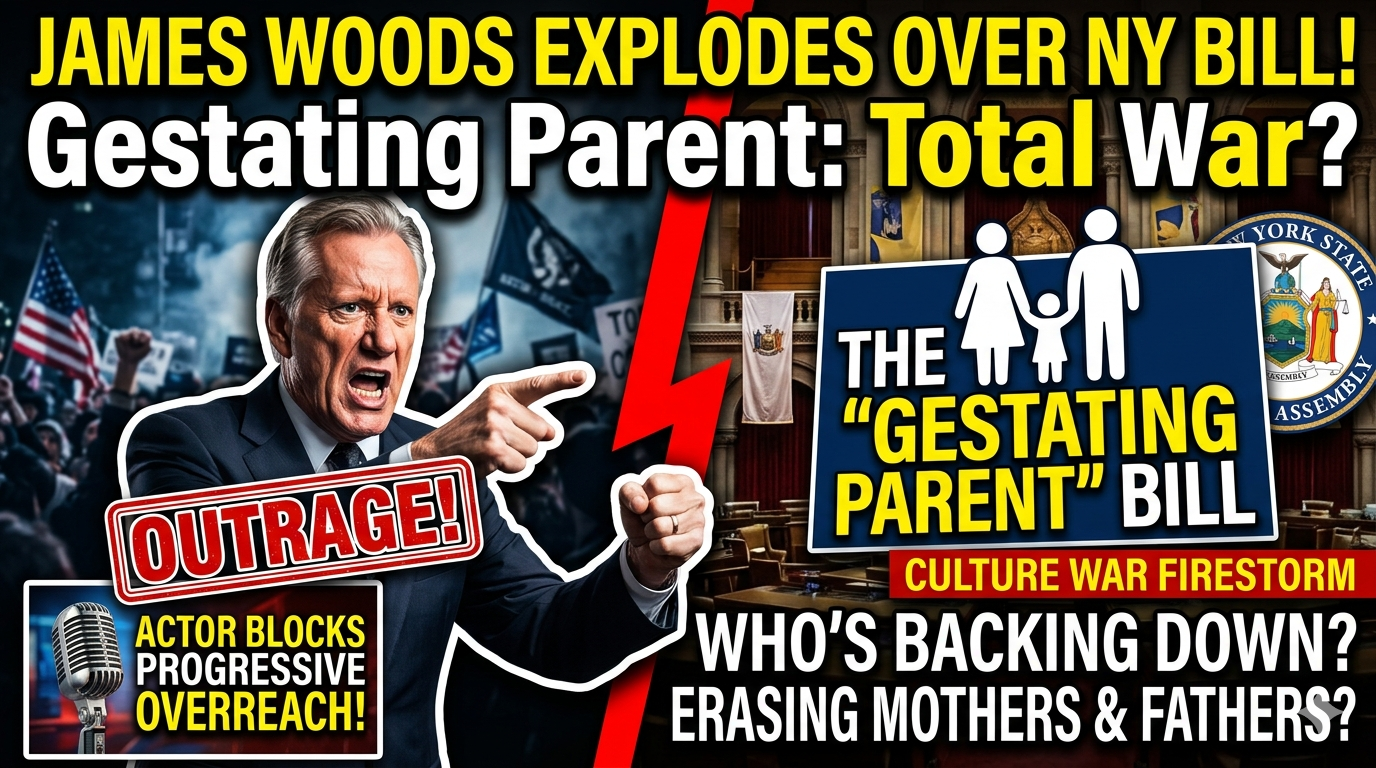
A new legislative proposal in New York has ignited another fierce culture-war battle, drawing reactions from politicians, activists, legal experts, and celebrities alike.
Among the loudest voices entering the debate is actor James Woods, who sharply criticized Democratic lawmakers after legislation advanced that would replace certain references to “mother” and “father” in family law statutes with gender-neutral terms such as “gestating parent” and “non-gestating parent.”
Supporters of the legislation argue the changes are intended to modernize family law and better accommodate surrogacy arrangements, same-sex couples, and diverse family structures.
Critics, however, see something entirely different.
They argue the proposal unnecessarily replaces traditional family language and reflects a broader cultural movement that many Americans reject.
The result has been a political and cultural firestorm that extends far beyond New York.
What the Bill Actually Does
At the center of the controversy is proposed legislation that updates terminology used in certain areas of New York family law.
Under the proposal, some references to “mother” and “father” would be replaced with terms such as “gestating parent” and “non-gestating parent.”
Supporters say the purpose is practical rather than ideological.
They argue that modern family arrangements can involve surrogates, same-sex couples, adoptive parents, and other situations where traditional terminology may not accurately describe legal relationships.
According to advocates, the revised language helps ensure that family law reflects the realities of contemporary families.
Supporters insist the legislation is not designed to erase mothers or fathers.
Instead, they argue it is meant to make legal definitions more inclusive.
James Woods Responds
Actor James Woods was among the most prominent critics to weigh in.
Reacting to reports on the legislation, Woods expressed outrage at the changes to the terminology.
In social media comments that quickly spread online, he argued that replacing traditional parental language represented an attack on common sense.
Woods wrote that New York Democrats appeared to “hate mothers and fathers” and mocked the phrase “gestating parent.”
He went even further, describing Democratic politics in harsh terms and accusing the party of embracing increasingly extreme cultural positions.
His remarks immediately attracted attention from both supporters and critics.
Why the Debate Is So Emotional
The controversy touches on something deeply personal for many people: family identity.
Words such as “mother” and “father” carry emotional, cultural, historical, and social significance.
For critics of the legislation, changing those terms feels like altering fundamental concepts that have existed for generations.
Many argue that mothers and fathers should remain explicitly recognized in law.
Others worry that replacing traditional language creates confusion and weakens important cultural norms.
Because family identity is such a sensitive issue, debates over terminology often become highly emotional.
Supporters Say Critics Are Misunderstanding the Bill
Advocates of the legislation argue that many criticisms stem from misunderstandings.
According to supporters, the proposal does not ban the use of the words “mother” or “father.”
Nor does it prevent families from identifying however they choose.
Instead, supporters say the legislation simply updates specific legal definitions in situations where traditional terminology may not fit every family structure.
For example, surrogacy arrangements can involve individuals who give birth but are not intended to become legal parents.
Similarly, same-sex couples may not fit neatly into older legal categories.
Supporters believe gender-neutral language helps address those situations.
Another Front in America’s Culture Wars
The dispute reflects a much larger national debate.
Across the United States, battles over language have increasingly become political flashpoints.
Arguments over pronouns, gender identity, educational materials, sports participation, and family terminology have generated intense disagreements.
Supporters of inclusive language argue that society evolves, and legal systems must evolve with it.
Critics argue that many institutions are changing language faster than public opinion supports.
The New York proposal has become the latest example of this broader conflict.
Social Media Amplifies the Fight
Unsurprisingly, the issue exploded across social media.
Conservative commentators praised Woods for speaking out.
Progressive activists accused critics of distorting the legislation’s purpose.
Memes, viral posts, and heated arguments quickly followed.
As often happens with culture-war controversies, nuanced legal discussions were frequently replaced by emotionally charged political messaging.
The debate became less about legal language and more about competing visions of society.
That dynamic helped transform a relatively technical legislative proposal into national news.
Political Implications
For Democrats, the controversy presents both opportunities and risks.
Supporters believe the party is standing up for inclusivity and ensuring that legal systems recognize all families.
Critics argue that Democrats are focusing on symbolic cultural issues rather than concerns such as inflation, crime, housing costs, and economic growth.
Republicans have increasingly used similar cultural debates to argue that progressive politicians are out of touch with ordinary voters.
As a result, even relatively narrow legislative changes can become politically significant.
The reaction to the New York proposal demonstrates how quickly cultural issues can shape broader political narratives.
What Happens Next?
The legislation still faces additional political and legal hurdles before becoming law.
Lawmakers will continue debating the language, and public reactions are likely to influence the conversation.
Advocacy groups on both sides are expected to remain heavily involved.
Regardless of the bill’s ultimate outcome, the controversy has already succeeded in drawing national attention.
The discussion has expanded far beyond New York and is now part of a larger conversation about language, identity, and the future of family law in America.
Final Thoughts
James Woods’ criticism of New York’s proposed family law changes has reignited one of the country’s most contentious cultural debates.
Supporters of the legislation argue that gender-neutral language helps accommodate modern family structures and legal realities.
Critics see the proposal as an unnecessary attempt to replace traditional concepts of motherhood and fatherhood.
As the political battle continues, one thing is clear:
The fight over language has become a fight over values, identity, and the direction of American society itself.
And judging by the reaction so far, neither side is backing down.