
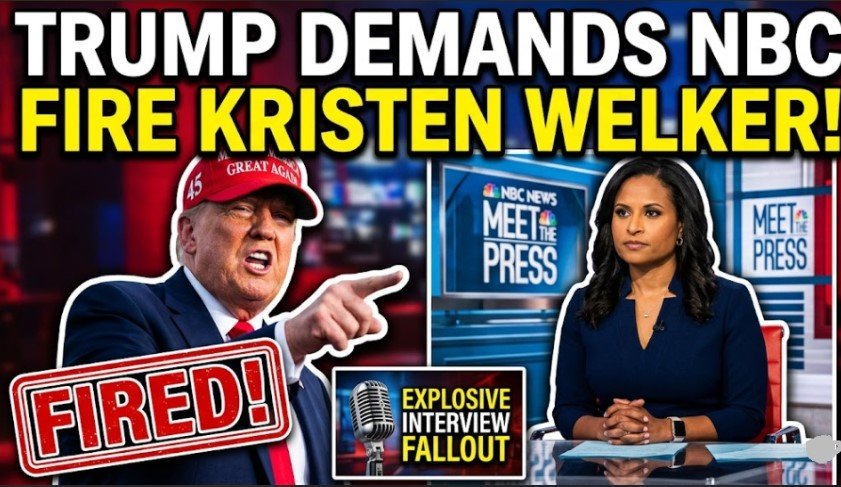
The fallout from Donald Trump’s explosive interview with NBC’s Meet the Press is still growing.
Days after abruptly ending a tense exchange with NBC moderator Kristen Welker, Trump has reportedly intensified his criticism of the veteran journalist and is now calling for NBC to remove her from her role.
The demand comes after an interview that quickly transformed from a routine political discussion into one of the most talked-about media confrontations of the year.
Supporters of the president argue Welker crossed the line from journalism into advocacy.
Critics argue she was simply doing her job by pressing a president for evidence and clarification.
The result is yet another major battle in the long-running war between Donald Trump and the mainstream media.
And once again, neither side appears willing to back down.
The Interview That Went Off the Rails
The controversy began during Trump’s appearance on NBC’s Meet the Press.
The interview covered a wide range of topics, including election integrity, the economy, foreign policy, and a controversial proposal involving a multi-billion-dollar compensation fund.
What started as a normal political interview quickly became increasingly tense.
Welker repeatedly challenged several of Trump’s claims and asked him to provide evidence supporting allegations of election fraud.
Trump pushed back aggressively.
The exchange grew more heated with each question.
Eventually, the president accused NBC and several major news organizations of being “crooked” before ending the interview early and walking away.
The dramatic exit immediately became national news.
Why Trump Is Angry
According to Trump and many of his supporters, the problem was not the questions themselves.
They argue the issue was the way the questions were asked.
Supporters claim Welker approached the interview with a predetermined agenda and spent more time challenging the president than seeking information.
They argue journalists should ask tough questions but should not act as participants in political debates.
For many conservatives, the interview became another example of what they view as hostile media treatment toward Trump.
That perception has existed throughout much of Trump’s political career.
The latest clash only reinforced those beliefs.
Welker’s Defenders Push Back
Supporters of Kristen Welker see the situation very differently.
They argue that journalists have a responsibility to challenge public officials when claims are disputed or unsupported by evidence.
From their perspective, asking follow-up questions is not biased.
It is journalism.
Many media observers noted that Welker repeatedly requested evidence for specific claims and attempted to keep the discussion focused on policy matters.
Her defenders argue that refusing to challenge powerful political figures would represent a failure of journalistic responsibility.
For them, the interview demonstrated exactly why independent media matters.
Trump’s Long History With the Media
The confrontation did not occur in a vacuum.
Trump has spent years criticizing major news organizations.
Throughout his political career, he has frequently accused networks such as NBC, CNN, ABC, CBS, and others of unfair coverage.
He has repeatedly argued that many journalists approach him with hostility and bias.
At the same time, media organizations often defend their reporting as necessary scrutiny of powerful political figures.
This ongoing conflict has become one of the defining features of Trump’s public life.
The clash with Welker fits squarely within that pattern.
Calls for Welker’s Removal Spark Debate
Trump’s reported demand that NBC remove Welker has generated a broader discussion about press freedom and journalistic independence.
Critics of the president argue that elected officials should not be attempting to influence staffing decisions at news organizations.
They warn that such demands can create pressure on journalists to avoid asking difficult questions.
Supporters counter that viewers have every right to criticize journalists they believe are unfair.
They argue that public figures, including presidents, should be free to express opinions about media performance.
The debate ultimately centers on where criticism ends and inappropriate pressure begins.
Media Trust Remains a Major Issue
The incident also highlights a larger problem facing the United States.
Public trust in the media remains deeply divided.
Many Americans believe major news organizations perform an essential democratic function.
Others believe large portions of the media have become politically biased.
Polling consistently shows significant differences between Republicans and Democrats when it comes to media trust.
Those differences help explain why reactions to the Welker interview were so dramatically different.
People often viewed the same interview through completely different lenses.
Social Media Turns the Clash Into a National Story
Within hours of the interview airing, clips began spreading across social media.
Supporters shared moments they believed showed unfair treatment.
Critics highlighted moments where Trump struggled to answer questions.
Hashtags began trending.
Commentators weighed in.
Political influencers joined the conversation.
The confrontation rapidly evolved from a television interview into a national political event.
That transformation reflects the modern media environment.
Today, a few minutes of video can dominate public discussion for days.
What This Means for NBC
NBC now finds itself in the middle of a highly visible political controversy.
The network has not indicated any intention of removing Welker, and media organizations traditionally resist outside pressure regarding personnel decisions.
Still, the situation places additional attention on both the network and its coverage.
Supporters of Trump will continue scrutinizing NBC’s reporting.
Critics of Trump will likely view any defense of Welker as a defense of press independence.
As a result, the controversy may continue long after the interview itself fades from headlines.
The Bigger Political Picture
The dispute is ultimately about more than one journalist.
It reflects the broader relationship between politicians and the media in modern America.
Presidents need media coverage to communicate with voters.
Journalists need access to political leaders to gather information.
Yet both sides frequently view each other with suspicion.
That tension has always existed to some degree.
Under Trump, however, it has become more visible and more confrontational than ever.
The Welker clash is simply the latest example.
Final Thoughts
Donald Trump’s reported demand that NBC remove Kristen Welker has added another chapter to one of America’s most enduring political conflicts.
Supporters say the president is standing up to biased media treatment.
Critics argue he is attacking a journalist for asking difficult questions.
The interview itself may be over.
The debate it sparked is not.
As the relationship between politicians and the press continues evolving, moments like this are likely to become increasingly common.
And when Donald Trump and the national media collide, the headlines almost always write themselves.