
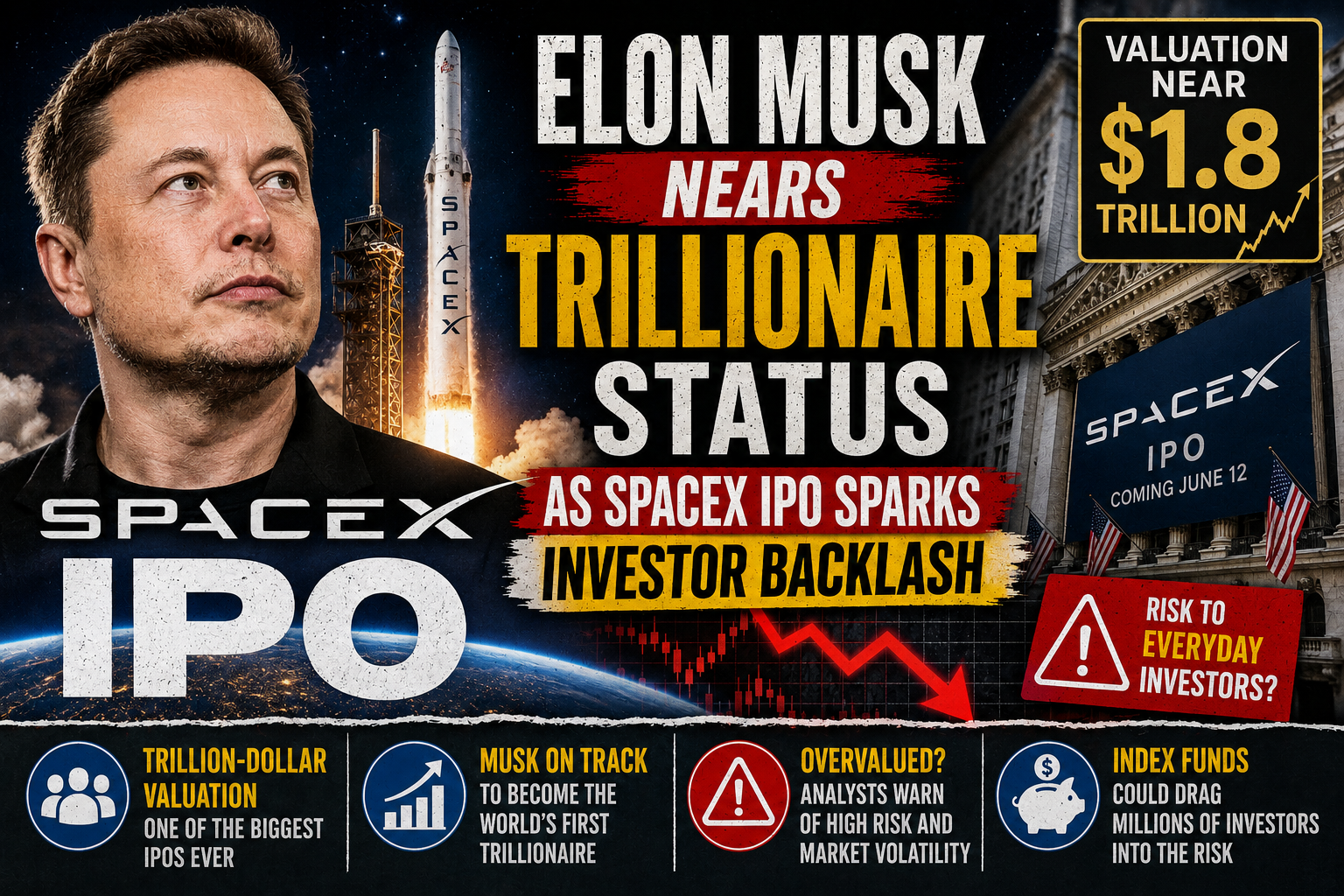
Billionaire entrepreneur Elon Musk is once again at the center of global financial attention as reports suggest his space company, SpaceX, could be preparing for a historic public market debut that may push his net worth into unprecedented territory.
According to market reporting and analyst commentary, the upcoming SpaceX IPO, expected around June 12, could value the company near $1.8 trillion, a figure that would make it one of the largest and most influential stock market listings in history.
If the valuation holds and market conditions align, Musk could become the world’s first trillionaire on paper. But alongside the excitement, a growing group of critics is warning that the structure and scale of the deal may shift significant financial risk onto everyday investors.
A Record-Breaking IPO in the Making
The anticipated SpaceX public debut is already being described as a potential watershed moment for global markets.
At a projected valuation approaching $1.8 trillion, SpaceX would immediately rank among the most valuable companies ever introduced to public trading. This would place it in the same category as the world’s largest tech giants, despite operating in a highly capital-intensive and still-evolving aerospace industry.
Supporters of the IPO argue that SpaceX represents:
- A dominant position in satellite internet infrastructure
- A proven track record in reusable rocket technology
- Rapid expansion of global communications systems through Starlink
- A long-term vision for commercial space travel and exploration
For investors bullish on the future of space commercialization, the IPO is being framed as a once-in-a-generation opportunity.
Why Critics Are Sounding the Alarm
Despite the enthusiasm, financial analysts and market commentators have raised concerns about how the IPO is being structured and priced.
A central issue is valuation.
Critics argue that SpaceX’s projected valuation is significantly higher than traditional market benchmarks used to assess companies with similar revenue profiles. Typically, companies are valued based on revenue multiples, earnings projections, and long-term cash flow potential.
In this case, skeptics say the valuation appears to be driven more by future expectations than current financial fundamentals.
Some analysts warn that such pricing could create:
- Overinflated market expectations
- Increased volatility after listing
- Risk of speculative trading behavior
- Potential long-term instability for late investors
The Index Fund Concern
One of the most controversial points raised involves how ordinary investors could be exposed to the stock without directly choosing to invest.
A significant portion of U.S. retirement savings is invested through index funds and ETFs, which automatically track major stock market indices.
If SpaceX is quickly added to those indices after its IPO, funds may be required to purchase shares in order to maintain index accuracy. That means millions of investors could gain exposure indirectly through:
- 401(k) retirement plans
- Pension funds
- Mutual funds
- Broad-market ETFs
Critics argue this creates a situation where everyday investors may be “dragged into” exposure to a highly anticipated and potentially volatile stock without actively selecting it themselves.
Supporters counter that index inclusion is a standard market mechanism and reflects investor demand and company scale.
The Wealth Effect and Musk’s Position
If SpaceX reaches its projected valuation and performs strongly post-IPO, Musk’s stake in the company could dramatically increase his already enormous net worth.
This is why some analysts have described the situation as a possible pathway to Musk becoming the world’s first trillionaire—at least on paper.
However, much of this wealth would remain tied to stock value rather than liquid cash, meaning its real-world impact would depend heavily on market stability and long-term performance.
Volatility Risks After IPO
Market history shows that high-profile IPOs often experience extreme early volatility.
Common patterns include:
- Initial price surges driven by hype
- Rapid correction phases as speculation cools
- Long-term stabilization based on fundamentals
- Divergent outcomes for early vs. late investors
Critics warn that if SpaceX follows a similar trajectory, investors entering during peak enthusiasm could face significant losses once the market normalizes expectations.
SpaceX’s Business Model Under Scrutiny
Beyond valuation concerns, some analysts are also examining SpaceX’s financial structure and business dependencies.
Key areas of focus include:
- Heavy reliance on government contracts
- Capital-intensive launch infrastructure
- Long development cycles for space technology
- Uncertainty around long-term profitability in commercial space markets
Supporters argue that these factors are normal for a frontier technology company and reflect long-term strategic positioning rather than weakness.
Still, skeptics insist that investors should carefully evaluate risk before buying into what they see as a highly speculative narrative.
The Broader Debate: Innovation vs. Speculation
The SpaceX IPO discussion has evolved into a broader debate about modern financial markets.
On one side, supporters see:
- A breakthrough moment for private space exploration
- A revolutionary company entering public markets
- A long-term bet on humanity’s expansion beyond Earth
On the other side, critics see:
- Overvaluation driven by hype and branding
- Increased exposure of retirement funds to risky assets
- Wealth concentration among top executives
- A potential “bubble-like” dynamic in high-growth tech sectors
This divide reflects a recurring tension in modern investing: innovation versus financial excess.
What Happens Next
As the IPO date approaches, attention will focus on:
- Final pricing structure
- Initial trading performance
- Index fund inclusion timelines
- Regulatory disclosures and financial filings
- Investor sentiment during the first weeks of trading
The outcome will likely determine whether SpaceX is viewed as a transformative financial milestone or a cautionary example of market exuberance.
Conclusion
The anticipated SpaceX IPO has placed Elon Musk once again at the center of global financial debate, with projections suggesting a valuation that could redefine corporate scale and personal wealth accumulation.
While supporters see a revolutionary leap in space-driven capitalism, critics warn that inflated expectations and passive investment mechanisms could expose everyday investors to hidden risks.
Whether SpaceX becomes a defining success story or a volatile market experiment, the implications of its public debut will be felt far beyond Wall Street.