
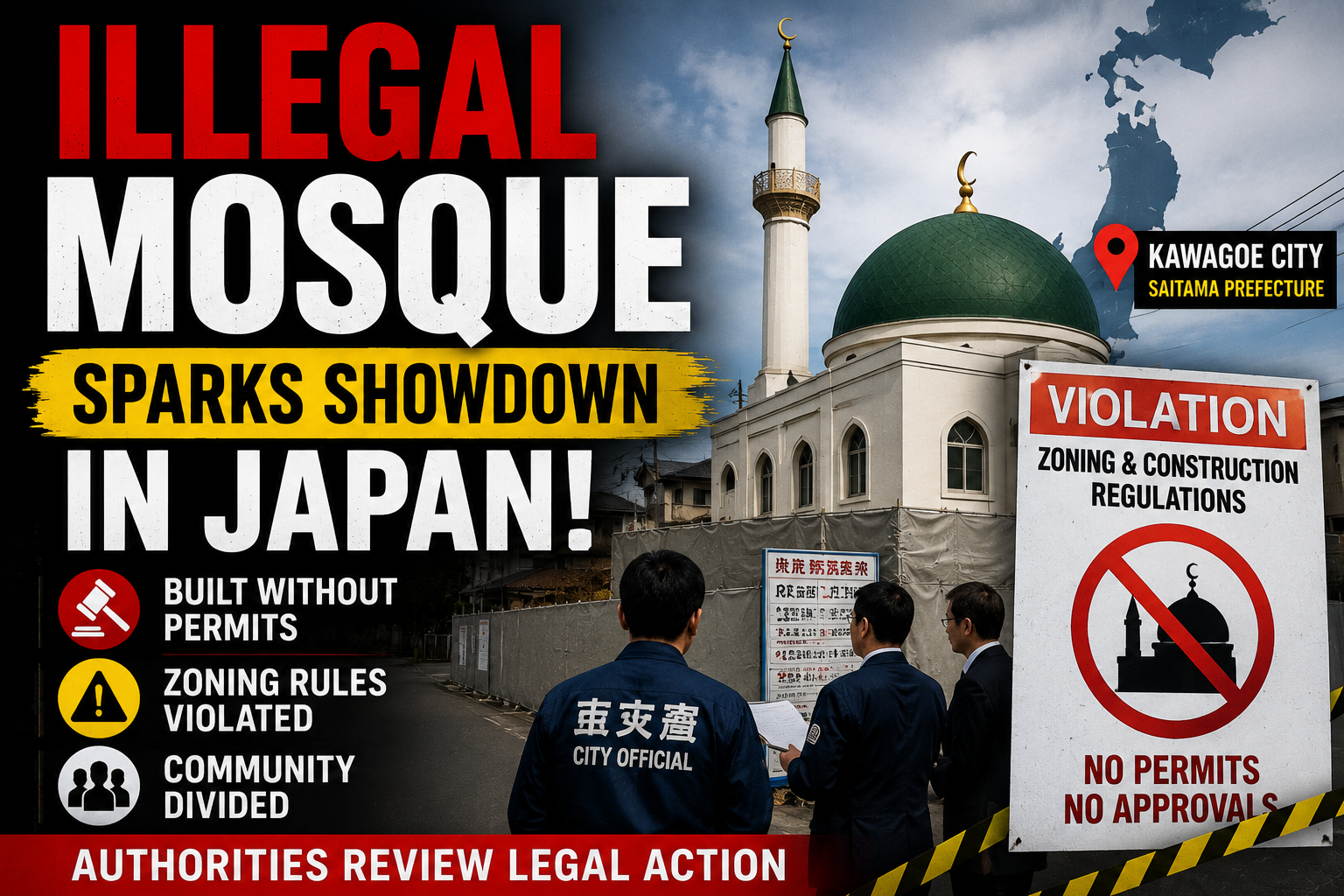
A newly constructed mosque in Japan has become the center of an increasingly heated debate after local authorities determined that the project did not comply with zoning and construction regulations.
The controversy is unfolding in Kawagoe City, located in Saitama Prefecture, where officials say the building was constructed in an area subject to specific land-use restrictions and was completed without obtaining all of the required permits and approvals.
While supporters of the project argue that places of worship deserve fair treatment and respect, critics insist that the issue is not about religion at all.
Instead, they say it is about following the law.
The dispute has quickly grown beyond a simple construction matter and evolved into a broader conversation about immigration, religious freedom, urban planning, community relations, and the future of local development in Japan.
How the Controversy Began
According to local authorities, concerns emerged during the construction process when officials discovered that the project was moving forward despite questions surrounding permits and zoning compliance.
City representatives reportedly issued multiple notices and warnings as construction continued.
However, those concerns remained unresolved.
By the time the building was completed, officials determined that the project had violated existing planning regulations.
That finding immediately raised questions about what happens next.
Will the structure be allowed to remain?
Will modifications be required?
Could legal action follow?
Those questions are now at the center of the debate.
Officials Say Rules Apply to Everyone
Local authorities have emphasized that the issue is not connected to religion.
Instead, officials argue that zoning regulations exist to ensure safe and orderly development.
Every city relies on planning rules to manage traffic, environmental concerns, public infrastructure, and neighborhood growth.
Officials say those regulations apply equally to all projects regardless of whether the building is a home, business, factory, church, temple, or mosque.
From their perspective, the central issue is straightforward.
Rules exist.
Projects must follow them.
Supporters See a Different Story
Some supporters of the mosque believe the situation is more complicated.
They argue that religious communities often face unique challenges when trying to establish places of worship.
As Japan’s Muslim population has grown over the past two decades, demand for mosques and community centers has increased as well.
Supporters worry that zoning disputes can sometimes create barriers that disproportionately affect minority religious groups.
They stress that Muslim residents deserve access to places where they can gather, worship, and build community connections.
For them, the conversation is not only about permits.
It is also about inclusion.
Growing Muslim Communities in Japan
Japan remains one of the least religiously diverse countries in the developed world.
However, demographic changes have gradually increased the number of foreign workers, international students, and immigrant communities throughout the country.
Among those groups are Muslims from countries across Asia, the Middle East, and Africa.
As these communities expand, the demand for religious infrastructure naturally grows.
Mosques have been established in several Japanese cities over the years.
Most projects attract little attention.
But when construction disputes emerge, they often become national news.
Why Zoning Rules Matter
Urban planning regulations may not sound exciting, but they play a major role in shaping communities.
Governments use zoning laws to determine where homes, businesses, factories, schools, and religious institutions can be located.
These rules help manage traffic flow, environmental impact, noise levels, public safety concerns, and future development.
Supporters of strict enforcement argue that ignoring those regulations can create long-term problems.
Once exceptions are made, critics say, enforcing standards consistently becomes more difficult.
That is why city officials appear determined to follow established procedures in this case.
Residents Are Divided
Like many local controversies, public opinion appears divided.
Some residents believe authorities are simply doing their jobs.
Others worry the dispute could create unnecessary tensions within the community.
Several local voices have emphasized the importance of finding a solution that respects both legal requirements and community relationships.
Many residents want clarity.
They want to know whether laws were broken, what consequences might follow, and how similar disputes can be prevented in the future.
The Bigger Debate About Immigration
The controversy arrives at a time when Japan is already debating immigration and demographic change.
The country faces an aging population and a shrinking workforce.
To address labor shortages, policymakers have gradually expanded opportunities for foreign workers.
That shift has brought new cultural and religious diversity to many communities.
Supporters view the trend as necessary for Japan’s economic future.
Critics worry about social integration and cultural change.
As a result, local disputes can sometimes become symbols of much larger national conversations.
Social Media Weighs In
As news of the mosque controversy spread online, reactions poured in from across Japan and around the world.
Some users focused on religious freedom.
Others focused on legal compliance.
Many argued that the same standards should apply to everyone regardless of faith.
Others questioned whether local authorities handled the situation appropriately.
The result has been a familiar modern phenomenon.
A local issue suddenly becomes a global debate.
What Happens Next?
The future of the mosque remains uncertain.
Authorities are continuing legal and administrative reviews while evaluating potential next steps.
Possible outcomes could include modifications, penalties, additional approvals, or other regulatory actions.
For now, officials appear focused on following established procedures rather than making immediate decisions.
The process could take time.
And as it continues, public attention is unlikely to fade.
Final Thoughts
The Kawagoe mosque controversy highlights the challenges that can emerge when rapid community development collides with complex planning regulations.
Supporters emphasize religious freedom and inclusion.
Officials emphasize legal compliance and urban planning standards.
Both sides believe they are defending important principles.
As authorities continue reviewing the case, the dispute serves as a reminder that modern cities must constantly balance growth, diversity, community concerns, and the rule of law.
The outcome may affect more than one building.
It could influence how future development projects are approached across Japan.