
Donald Trump has had countless confrontations with the media over the years.
But his latest clash may be one of the most talked-about yet.
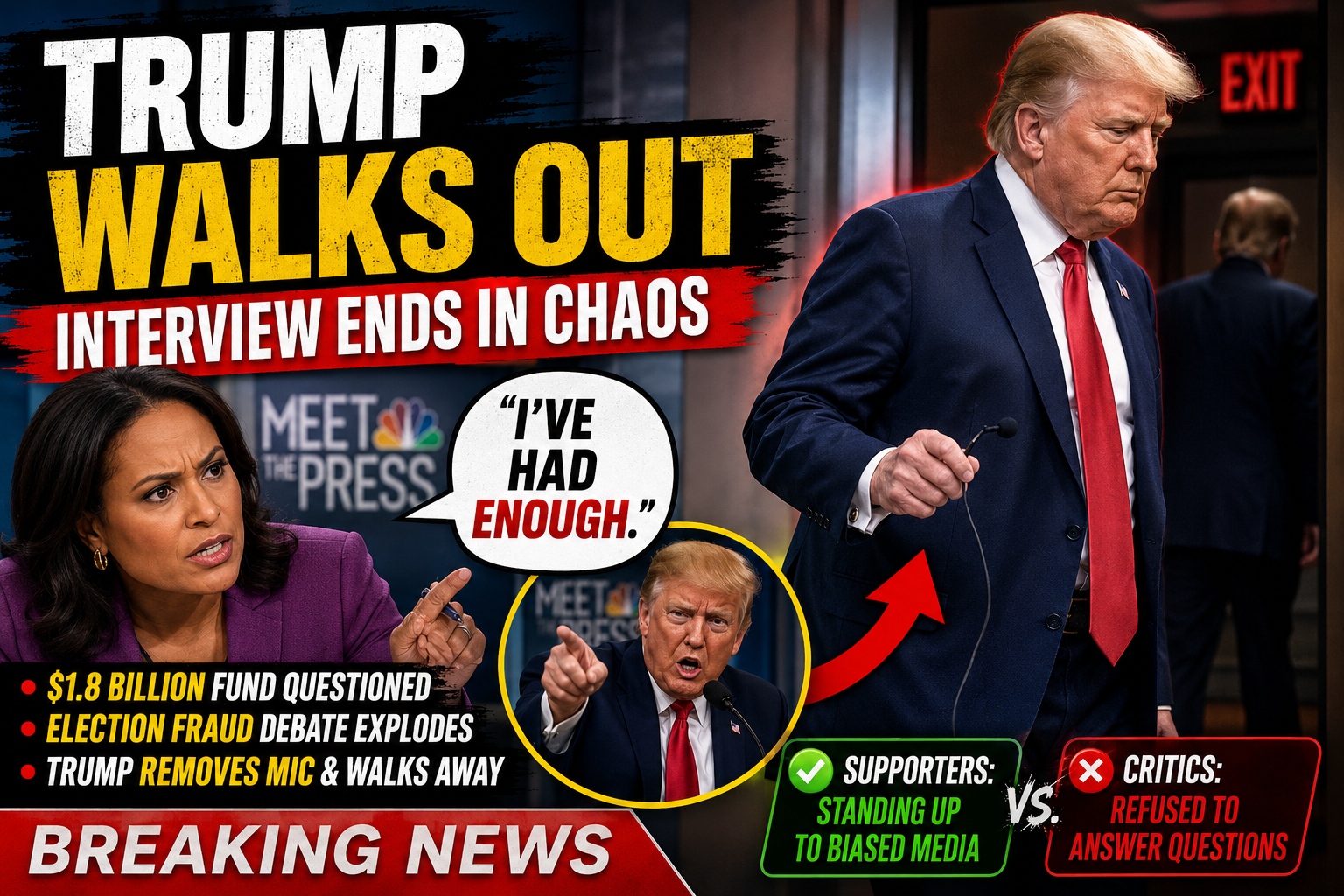
During a tense appearance on NBC’s Meet the Press, Trump abruptly ended the interview, removed his microphone, and walked away after host Kristen Welker repeatedly challenged his claims about election fraud, January 6, and a controversial $1.8 billion fund proposal. The dramatic exit immediately became national news and reignited debate over Trump’s relationship with the press.
Supporters say he was standing up to a biased media establishment.
Critics say he simply refused to answer difficult questions.
Either way, the confrontation has become the latest viral moment in America’s never-ending political drama.
The Interview Started Normally
The interview was recorded in Wisconsin ahead of a Trump event focused on farmers and rural issues.
At first, the discussion covered familiar topics, including the economy, foreign policy, election integrity, and Trump’s plans moving forward.
But things quickly became heated when Welker began pressing Trump on issues he has frequently discussed in public appearances and on social media.
One topic in particular appeared to irritate the president.
The controversial $1.8 billion “anti-weaponization” fund.
The proposal had already generated criticism from both Democrats and some Republicans, making it one of the most sensitive issues facing the administration.
The $1.8 Billion Question
Welker repeatedly asked Trump about the fund and whether individuals connected to January 6 cases could potentially receive compensation.
Trump defended the concept, arguing that some Americans had been unfairly targeted by government agencies and deserved justice.
But when Welker asked for evidence supporting some of his claims, the conversation became increasingly confrontational.
Instead of providing detailed answers, Trump began attacking the media itself.
That is where the interview shifted from policy discussion to personal conflict.
The Election Debate Returns
As the exchange intensified, Trump returned to one of the most controversial issues of his political career.
Election fraud.
He repeated claims that the 2020 election had been rigged and also raised concerns about more recent election processes.
Welker pushed back, noting that courts, election officials, and numerous investigations have not produced evidence supporting those claims.
Trump insisted otherwise.
Welker continued asking for proof.
The tension escalated.
“I’ve Had Enough”
Then came the moment everyone is talking about.
After several minutes of back-and-forth exchanges, Trump declared, “I’ve had enough.”
He removed his microphone.
He stood up.
And he walked away from the interview.
The clip immediately spread across television networks, YouTube, Facebook, TikTok, and X.
Within hours, it became one of the most discussed political moments in the country.
Supporters Say Trump Did the Right Thing
Trump supporters argue the walkout was justified.
Many believe mainstream media outlets routinely treat Trump differently from other politicians.
From their perspective, journalists frequently interrupt him, challenge his statements more aggressively, and frame questions in a hostile manner.
For those supporters, the walkout was not a weakness.
It was resistance.
They see it as another example of Trump refusing to play by what they view as unfair media rules.
That interpretation quickly gained traction among conservative commentators.
Critics See Something Else
Critics tell a very different story.
They argue that elected officials should answer difficult questions, especially when discussing taxpayer-funded programs and election claims.
To them, the interview demonstrated what happens when Trump is asked to provide evidence rather than simply make assertions.
Instead of responding directly, critics argue, he attacked the messenger and exited the conversation.
That criticism has become a central theme in media coverage following the interview.
Why This Moment Matters
Political interviews are often carefully managed.
Questions are expected.
Disagreements happen.
But it is relatively rare for a sitting president to remove a microphone and walk away during a nationally televised interview.
That is one reason this incident attracted so much attention.
The visual itself is powerful.
A president standing up and ending an interview creates headlines regardless of political affiliation.
Moments like these often become symbols larger than the event itself.
The Media War Continues
Trump’s relationship with major media organizations has been turbulent from the beginning.
He has frequently referred to networks as dishonest, biased, or politically motivated.
Media organizations, in turn, have aggressively fact-checked many of his statements and challenged his claims.
The result is an ongoing conflict that has lasted for years.
The Meet the Press walkout may simply be the latest chapter in that story.
Few political figures have maintained such a combative relationship with the press while simultaneously dominating media coverage.
Could the Walkout Help Trump?
Ironically, moments like this often energize Trump’s supporters.
His political brand has long been built around confrontation.
Many voters who support him enjoy seeing him challenge journalists, political opponents, and institutions they distrust.
As a result, what critics see as a damaging moment can sometimes strengthen his standing among loyal supporters.
Trump has benefited from that dynamic repeatedly throughout his political career.
Final Thoughts
The Meet the Press confrontation was about much more than one interview.
It reflected larger debates about media credibility, political accountability, election integrity, and presidential behavior.
Supporters saw a president refusing to be cornered.
Critics saw a president refusing to answer questions.
Neither side is likely to change its mind.
But one thing is certain.
The image of Donald Trump removing his microphone, saying “I’ve had enough,” and walking off the set is likely to become one of the defining political moments of 2026.