
A powerful earthquake has once again reminded the world that nature can change lives in seconds.
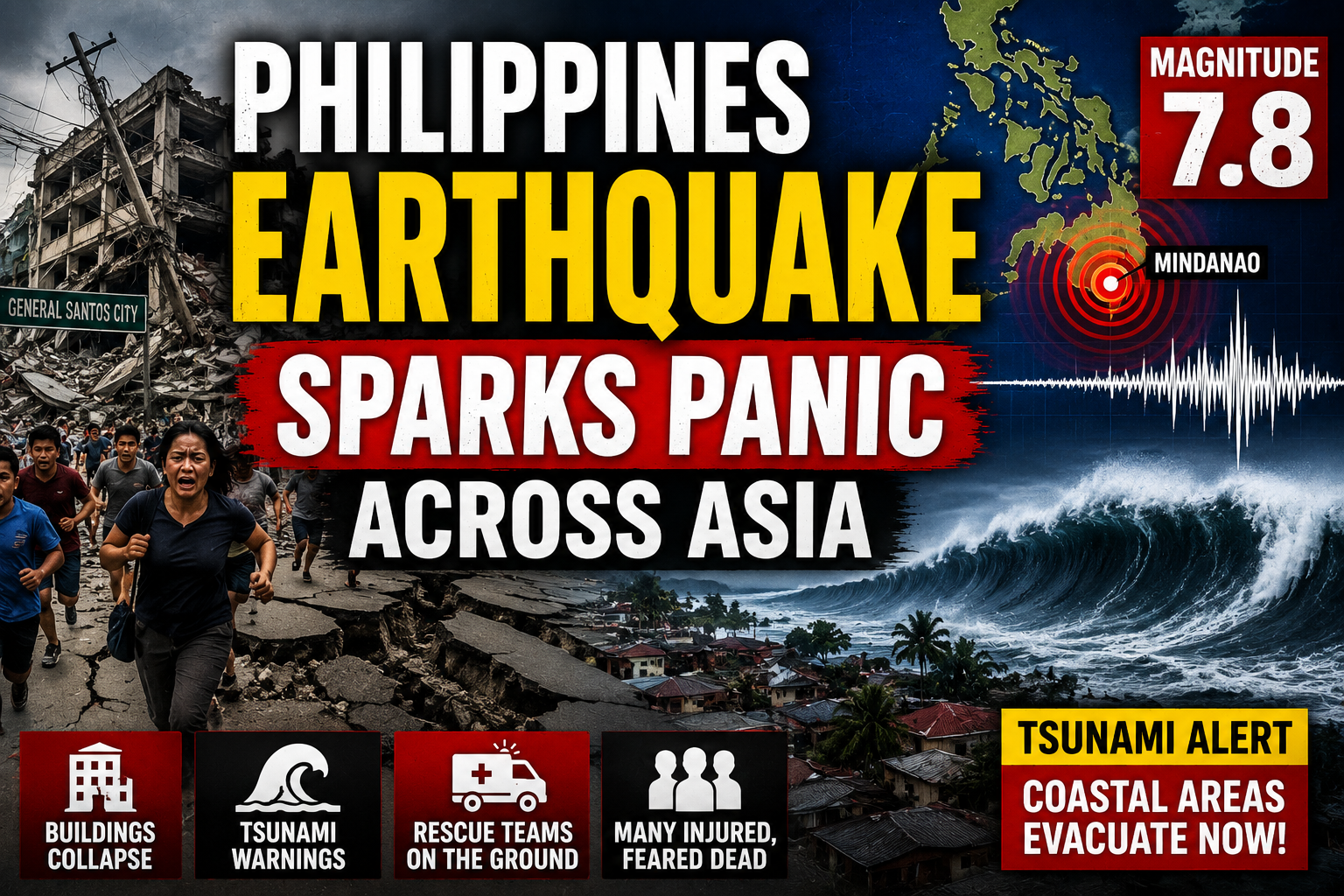
The Philippines was rocked by a massive earthquake that sent residents running into the streets, triggered tsunami warnings across parts of Asia, and raised fears of widespread destruction. As emergency crews rushed to assess the damage, millions of people watched unfolding events with concern, wondering whether the disaster could become one of the deadliest earthquakes the region has seen in recent years.
For a country that sits on one of the most active seismic zones on Earth, earthquakes are a reality of life. Yet even in a nation accustomed to natural disasters, the latest tremor left many residents shaken.
Videos shared online showed frightened families fleeing buildings, office workers evacuating high-rises, and communities gathering in open areas while emergency sirens echoed in the background.
For many people, the terrifying moments felt endless.
The Moment the Ground Began to Shake
Witnesses described a scene of confusion and panic.
People eating breakfast suddenly found the furniture rattling, the walls shaking, and the lights swaying overhead. Office workers abandoned buildings. Students rushed from classrooms. Drivers pulled vehicles to the side of the road.
In some areas, power outages were reported almost immediately.
The strongest shaking was felt across parts of Mindanao, where residents have experienced earthquakes before but said this event felt unusually intense.
Many families feared the worst.
Some grabbed their children and fled their homes without taking any belongings.
Others waited outside long after the shaking stopped, worried that another powerful tremor could follow.
Tsunami Fears Trigger New Panic
The earthquake itself was frightening enough.
Then came the tsunami warnings.
Emergency officials warned coastal residents to move away from beaches and low-lying areas as a precaution.
That announcement created a second wave of anxiety.
Across the Pacific region, governments began monitoring ocean activity while emergency management agencies reviewed evacuation plans.
Although tsunami threats are common following major undersea earthquakes, the possibility of giant waves striking coastal communities remains one of the most terrifying aspects of these disasters.
Many residents remember previous tsunami disasters that claimed thousands of lives.
As a result, warnings are rarely taken lightly.
Why the Philippines Is So Vulnerable
The Philippines experiences more earthquakes than most countries in the world.
The reason is simple geography.
The nation sits on the Pacific Ring of Fire, a massive horseshoe-shaped zone surrounding much of the Pacific Ocean.
This region contains some of the world’s most active volcanoes and fault lines.
Several tectonic plates collide beneath the Philippines.
As pressure builds underground, it is eventually released through earthquakes.
Scientists have long warned that powerful earthquakes are not a question of if but when.
That reality means millions of Filipinos live with the constant possibility of another major seismic event.
The Economic Impact Could Be Massive
While attention initially focuses on casualties and rescue operations, large earthquakes often leave lasting economic scars.
Roads can be damaged.
Bridges may require repairs.
Businesses can be forced to close.
Schools and hospitals sometimes suffer structural damage.
Tourism can also take a hit if travelers become concerned about safety.
For developing regions, recovery costs can be enormous.
Government officials are now working to determine the full financial impact of the disaster.
That process could take weeks or even months.
Social Media Captures the Chaos
As with many modern disasters, social media became one of the primary sources of real-time information.
Videos showing shaking buildings quickly spread across Facebook, TikTok, X, and YouTube.
Some clips gathered millions of views within hours.
People across the world watched ceilings collapse, store shelves empty onto floors, and frightened residents scramble for safety.
The footage offered a powerful reminder of how quickly normal life can be interrupted.
It also demonstrated the growing role social media plays during emergencies.
Information now travels faster than ever.
Unfortunately, misinformation does too.
False Reports Begin Circulating
Almost immediately after the earthquake, misleading posts began appearing online.
Some claimed giant tsunamis were already approaching.
Others exaggerated casualty figures or shared old earthquake footage as if it were connected to the latest event.
Emergency officials urged the public to rely on verified information.
Disasters often create an environment where rumors spread rapidly.
That can make an already dangerous situation even more chaotic.
Authorities continue encouraging residents to follow official updates rather than viral social media claims.
Rescue Teams Race Against Time
For emergency responders, the first 72 hours following a major earthquake are often the most critical.
Every minute matters.
Rescue workers search damaged buildings for survivors.
Medical teams treat injuries.
Emergency shelters provide temporary housing for displaced families.
In many disasters, survival rates decrease dramatically as time passes.
That reality places enormous pressure on first responders.
Across affected areas, rescue personnel are working around the clock to help communities recover.
Could More Earthquakes Follow?
One concern among residents is the possibility of aftershocks.
Major earthquakes are frequently followed by dozens or even hundreds of smaller tremors.
Some aftershocks can be powerful enough to cause additional damage.
Buildings weakened during the initial quake are particularly vulnerable.
Experts continue warning residents to remain alert.
The danger does not necessarily end when the main earthquake stops.
Climate Change Isn’t the Cause But It Can Make Recovery Harder
Whenever major natural disasters occur, discussions about climate change often follow.
Scientists emphasize that earthquakes are not caused by climate change.
They result from tectonic activity beneath the Earth’s surface.
However, climate-related challenges can complicate disaster recovery.
Communities already facing storms, flooding, and infrastructure strain may find it harder to bounce back after a major earthquake.
The combination of multiple risks creates additional challenges for governments and emergency planners.
A Reminder of Nature’s Power
One lesson emerges from every major earthquake.
Human beings remain vulnerable to the forces of nature.
Despite advances in technology, engineering, and forecasting, earthquakes still arrive with little warning.
Entire communities can be transformed within seconds.
Lives can change forever.
Families can lose homes, businesses, and loved ones almost instantly.
That reality explains why earthquakes continue to command global attention.
They remind people how fragile everyday life can be.
The Road to Recovery
The headlines will eventually move on.
The cameras will leave.
Social media will focus on something else.
But for the communities affected by this earthquake, recovery is only beginning.
Families will rebuild homes.
Businesses will reopen.
Schools will repair damage.
Governments will invest in reconstruction.
The process may take months or even years.
Yet history shows that communities often emerge stronger after enduring hardship.
The resilience of the Filipino people has been tested many times before.
It is likely to be tested again.
Final Thoughts
The powerful earthquake that struck the Philippines has once again demonstrated why the country remains one of the world’s most disaster-prone regions.
The shaking may have lasted only moments, but its impact could be felt for years.
As rescue efforts continue and officials assess the damage, attention will remain focused on the affected communities and the challenges that lie ahead.
For now, millions are simply grateful to be alive.
And as aftershocks continue, many are hoping the worst is finally behind them.