
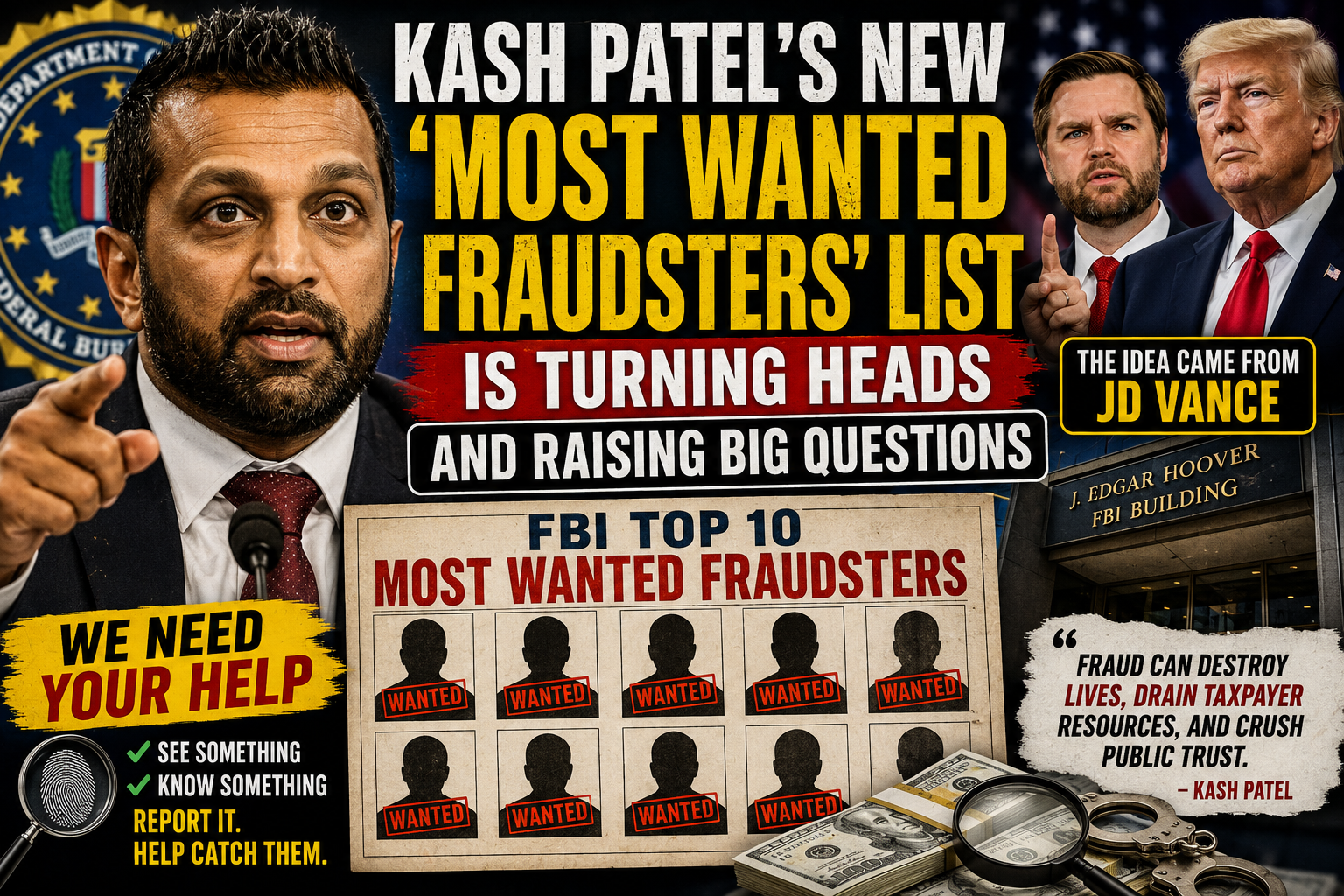
The FBI has long maintained its famous Ten Most Wanted Fugitives list, a tool designed to enlist the public’s help in tracking down some of America’s most dangerous criminals.
Now, FBI Director Kash Patel is taking that concept in a new direction.
This week, Patel unveiled the FBI’s new Top 10 Most Wanted Fraudsters List, a public database targeting individuals accused of massive financial crimes involving tens of millions and, in some cases, billions of dollars. According to Patel, the initiative was inspired by JD Vance and aims to bring greater public attention to large-scale fraud schemes that often receive less attention than violent crime.
But while supporters are celebrating the move as a long-overdue crackdown on white-collar crime, critics are already asking whether the FBI is creating a new crime-fighting tool—or a new political spectacle.
The idea came from JD Vance
During the announcement, Patel revealed that Vice President Vance suggested creating a fraud-focused version of the FBI’s famous Top Ten list.
According to Patel, Vance questioned why the FBI maintained highly publicised lists for terrorists, cartel leaders, murder suspects, and violent fugitives, but not for individuals accused of massive financial fraud.
Patel embraced the idea.
The result is a new public-facing list dedicated specifically to alleged fraudsters accused of causing enormous financial damage across the country.
For an administration that has repeatedly emphasised financial accountability and government fraud investigations, the initiative fits neatly into a broader political message.
Patel’s Message Was Clear
Patel used the announcement to highlight what he sees as the devastating impact of large-scale fraud.
He urged Americans to examine the list and pay attention to the scale of the alleged crimes.
According to Patel, many of the individuals targeted are accused of schemes involving tens of millions or even billions of dollars.
His message was straightforward:
These crimes may not always involve guns or violence, but the damage can be enormous.
Fraud can:
- Destroy retirement savings
- Drain public assistance programs
- Target elderly victims
- Exploit taxpayers
- Undermine public trust
Patel argued that financial criminals often leave behind thousands of victims whose lives are permanently affected.
The FBI Wants the Public Involved
One of the most notable parts of Patel’s remarks was his emphasis on public participation.
The FBI’s traditional Most Wanted program has relied heavily on tips from ordinary citizens for decades. Historically, public tips have helped authorities locate and arrest numerous fugitives on the list.
Patel is hoping to replicate that success with fraud investigations.
“We rely on you,” Patel said. “Our best form of information is the American public.”
The strategy is simple:
Make alleged fraudsters famous enough that someone, somewhere, recognises them.
Why This Is Already Becoming Controversial
On the surface, targeting fraudsters sounds like a policy almost everyone could support.
After all, few Americans are likely to defend large-scale fraud schemes.
Yet the announcement has immediately sparked debate.
Critics Ask: Why Only Ten?
Some observers question how the FBI chooses which alleged fraudsters make the list.
America experiences billions of dollars in fraud losses annually, ranging from healthcare fraud and investment scams to cryptocurrency schemes and international money laundering operations.
Who decides which offenders qualify as the “worst of the worst”?
And what criteria are being used?
These questions could become increasingly important as the list gains attention.
Others See a Political Component
Critics also note that the initiative emerged from a Trump-Vance administration effort focused heavily on fraud enforcement.
Supporters view that as a positive development.
Sceptics wonder whether the list could eventually become intertwined with political messaging.
Any highly publicised government list carries risks:
- Selective enforcement accusations
- Questions about priorities
- Debates over transparency
- Allegations of political influence
The FBI insists the goal is straightforward: identify major fraud suspects and generate leads that help bring them to justice.
Still, controversy often follows any law-enforcement initiative that receives national political attention.
A Shift in How America Thinks About Crime
The most interesting aspect of Patel’s announcement may be what it says about changing crime priorities.
For decades, America’s most famous criminal lists focused primarily on:
- Murderers
- Terrorists
- Organised crime figures
- Drug traffickers
The new fraud list reflects a growing belief that financial crime deserves similar public attention.
Supporters argue that a fraudster who steals hundreds of millions of dollars can damage communities just as severely as many traditional criminals.
The victims may not always make headlines, but the consequences can be devastating.
The Bigger Question
The launch of the Top 10 Most Wanted Fraudsters List raises a larger issue.
Americans often hear about violent crime because it is visible.
Fraud is different.
Many fraud schemes operate quietly for years before they are exposed. Victims often suffer financial ruin without receiving the same public attention as victims of more visible crimes.
Patel appears to be betting that public awareness can change that.
The question is whether a high-profile list will actually help investigators catch criminals—or simply generate headlines.
Conclusion
Kash Patel’s new Top 10 Most Wanted Fraudsters List represents one of the most significant changes to the FBI’s public-facing crime strategy in years.
Supporters see a powerful new tool aimed at exposing criminals who allegedly steal millions and billions of dollars from Americans.
Critics see potential concerns about publicity, priorities, and politics.
Either way, the initiative is already generating discussion across the country.
And that may be exactly what Patel wants.
If the public starts paying as much attention to financial crime as it does to violent crime, the FBI’s newest Most Wanted list could become one of the bureau’s most influential tools—or one of its most controversial.