
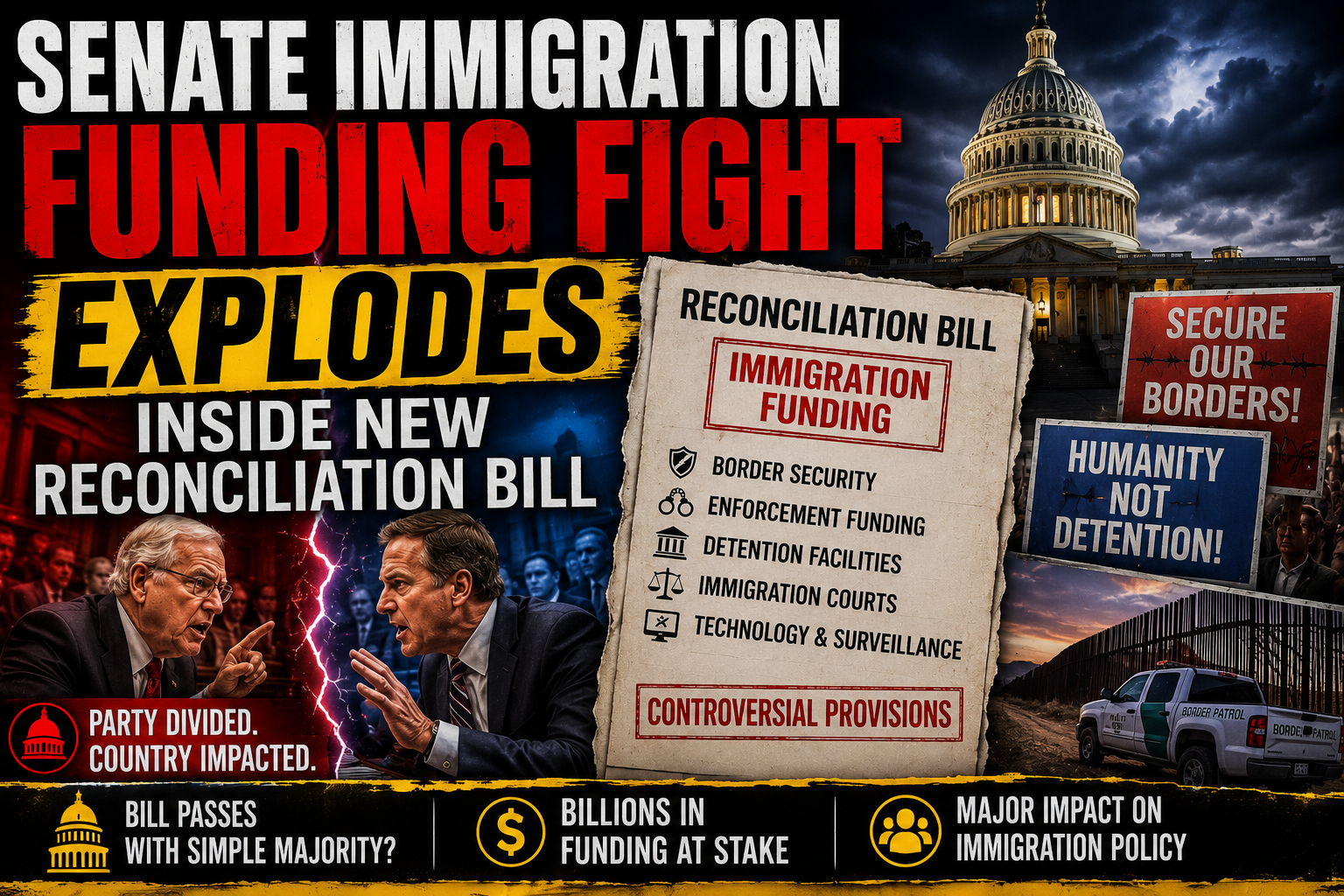
A major political battle is unfolding in Washington as lawmakers clash over immigration funding tied to a new Senate reconciliation bill. What might appear on the surface as a routine budget negotiation has quickly become one of the most contentious policy disputes of the year.
At the center of the debate is how much money should be allocated for immigration enforcement, border security operations, detention capacity, and immigration processing systems, and what those funding decisions signal about the broader direction of U.S. immigration policy.
As negotiations intensify, the reconciliation bill has become a flashpoint for deeper disagreements about border control, humanitarian policy, and federal spending priorities.
What a Reconciliation Bill Actually Means
A reconciliation bill is a powerful legislative tool in the U.S. Senate that allows certain budget-related measures to pass with a simple majority, bypassing the usual 60-vote filibuster threshold.
This makes reconciliation bills especially important for:
- Tax policy changes
- Federal spending adjustments
- Healthcare funding changes
- Immigration enforcement budgets
Because it avoids the filibuster, reconciliation often becomes the battleground for high-stakes political priorities.
In this case, immigration funding has become one of the most controversial elements under negotiation.
Why Immigration Funding Is Central to the Bill
Immigration policy in the United States is heavily dependent on federal funding. The reconciliation bill reportedly includes provisions that could affect:
- Border security infrastructure
- Staffing and operations for immigration enforcement agencies
- Immigration courts and case processing systems
- Detention facility capacity
- Technology and surveillance systems at the border
Supporters of increased funding argue that existing systems are overwhelmed and require modernization and expansion.
Opponents argue that expanding enforcement budgets without broader immigration reform could worsen humanitarian concerns and lead to more aggressive enforcement practices.
The Core Political Divide
The debate over immigration funding in the reconciliation bill reflects a deeper ideological divide in Congress.
Republican Position
Many Republicans argue that:
- Border security is underfunded
- Enforcement agencies lack the necessary resources
- Stronger infrastructure is needed to reduce illegal crossings
- Immigration courts are backlogged and require investment
From this perspective, increased funding is framed as a national security necessity.
Democratic Position
Many Democrats argue that:
- Funding increases should be tied to broader immigration reform
- Overemphasis on enforcement ignores humanitarian concerns
- Detention expansion raises ethical and legal questions
- Resources should also support asylum processing and legal pathways
From this perspective, immigration policy must balance enforcement with due process and humanitarian obligations.
Why Reconciliation Makes This More Controversial
Because the reconciliation process allows legislation to pass without bipartisan agreement, it intensifies political conflict.
This means:
- One party can potentially pass funding changes without opposition support
- Negotiations happen internally within party coalitions
- Moderate lawmakers often become decisive votes
- Policy details are often adjusted behind closed doors
As a result, immigration funding becomes not just a policy issue, but a test of party unity.
What’s at Stake in Immigration Funding
The financial decisions inside the bill could have long-term effects on the U.S. immigration system, including:
1. Border Enforcement Capacity
Increased funding could expand personnel, surveillance, and physical infrastructure along the border.
2. Immigration Court Backlogs
Additional funding may aim to reduce case delays that currently stretch for years in some jurisdictions.
3. Detention System Expansion
Funding could determine the capacity and conditions of detention facilities used during processing.
4. Technology and Data Systems
Modernization efforts may include biometric tracking, digital case management, and expanded monitoring tools.
Each of these areas carries both operational and ethical implications, depending on political perspective.
Internal Senate Negotiations
Inside the Senate, negotiations over reconciliation bills often involve complex trade-offs.
Lawmakers may:
- Exchange support for unrelated provisions
- Adjust funding levels to secure key votes
- Modify enforcement language to align with political concerns
- Delay or accelerate sections of the bill
Because immigration is such a politically sensitive issue, even small changes in funding language can trigger major debate.
Public and Political Reaction
The immigration funding debate has already begun shaping public discourse.
Supporters of increased enforcement funding argue it is essential for:
- National security
- Rule of law enforcement
- Managing border pressure
Critics argue that the approach risks:
- Over-criminalization of migrants
- Insufficient attention to asylum systems
- Expansion of detention infrastructure
- Lack of comprehensive immigration reform
This divide reflects broader national disagreements about immigration policy that have persisted for decades.
Why This Bill Matters Beyond Politics
Even though reconciliation bills are technical budget instruments, their impact is often significant.
This particular debate matters because it could determine:
- The scale of federal immigration enforcement
- The speed of immigration case processing
- The structure of border security operations
- Long-term funding priorities for agencies involved in immigration
In other words, it is not just about dollars—it is about how immigration policy is implemented on the ground.
The Bigger Picture
The immigration funding dispute highlights a recurring challenge in U.S. governance: balancing security, legal process, and humanitarian considerations within a politically divided system.
Reconciliation bills often amplify these tensions because they force decisions into a fast-moving, majority-driven process rather than slower bipartisan negotiation.
As a result, immigration funding becomes a symbolic and practical battleground for competing visions of national policy.
Conclusion
The Senate reconciliation bill’s immigration funding provisions have become one of the most closely watched elements of current U.S. legislative activity.
While supporters view increased funding as necessary to strengthen border enforcement and manage system strain, critics see it as a potential escalation of enforcement-focused policy without broader reform.
As negotiations continue, the final outcome will likely shape U.S. immigration enforcement and policy direction for years to come.