
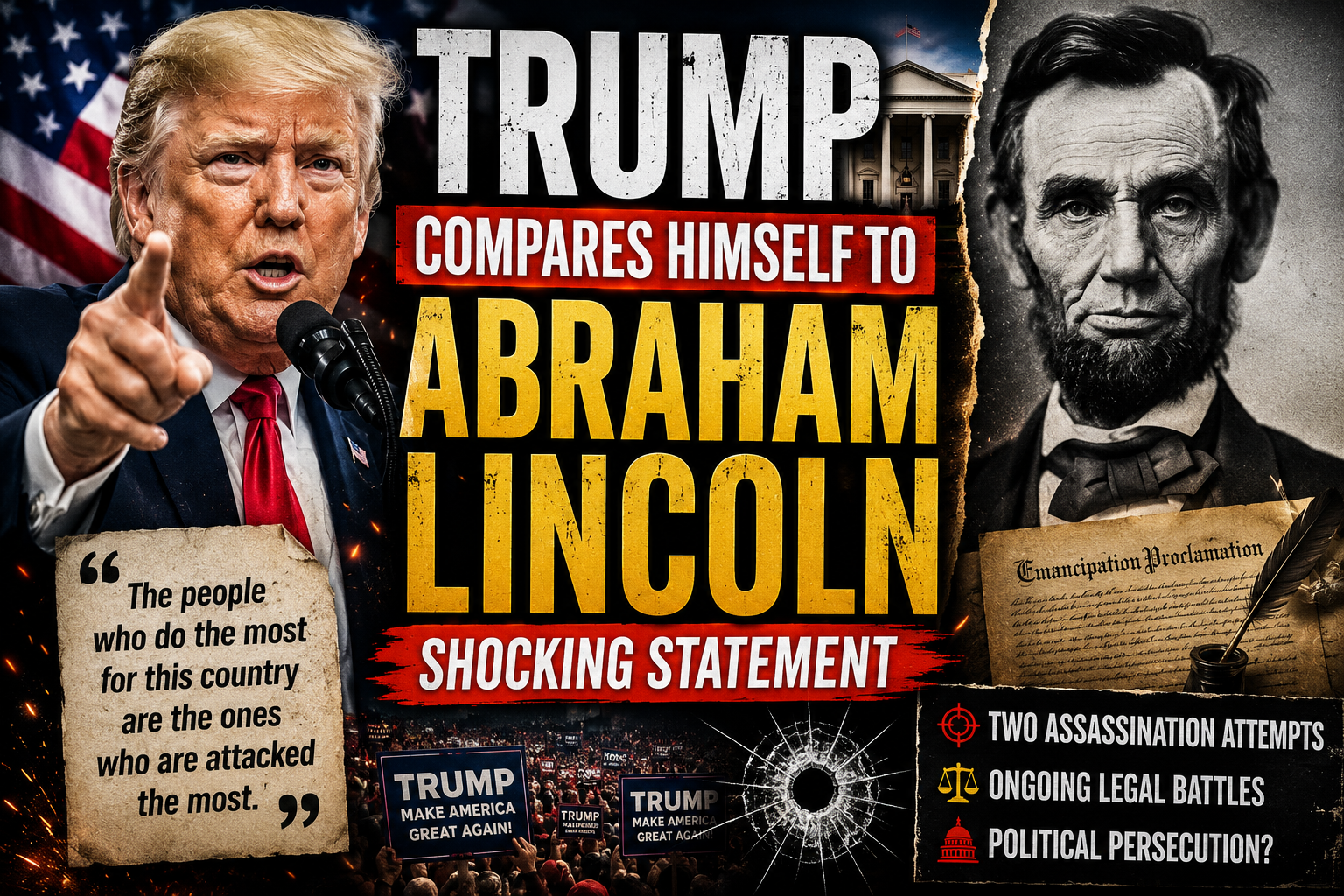
Donald Trump has once again sparked national and historical debate after comparing himself to one of the most iconic figures in American history, Abraham Lincoln.
In a recent statement, the former president suggested that leaders who do the most for the country are often the ones who face the most extreme opposition, including assassination attempts. He tied that idea directly to his own political experience, pointing to threats against his life and ongoing legal battles as evidence of political persecution.
The comparison immediately drew attention because it places Trump in the same narrative frame as Lincoln, a president widely remembered for preserving the United States and ending slavery.
What Trump Actually Said
Trump argued that individuals who make major contributions to the country often become targets.
He referenced:
- Historical patterns of political violence
- Assassinations of major leaders
- His own survival of two assassination attempts
- Ongoing legal and political pressure
From his perspective, these events are not isolated incidents but part of a broader pattern: leaders who challenge the system face the strongest resistance.
He used this framing to suggest that opposition against him is evidence of the impact he has had on American politics.
Why Abraham Lincoln Was Mentioned
Abraham Lincoln is one of the most revered presidents in U.S. history. He led the country through the Civil War and played a central role in ending slavery with the Emancipation Proclamation and the 13th Amendment.
Lincoln was assassinated in 1865 by John Wilkes Booth shortly after the Civil War ended.
By invoking Lincoln, Trump is drawing a direct parallel between:
- Political resistance during times of national division
- Personal risk faced by leaders
- The idea of being targeted for doing “important work.”
This comparison is powerful politically—but also highly controversial.
The Historical Pushback
Many historians and political analysts argue that the comparison is a significant stretch.
The key difference lies in scale and historical context:
- Lincoln’s presidency involved preserving the Union during the Civil War
- He permanently ended legal slavery in the United States
- His assassination occurred during one of the most unstable periods in U.S. history
Trump’s presidency and political career, while highly influential and polarizing, operate in a very different constitutional and historical context.
Because of this, critics argue that equating modern political conflict with Lincoln’s era oversimplifies both history and current events.
The Political Strategy Behind the Statement
Regardless of historical accuracy, the statement reflects a familiar political strategy used by Trump throughout his career: framing himself as a figure under siege.
This narrative includes:
- Claims of political persecution
- Emphasis on legal investigations and indictments
- Highlighting threats and assassination attempts
- Positioning opposition as resistance to change
For supporters, this reinforces the idea that Trump is an outsider challenging a powerful system. For critics, it is seen as an attempt to reframe legal and political accountability as persecution.
Why This Message Resonates With Supporters
Trump’s core base is unlikely to interpret his comparison to Lincoln literally.
Instead, it functions symbolically:
- It reinforces a sense of struggle against powerful institutions
- It connects modern political conflict to historical patriotism
- It strengthens the idea of Trump as a transformative figure
This type of messaging has historically proven effective in strengthening political identity among supporters.
Critics Say the Comparison Goes Too Far
Opponents argue that invoking Abraham Lincoln in this context risks:
- Distorting historical significance
- Minimizing the gravity of Lincoln’s era
- Inflaming political tensions
- Oversimplifying modern legal and political processes
They also point out that surviving assassination attempts or facing legal scrutiny does not necessarily equate to historical legacy or moral equivalence.
The Bigger Picture
This moment highlights a single quote, but it highlights how modern political actors shape their narratives in America.
In today’s media environment:
- Historical references are often used as rhetorical tools
- Political figures increasingly frame themselves in legacy terms
- Public perception is heavily influenced by viral interpretations
Trump’s comparison to Lincoln fits into a broader pattern of political messaging that blends history, identity, and personal narrative.
Conclusion
Donald Trump’s comparison of himself to Abraham Lincoln has reignited debate about political rhetoric, historical memory, and personal legacy.
Supporters see it as a reflection of resilience under pressure. Critics see it as an exaggerated and historically inappropriate comparison.
Either way, the statement highlights how political storytelling deeply shapes how the public perceives reality, and how modern political actors weaponize historical figures in today’s battles.