
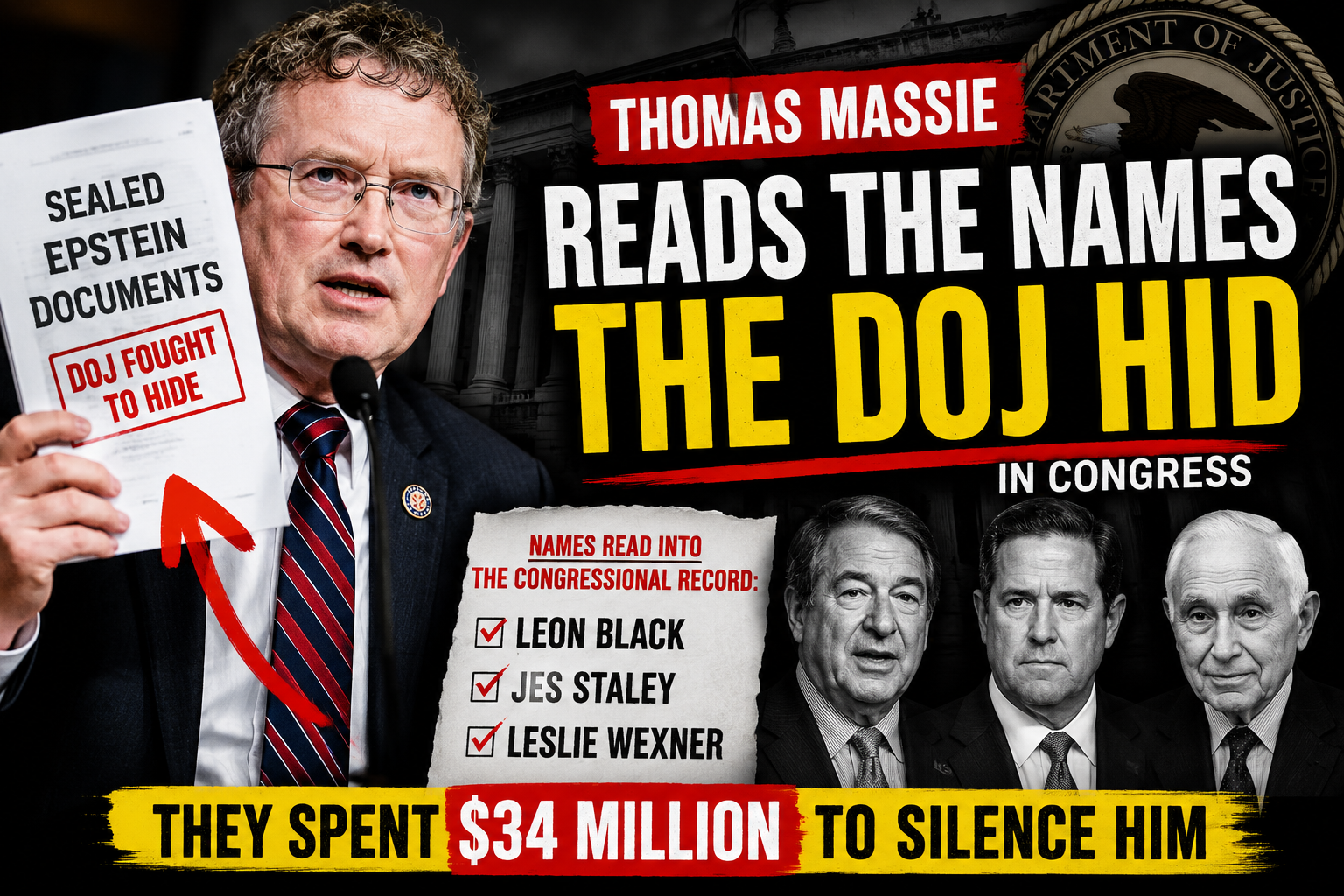
When Kentucky Congressman Thomas Massie stepped onto the House floor, few expected what would happen next.
Just days after suffering a crushing political defeat in one of the most expensive House primaries in American history, Massie allegedly used one of the Constitution’s most powerful legal protections to publicly name individuals connected to sealed Jeffrey Epstein-related court documents.
According to viral claims spreading across social media, Massie invoked the Speech or Debate Clause of the U.S. Constitution and read names that the Department of Justice had fought to keep hidden from the public.
Among the names mentioned were billionaire financier Leon Black, former Barclays CEO Jes Staley, and Leslie Wexner, the retail magnate long associated with Epstein.
The story exploded online almost instantly.
Supporters hailed Massie as a politician finally willing to confront powerful elites. Critics questioned whether the claims were exaggerated, politically motivated, or missing important legal context.
Either way, the incident reignited public anger surrounding the Jeffrey Epstein scandal and the long-running accusations that wealthy and influential individuals have been shielded from accountability.
The Speech or Debate Clause Explained
At the center of this controversy is a constitutional protection most Americans rarely hear about.
Article I, Section 6 of the United States Constitution contains what is known as the Speech or Debate Clause. The clause protects members of Congress from being sued or prosecuted over statements made during official legislative proceedings.
In practical terms, it means lawmakers can speak freely on the House or Senate floor without fear of civil lawsuits or criminal liability tied to those remarks.
That protection exists for a reason. The Founding Fathers wanted Congress to operate independently from outside pressure, especially from powerful political or financial interests.
Supporters of Massie argue that this constitutional shield gave him the ability to publicly read names connected to sealed or controversial records without fear of retaliation.
The moment immediately drew comparisons to past congressional bombshells where lawmakers used floor speeches to disclose sensitive information that would normally carry legal risks outside Congress.
The Epstein Files Continue to Haunt Powerful Figures
The shadow of Jeffrey Epstein continues to stretch across politics, finance, media, and global business networks years after his death.
Epstein’s connections to influential individuals have fueled endless speculation, investigations, and public outrage. Court documents, flight logs, private emails, and testimony from victims have repeatedly revealed how deeply connected Epstein was to some of the world’s wealthiest and most powerful figures.
However, an important distinction often gets lost online: appearing in court documents or having associations with Epstein does not automatically imply criminal conduct.
Still, many Americans believe the full truth about Epstein’s network has never been revealed.
That belief intensified after years of sealed court battles involving the Department of Justice, private litigants, journalists, and victims seeking access to records connected to Epstein’s activities.
When names tied to these documents surface publicly, they instantly trigger global attention.
Leon Black and the Apollo Connection
One of the most high-profile names allegedly mentioned by Massie was Leon Black.
Black, the billionaire co-founder of Apollo Global Management, previously admitted to paying Epstein millions of dollars for financial and tax-related advice.
A 2021 independent review commissioned by Apollo found that Black paid Epstein approximately $158 million over several years. Black has maintained that he was unaware of Epstein’s criminal conduct during much of their relationship.
The revelations damaged his reputation and ultimately led to his departure from Apollo.
Even though no criminal charges were filed against Black in connection with Epstein, his association with the disgraced financier became one of the most controversial corporate scandals on Wall Street.
Jes Staley’s Long-Running Epstein Controversy
Another name reportedly read into the Congressional Record was Jes Staley.
Staley has faced years of scrutiny over his relationship with Epstein, particularly during his time at JPMorgan Chase.
Court filings and internal communications revealed extensive contact between the two men over many years. Some emails released during litigation sparked intense media attention and raised questions about what Staley knew regarding Epstein’s activities.
Staley has repeatedly denied knowledge of Epstein’s crimes.
Nevertheless, investigations and lawsuits involving JPMorgan and Epstein-related victims placed Staley at the center of one of the largest financial controversies tied to the Epstein network.
Leslie Wexner’s Role in Epstein’s Rise
Perhaps no relationship in the Epstein saga has drawn more fascination than the connection between Epstein and Leslie Wexner.
Wexner, the billionaire behind L Brands, played a major role in Epstein’s early rise to extraordinary wealth and influence.
For years, Epstein managed Wexner’s finances and gained access to immense resources, luxury properties, and elite social circles through that relationship.
Critics have long questioned how Epstein obtained such unusual power despite lacking a traditional financial background.
Wexner has publicly stated that Epstein misappropriated money from him and that he severed ties once concerns emerged. Still, the relationship remains one of the most scrutinized elements of the Epstein story.
Why This Story Went Viral
The viral reaction to Massie’s alleged floor speech reflects a growing distrust of institutions across the political spectrum.
Many Americans believe powerful people operate under a different set of rules than ordinary citizens. The Epstein scandal became a symbol of that frustration because of the enormous number of elite figures connected to Epstein over the years.
Every new document release, court filing, or leaked testimony sparks renewed speculation that major information is still being hidden.
Social media amplified the narrative even further by framing Massie as a lone politician willing to expose names the government supposedly wanted buried.
Phrases like “they spent $34 million trying to silence him” spread rapidly across X, TikTok, YouTube, and alternative media platforms.
Whether entirely accurate or partially exaggerated, the emotional power of the narrative resonated with millions already skeptical of government transparency.
Did the DOJ Really Try to Hide These Names?
This is where the story becomes more complicated.
The Department of Justice has been involved in multiple legal disputes connected to Epstein records, but not every sealed document exists because authorities were “protecting elites.”
In many cases, records are sealed temporarily due to ongoing investigations, privacy concerns, victim protection, or procedural court rules.
Some documents involving Epstein have eventually become public through civil litigation and court orders.
That distinction matters because online narratives often collapse years of separate lawsuits, investigations, and court battles into one simplified storyline.
Still, critics argue that the pace and handling of Epstein-related disclosures have fueled suspicions that influential individuals received special treatment.
Thomas Massie’s Political Fallout
Thomas Massie has long been viewed as one of Congress’s most independent and controversial lawmakers.
Known for clashing with both Democrats and Republicans, Massie built a reputation as a libertarian-minded politician willing to challenge party leadership.
His political battles intensified in recent years, particularly over government spending, surveillance, foreign policy, and internal Republican conflicts.
The claim that he had “nothing left to lose” after his election defeat became central to the viral narrative surrounding the speech.
Supporters portrayed him as a politician finally freed from political pressure. Opponents argued the timing raised questions about political motives and attention-seeking behavior.
Regardless of perspective, the controversy ensured that Massie’s name dominated online political discussions once again.
The Bigger Question Americans Keep Asking
Beyond the specific names involved, the larger issue remains public trust.
Why do so many Americans believe critical information about Epstein’s network remains hidden?
Part of the answer lies in the sheer scale of Epstein’s connections. Presidents, royalty, billionaires, academics, celebrities, and corporate executives all appeared within his orbit at different times.
Another factor is Epstein’s death itself, which continues to generate endless speculation online.
Combined with sealed records, delayed disclosures, and years of media coverage, the entire case became fertile ground for conspiracy theories, political narratives, and public anger.
For many people, every new revelation feels less like closure and more like proof that deeper secrets remain buried.
Final Thoughts
The claims surrounding Thomas Massie and the alleged reading of Epstein-linked names into the Congressional Record have reignited one of America’s most explosive unresolved scandals.
Whether viewed as an act of courage, political theater, or constitutional defiance, the moment tapped into widespread frustration over elite accountability and government transparency.
What remains undeniable is this: the Epstein story still has enormous power over the public imagination.
Years after his death, Jeffrey Epstein continues to cast a shadow over institutions, corporations, and political systems worldwide.
And every time another name surfaces, the public debate begins all over again.