
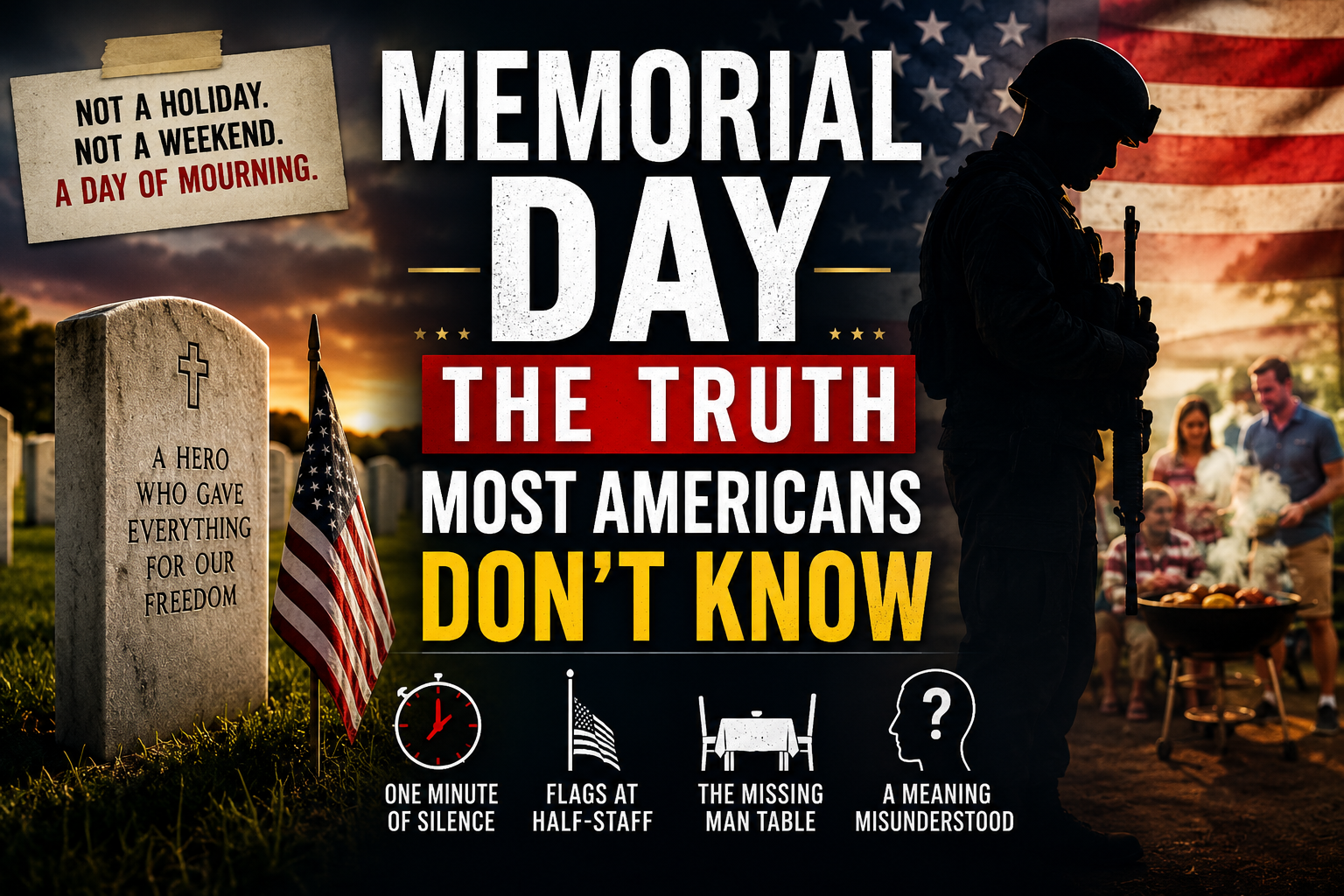
Every year, America pauses for one day that is supposed to mean everything, and somehow, it still gets misunderstood by millions.
Memorial Day is not just a long weekend.
>It is not just the unofficial start of summer.
>It is not just barbecue sales, road trips, and discounts.
It is the nation’s official day of mourning for the men and women who never came home from war.
And yet, if you ask what Memorial Day means to many Americans, the answers reveal something uncomfortable:
Most don’t actually know.
The Moment America Was Supposed to Stop Everything
In 2000, Congress created a tradition called the National Moment of Remembrance, asking Americans to pause at 3:00 p.m. local time for one minute of silence.
It sounds simple.
But studies and public surveys over the years have shown a harsh reality: many people don’t know it exists or what it represents.
At its core, that moment was meant to interrupt the noise of the holiday:
- The cookouts
- The travel rush
- The retail sales
- The beach trips
And replace it with something uncomfortable but necessary: silence for the dead.
Yet even that moment often passes unnoticed.
U.S Flags at Half-Staff: A Symbol Most People Never Understand
One of the most visually striking traditions happens in silence across the country.
On Memorial Day:
- The American flag is raised to full height at sunrise
- Then lowered to half-staff until noon
- Then raised again to full staff for the rest of the day
This is not decoration.
It is symbolism:
- Morning = national mourning
- Afternoon = resilience and survival
As reported in the flag protocol guidance, the practice is intentional: grief first, then continuation of national life.
Most people see the flags.
Very few understand the meaning behind their movement.
What Memorial Day Actually Is (And What It Is Not)
Memorial Day originated after the Civil War and was originally called Decoration Day, when communities would literally decorate the graves of fallen soldiers with flowers and flags.
Over time, it evolved into a federal holiday in 1971.
But here is where confusion still dominates public understanding:
- Memorial Day is NOT for all veterans
- It is NOT a celebration of military service
- It is ONLY for those who died in military service
Veterans Day honors living and dead service members.
Memorial Day is exclusively for the fallen.
That distinction is often lost in modern culture.
The Graveyards That Become America’s Quietest Crowds
Across the country, every Memorial Day, cemeteries become some of the most visited places in America.
At Arlington National Cemetery and hundreds of others, the scenes are striking:
- Rows of identical white headstones
- Families placing flags and flowers
- Military honor guards performing volleys
- Moments of silence broken only by the wind
In Houston, over 124,000 veterans are buried in just one cemetery complex alone, making it one of the largest in the nation.
And yet, outside these spaces, life continues almost normally.
That contrast is part of what makes the day so emotionally divided.
The Missing Man Table: The Most Powerful Symbol You Probably Haven’t Seen
In military ceremonies, there is a haunting tradition known as the Missing Man Table.
It is a small table set for one:
- A single empty chair
- A white cloth
- A black napkin for sorrow
- A lemon for bitterness
- An inverted glass
Each item represents those who never returned home.
It is one of the most emotionally powerful rituals in U.S. military culture—and yet most civilians have never seen it, even on Memorial Day itself.
The Uncomfortable Truth: Most Americans Misunderstand the Holiday
Here is where things become controversial.
A Gallup poll cited in discussions about the National Moment of Remembrance found that only a small portion of Americans correctly identified Memorial Day’s purpose when asked.
In other words:
- A large share of the country associates it with leisure, not loss
- The original meaning competes with consumer culture
- The emotional weight of the day is often overshadowed by “summer kickoff” branding
That tension has become one of the most debated cultural shifts in modern America.
The Debate No One Agrees On
Every year, a quiet argument resurfaces:
Should Memorial Day remain sacred?
Or has it already become something else?
One side argues:
“You cannot separate remembrance from modern life. People will always celebrate the day differently.”
The other insists:
“If the meaning is lost, so is the sacrifice behind it.”
Even recent commentary and opinion pieces have gone further, suggesting America risks forgetting not just the individuals who died, but the cost of war itself.
A Growing Global Conversation About War and Memory
Interestingly, Memorial Day has inspired broader global discussions about how societies remember conflict.
Some scholars argue that modern memorial culture focuses heavily on military sacrifice while often overlooking civilian casualties in wars across the world.
This has led to calls in academic and policy spaces for expanded forms of remembrance, not to replace Memorial Day, but to broaden its moral scope.
The Real Question Memorial Day Leaves Behind
At its heart, Memorial Day is not really about history.
It is about memory.
And memory is fragile.
Because every generation that grows up associating this day with:
- sales
- vacations
- parties
- and social media posts
moves one step further away from the reason it exists at all.
So the uncomfortable question remains:
When a nation forgets what it is remembering… does the remembrance still matter?
Final Thought
Memorial Day is one of the few national holidays built entirely on loss.
There are no gifts.
No fireworks by design.
No celebration in its original intent.
Only silence, flags, and names carved into stone.
And perhaps the most important truth is this:
Freedom is not just inherited; it is paid for.
Every year.
Every generation.
In ways most people never see.