
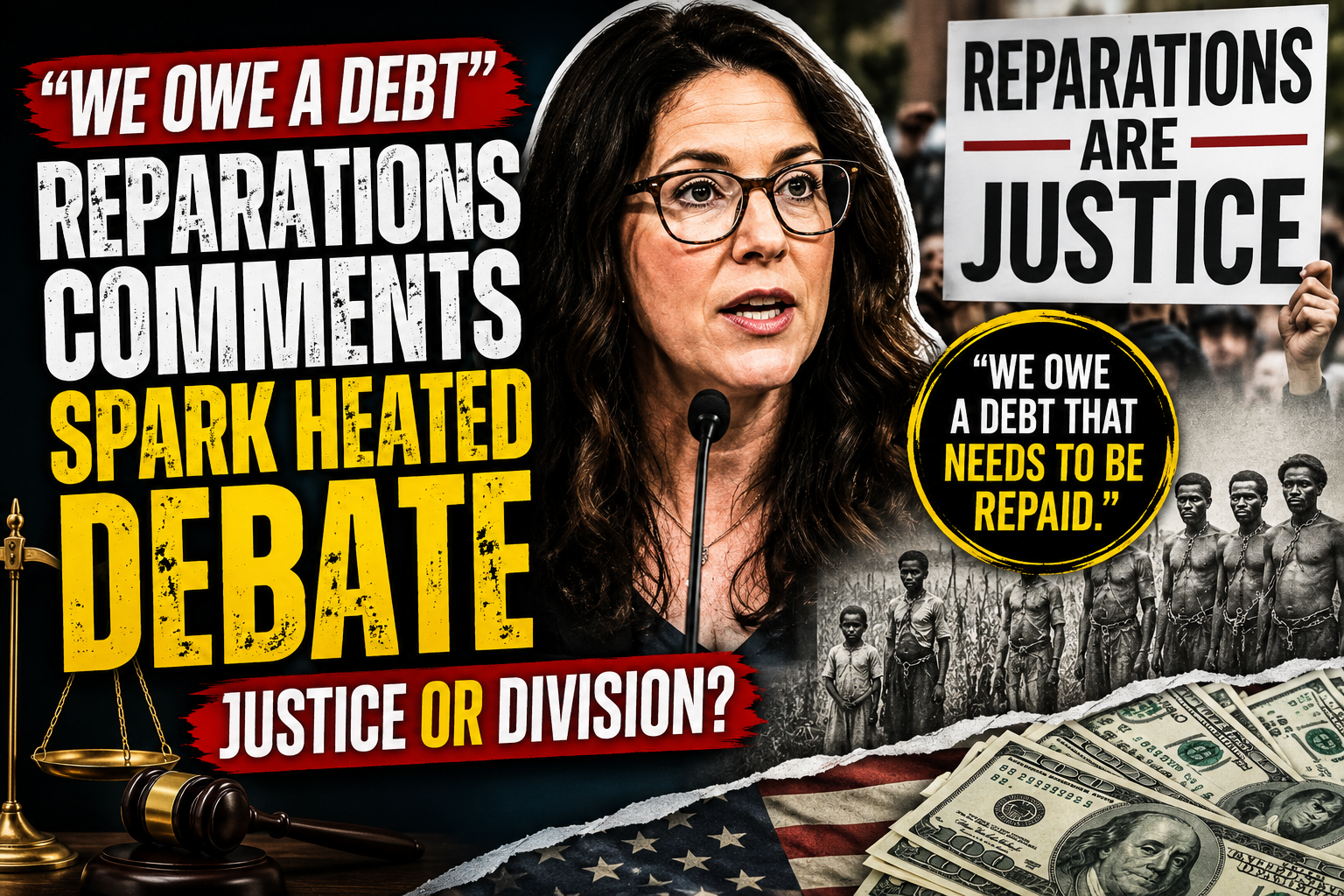
A fresh debate over reparations has erupted online after Naomi Scheman argued that reparations should be viewed as a matter of justice, not charity.
Her remarks quickly spread across social media, triggering intense reactions from both supporters and critics as Americans once again found themselves divided over one of the country’s most controversial issues.
At the center of the discussion is a powerful and emotionally charged claim:
That white Americans continue to benefit from systems built on the historical exploitation and discrimination of Black Americans, even if their families arrived in the United States long after slavery ended.
And according to Scheman, that creates what she described as a debt that still needs to be repaid.
“We Owe a Debt That Needs to Be Repaid”
During her testimony and public remarks, Scheman argued that the effects of slavery and systemic discrimination did not simply disappear after abolition or the civil rights movement.
Instead, she claimed many modern systems and institutions still reflect inequalities created generations ago.
According to Scheman, white Americans continue benefiting “in ways large and small” from advantages tied to those historic structures.
Her argument focused on the idea that reparations are not about guilt for actions personally committed by modern individuals, but rather about addressing systems and economic realities that continue to produce unequal outcomes today.
That distinction became one of the biggest talking points online.
Supporters praised her framing of reparations as accountability and justice rather than charity or sympathy.
Critics, however, strongly rejected the idea of collective responsibility for historical wrongs.
The Internet Immediately Exploded
As clips and quotes from Scheman’s comments circulated online, reactions became intense almost instantly.
Some users applauded the conversation around historical accountability, wealth inequality, and institutional discrimination.
Others argued that modern Americans should not be held financially or morally responsible for actions committed by previous generations.
The debate quickly spread across:
- X/Twitter,
- Facebook,
- TikTok,
- YouTube,
- and political discussion forums.
For many people, the issue touches on more in-depth questions about race, identity, fairness, and the role history should play in shaping present-day policy.
That is why reparations remain one of the most emotionally divisive topics in American politics.
What Supporters of Reparations Believe
Supporters of reparations argue that the economic consequences of slavery and segregation still exist today.
Many point to:
- racial wealth gaps,
- housing discrimination,
- unequal educational opportunities,
- and generational economic disadvantages.
They argue that centuries of forced labor and discriminatory policies created lasting barriers that cannot simply be ignored.
Some advocates believe reparations could include:
- direct financial payments,
- educational investment,
- housing assistance,
- business funding,
- or broader economic programs aimed at historically disadvantaged communities.
Scheman also connected her views to Black-led economic initiatives and community-building efforts.
She described those efforts as part of building what Martin Luther King Jr. once called the “beloved community”, a society without unjust systems of power dividing people.
That phrase became another major talking point online after her remarks began trending.
Critics Strongly Push Back
Critics of reparations argue that modern individuals should not be blamed for actions they did not personally commit.
Some also argue that many immigrant families arrived in America long after slavery ended and struggled economically themselves.
Others question how reparations would be calculated, funded, or distributed fairly.
Opponents additionally warn that reparations discussions could deepen racial divisions rather than heal them.
Online critics especially focused on Scheman’s argument that white Americans continue benefiting from historical systems regardless of personal family history.
That statement became one of the most controversial parts of the debate.
Why Reparations Remain So Politically Explosive
The reparations debate has existed in America for decades, but it continues to become more visible in modern political and academic discussions.
Part of the reason is simple:
The conversation combines history, economics, race, morality, and politics all at once.
Very few issues generate stronger emotional reactions.
For supporters, reparations represent acknowledgment of historic injustice and an attempt to address long-term inequality.
For critics, the idea raises concerns about fairness, personal responsibility, and social division.
That clash guarantees intense public reactions every time the subject returns to national attention.
Social Media Is Fueling the Debate
Modern political debates rarely stay inside universities or government hearings anymore.
Instead, they explode online almost immediately.
Short clips, emotional quotes, and viral reactions now shape public conversations faster than traditional media ever could.
That is precisely what happened here.
Within hours, Scheman’s comments were being reposted across social platforms with millions of views and thousands of arguments unfolding in comment sections.
Some users praised her honesty.
Others accused the argument of unfairly targeting people based on race.
And as expected, the internet quickly split into opposing camps.
The Debate Is Far From Over
Whether people agree or disagree with Scheman’s views, one thing is obvious:
The reparations conversation is not disappearing anytime soon.
Questions surrounding historical injustice, systemic inequality, race, and economic opportunity continue shaping political discussions across the United States.
And every time a public figure makes strong comments on the issue, the debate reignites all over again.
For now, Naomi Scheman’s remarks have once again forced Americans into one of the country’s most uncomfortable and divisive conversations:
What does justice for historical injustice actually look like in modern America?