
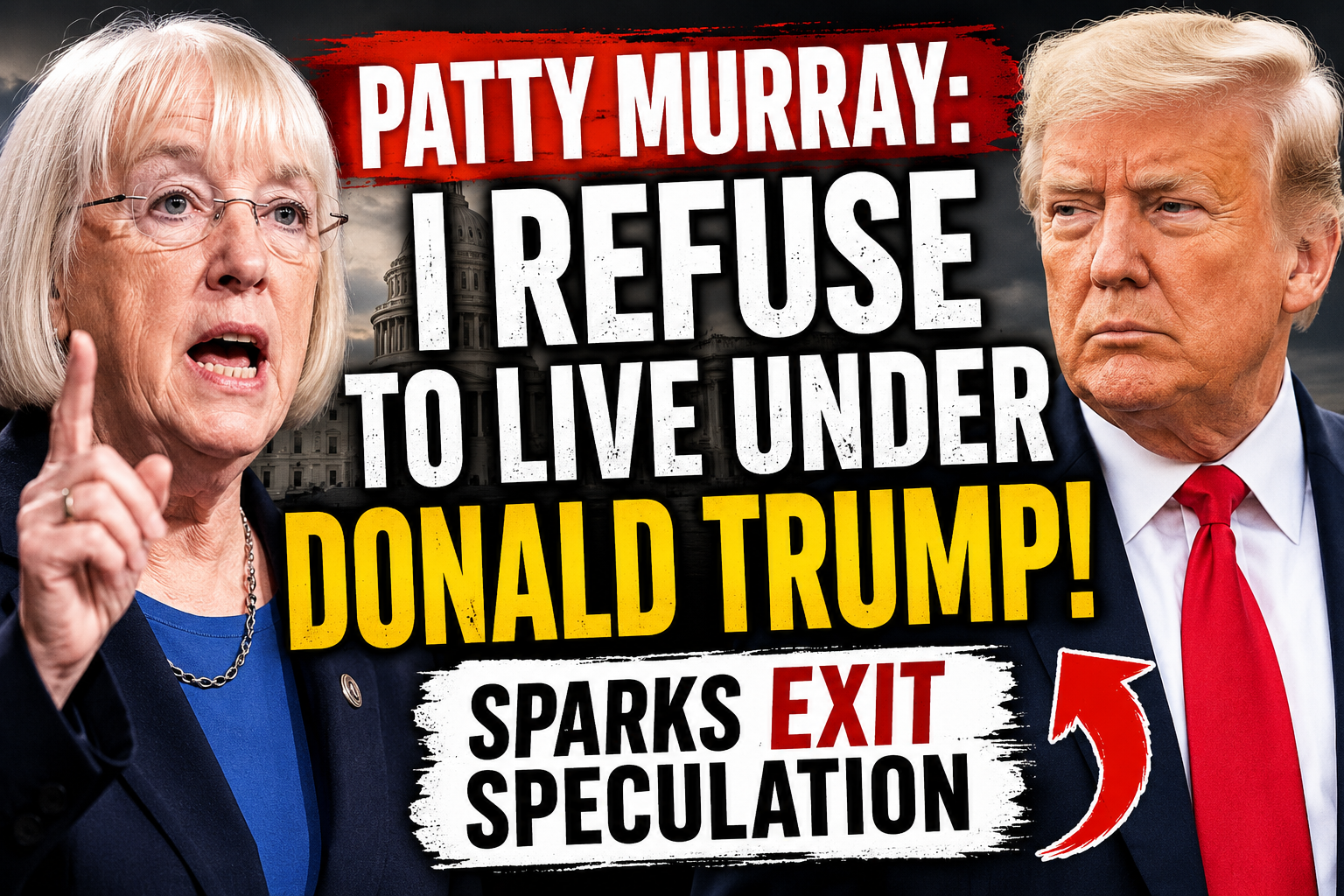
A political firestorm has erupted online after remarks attributed to U.S. Senator Patty Murray criticizing former President Donald Trump went viral across social media platforms, triggering widespread debate about free speech, executive power, and the direction of American democracy.
The controversy centers around a statement in which Senator Murray allegedly condemned what she described as the misuse of federal authority to pressure media voices. In her remarks, she said: “I refuse to live in a country where a crooked president can illegally use the force of the federal government to push a talk show host off the air.”
While the quote has circulated widely, it has also sparked intense scrutiny, as many question its context, intent, and online interpretation.
A Statement That Instantly Went Viral
Within hours of circulating on social media, Murray’s comments were amplified across political pages, news aggregators, and partisan discussion forums. The wording of the statement, particularly the phrase “I refuse to live in a country,” quickly became the focal point of speculation.
Some users interpreted the statement as emotional political rhetoric, while others went further, suggesting it could indicate deeper dissatisfaction with the current political climate or even hint at stepping back from public life if Donald Trump regains or maintains influence in U.S. politics.
However, at this time, there is no official evidence or announcement suggesting that Senator Murray intends to resign from office, relocate, or leave the country.
No Confirmation of Exit Plans or Resignation
Despite viral interpretations, political records and public statements from Senator Murray’s office do not indicate any intention to resign from the Senate or abandon her political role.
Analysts note that in highly polarized political environments, observers often interpret strongly worded statements beyond their literal meaning. Speakers commonly use the phrase “I refuse to live in a country where…” in political speech to provide moral or rhetorical emphasis rather than to declare a literal departure.
Still, the ambiguity of the language has fueled speculation online, where fragments of quotes often circulate without full context.
Trump, Media Power, and Ongoing Political Tensions
At the center of the controversy is the broader political tension surrounding Donald Trump and ongoing debates about his relationship with the media.
Critics of Trump argue that his political rhetoric has, at times, contributed to hostility toward journalists and media institutions. They point to previous conflicts between his administration and major news organizations as evidence of a broader pattern of pressure or antagonism.
Supporters, however, strongly reject these claims, arguing that a biased media has consistently targeted Trump and that political motives, rather than facts, drive these criticisms. This divide has created a highly charged environment where observers often interpret statements about media freedom and government authority through partisan lenses.
Free Speech Concerns at the Heart of the Debate
Beyond the personalities involved, the controversy highlights a deeper constitutional and philosophical issue in American politics: the balance between government authority and freedom of expression.
The United States has long positioned itself as a global leader in protecting free speech and press independence.
However, recent political disputes have increasingly raised questions about how authorities apply those protections in practice.
Supporters of Senator Murray’s position argue that elected officials have a responsibility to speak out against perceived abuses of power, especially when media independence is at stake.
Critics counter that such statements risk escalating distrust in institutions and may exaggerate or misrepresent the scope of governmental action.
Social Media Reaction: Divided and Intensified
As with many modern political controversies, social media played a central role in amplifying the story.
On one side, users praised Murray for what they described as a “bold stand against authoritarian behavior,” framing her remarks as a defense of democratic values and press freedom.
On the other side, critics accused her of using inflammatory language and contributing to political polarization. Some users dismissed the comments as political theater, arguing that they were designed to energize partisan audiences rather than reflect policy reality.
The result was a rapid escalation of interpretations, with the original statement often detached from its broader context.
Is This a Turning Point or Political Rhetoric?
Political analysts suggest that incidents like this are increasingly common in the current media ecosystem, where short clips and quotes spread faster than full transcripts or verified context.
In this case, the key question is not only what was said, but how it is being interpreted.
Without official clarification indicating any resignation intent or policy shift, most experts view the situation as an example of heightened rhetorical conflict rather than a literal political development.
Still, the intensity of the reaction demonstrates how sensitive U.S. political discourse has become, particularly when it involves figures like Donald Trump and senior members of Congress.
Conclusion
For now, the controversy surrounding Senator Patty Murray remains rooted in interpretation rather than confirmed action.
No resignation has been announced. No departure plans have been confirmed. And no official statements suggest she intends to leave her position or the country.
What remains clear, however, is that her remarks have reignited an ongoing national debate about political accountability, media freedom, and the increasingly volatile nature of American political communication.
As the story continues to circulate online, it serves as another reminder of how quickly political statements can evolve into national speculation in the digital age.