
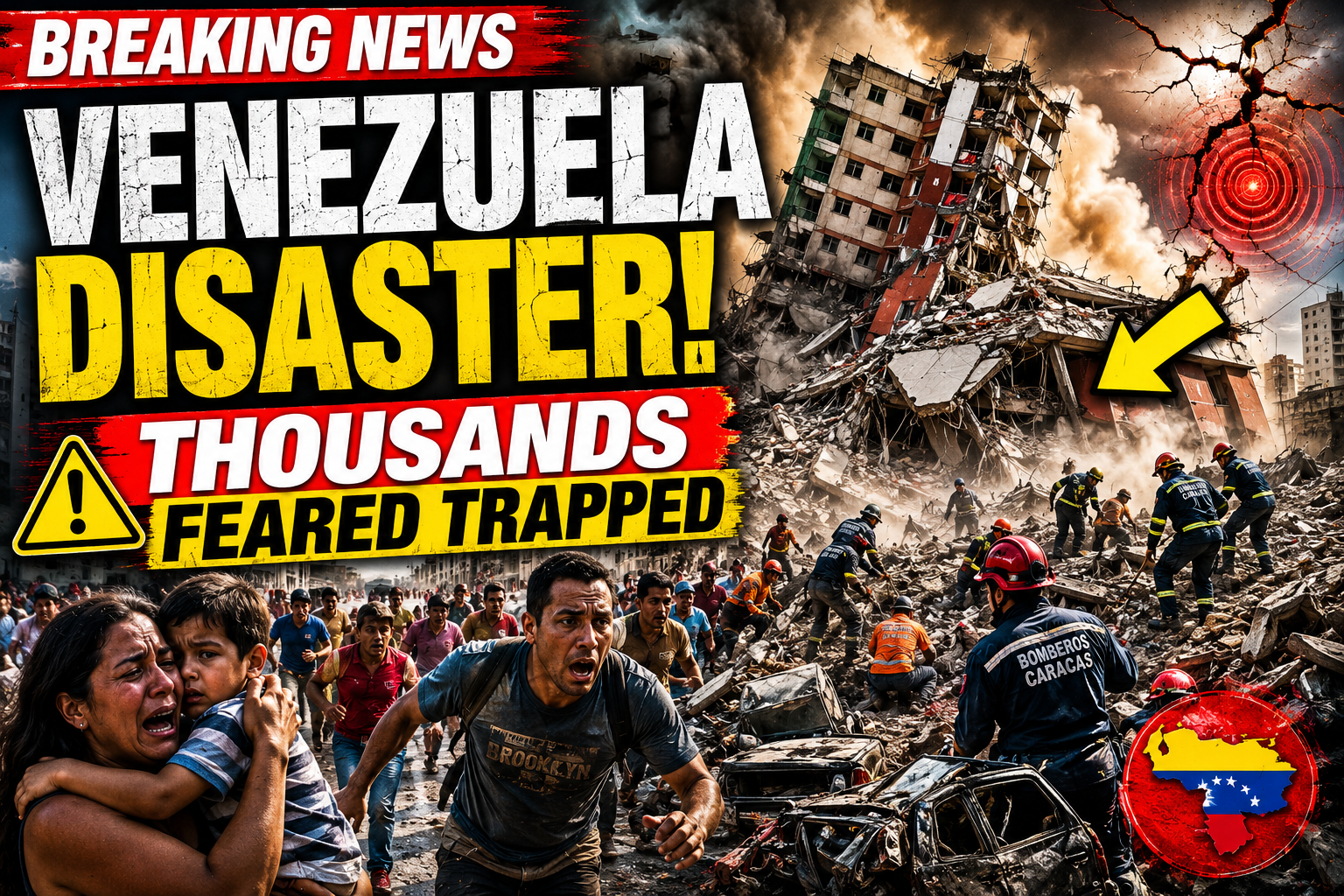
Venezuela is facing one of its worst natural disasters in decades after two powerful earthquakes struck the country within moments of each other, leaving dozens dead, hundreds injured, and thousands of families fearing for loved ones who remain missing.
The devastating twin earthquakes sent shockwaves across northern Venezuela, causing buildings to collapse, damaging critical infrastructure, and triggering panic in cities and towns throughout the region. Emergency crews continue working around the clock as authorities attempt to determine the full scale of the disaster.
While official casualty figures continue to evolve, the tragedy has already become one of the most significant seismic events in Venezuela’s recent history.
Twin Earthquakes Strike Without Warning
According to reports from international monitoring agencies, the disaster began when a powerful earthquake measuring approximately 7.2 magnitude struck western areas near the Venezuelan coast.
Less than a minute later, a second and even stronger quake measuring 7.5 magnitude hit nearby, dramatically increasing the destruction and complicating rescue efforts.
Residents described terrifying scenes as buildings swayed violently and streets filled with frightened people attempting to reach open areas.
In Caracas, the nation’s capital, office workers, families, and visitors rushed outside as the ground shook beneath them.
Many residents reported losing electricity, internet access, and communication services almost immediately after the quakes struck.
Buildings Reduced to Rubble
The hardest-hit areas experienced extensive structural damage.
Entire apartment buildings partially collapsed, while older structures suffered severe cracks and foundation failures.
Images emerging from affected regions show rescue workers digging through mountains of concrete, twisted metal, and shattered glass in search of survivors.
Emergency responders have been using heavy machinery alongside hand tools in an effort to locate people trapped beneath collapsed buildings.
The situation remains especially critical in densely populated areas where large numbers of residents were inside buildings when the earthquakes occurred.
Officials fear that casualty numbers could continue rising as more damaged structures are searched.
Hundreds Injured, Thousands Affected
Authorities have confirmed at least dozens of deaths and hundreds of injuries, though emergency officials continue to warn that the true impact may not yet be fully understood.
Hospitals in multiple regions quickly became overwhelmed as injured residents arrived seeking treatment.
Medical workers were forced to establish temporary treatment areas to accommodate the surge of patients.
Doctors and nurses have reportedly been working extended shifts while additional emergency personnel are being deployed to affected areas.
Beyond the immediate casualties, thousands of families have been displaced after their homes were damaged or destroyed.
Many residents spent the night outdoors, afraid that aftershocks could trigger additional collapses.
Airport and Transportation Disruptions
The earthquakes also disrupted transportation networks across the country.
Officials reported damage at Simón Bolívar International Airport, forcing temporary closures and creating travel delays for thousands of passengers.
Videos shared online showed scenes of panic inside airport terminals as travelers scrambled for safety while lights flickered and infrastructure shook.
Road networks in several regions were also affected, making it more difficult for rescue teams and aid organizations to reach some communities.
These logistical challenges have complicated emergency response efforts during the critical first days following the disaster.
International Aid Begins Arriving
As news of the catastrophe spread around the world, multiple countries offered assistance to Venezuela.
Governments throughout the Americas and beyond expressed condolences and pledged support for rescue and recovery operations.
Emergency response teams, medical specialists, and humanitarian organizations are preparing to assist local authorities.
International cooperation could prove essential as Venezuela faces the enormous task of recovering from widespread destruction.
The offers of support reflect the global nature of disaster response, where political differences often take a back seat to humanitarian needs.
Why Venezuela Is Vulnerable to Earthquakes
Although Venezuela is not as frequently associated with major earthquakes as some neighboring countries, it sits within an active seismic region.
The country’s location near significant tectonic boundaries means powerful earthquakes remain a constant possibility.
Scientists have long warned that northern Venezuela faces earthquake risks due to geological fault systems running through the region.
Experts note that densely populated urban areas can be especially vulnerable when strong earthquakes occur because of building density and aging infrastructure.
The latest disaster serves as a reminder that even regions without frequent major earthquakes can still experience devastating seismic events.
Fear of Aftershocks Remains
One of the biggest concerns facing residents and emergency officials is the possibility of strong aftershocks.
After major earthquakes, additional tremors often occur for days or even weeks.
These secondary shocks can cause further structural damage and create additional dangers for rescue workers operating near unstable buildings.
Many Venezuelans remain reluctant to return indoors despite the need for shelter.
Emergency authorities continue urging residents to follow safety guidance and remain alert for further seismic activity.
A Nation Faces a Long Recovery
Even after rescue operations conclude, Venezuela faces a lengthy and difficult recovery process.
Damaged homes must be rebuilt.
Infrastructure must be repaired.
Businesses will need time to recover.
Families who lost loved ones will continue dealing with the emotional consequences long after the headlines fade.
Natural disasters often leave scars that last for years.
The full economic cost of the earthquakes may not be known for months.
What is already clear, however, is that communities across Venezuela will require significant support as they rebuild.
The Human Stories Behind the Headlines
While statistics help measure the scale of the disaster, they cannot fully capture the human impact.
Every collapsed building represents families whose lives changed in seconds.
All A rescue operation carries hope that survivors may still be found.
Every emergency worker searching through debris is part of a nationwide effort to save lives and restore stability.
Across Venezuela, stories of courage, sacrifice, and resilience are already emerging.
Neighbors are helping neighbors.
Rescue teams are risking their own safety to reach trapped victims.
Communities are coming together during one of the country’s most difficult moments.
Final Thoughts
The powerful twin earthquakes that struck Venezuela have created a humanitarian emergency that continues to unfold.
With dozens dead, hundreds injured, widespread damage reported, and rescue operations still underway, the country faces enormous challenges in the days ahead.
As emergency crews race against time and international aid begins arriving, the focus remains on saving lives and helping affected communities recover.
For millions of Venezuelans, the road to recovery has only just begun.
Recommended Posts
Hakeem Jeffries Declares War on Islamophobia in America
AOC Says She’d Crush Marco Rubio in a Presidential Race
Pirro Warns Vandalism Could Lead to Prosecution
Juneteenth 2026: Uniting America or Fueling Division?
JD Vance Declares Culture War Ahead of 2026 Midterms