
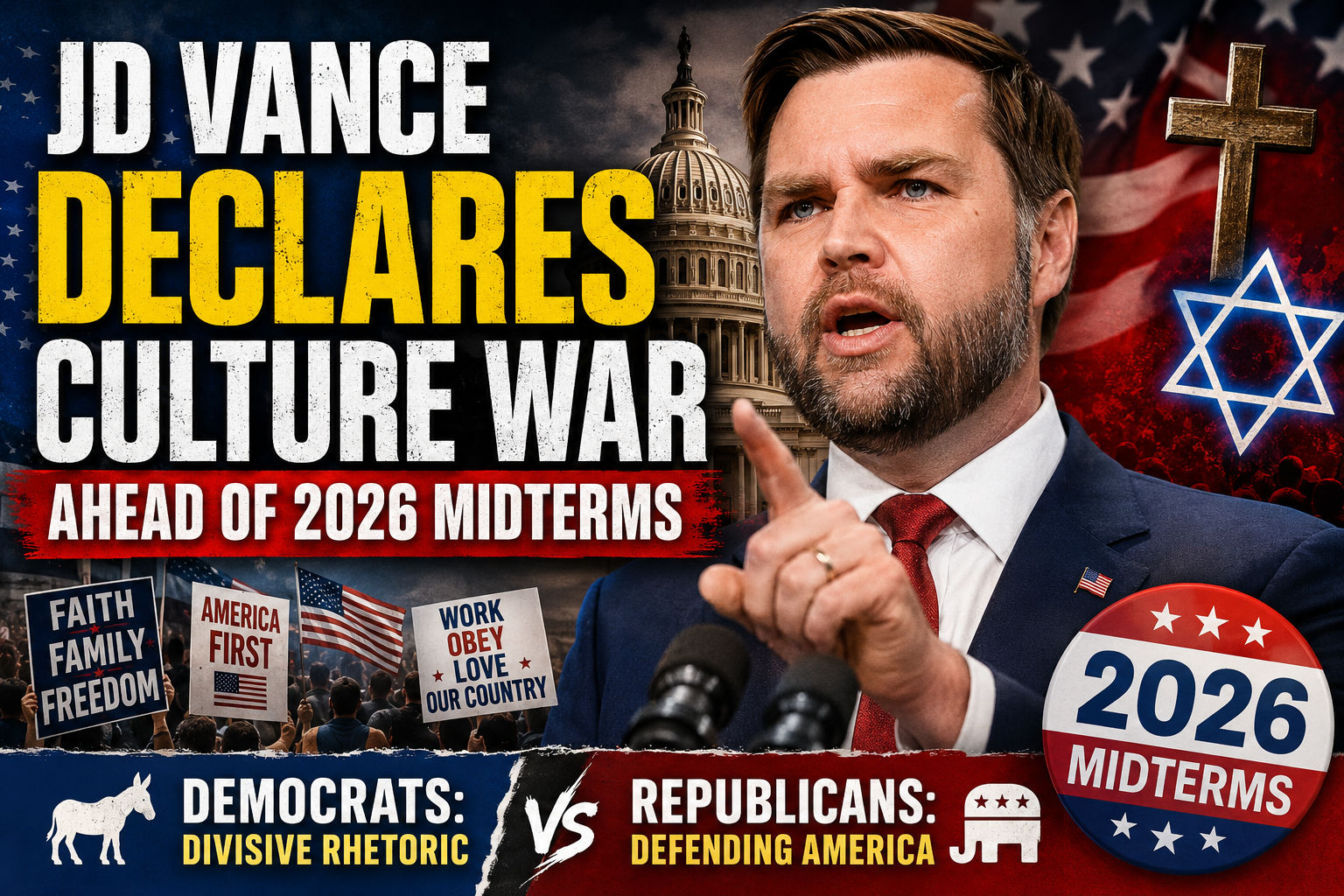
Vice President JD Vance is making it clear that Republicans intend to fight the 2026 midterm elections on more than just economic issues.
In a sweeping public statement that immediately ignited controversy, Vance accused the Democratic Party of becoming anti-Semitic, anti-Christian, and anti-White. At the same time, he presented what he described as a broader vision for the Republican coalition, arguing that Americans who work hard, follow the rules, and love their country should see themselves as part of the GOP’s future.
The comments have already generated strong reactions across the political spectrum.
Supporters view the remarks as a forceful defense of traditional values and national identity.
Critics argue that the vice president is relying on divisive rhetoric designed to inflame cultural tensions ahead of a major election year.
Regardless of where voters stand, one thing is becoming increasingly clear:
The battle for control of Congress in 2026 is shaping up to be as much about culture and identity as it is about policy.
A Clear Midterm Strategy Emerges
Political observers have spent months trying to determine what message Republicans would emphasize heading into the midterm elections.
Vance’s latest comments may provide the clearest answer yet.
Rather than focusing exclusively on inflation, taxes, border security, or foreign policy, the vice president placed cultural issues at the center of his message.
His argument suggests that Republicans believe many voters are increasingly concerned about questions involving national identity, religious freedom, education, and cultural values.
The strategy reflects a broader trend that has been developing within the Republican Party for years.
Issues that were once considered secondary topics have become major campaign themes.
Many Republican leaders now argue that cultural debates are inseparable from political leadership.
The Democratic Response
Democrats were quick to reject Vance’s characterization of their party.
Party leaders and activists argued that the accusations are politically motivated and designed to energize conservative voters ahead of the midterms.
Many Democrats contend that their policies are focused on expanding economic opportunity, protecting civil rights, improving healthcare access, and strengthening democratic institutions.
From their perspective, Vance’s comments oversimplify complex political disagreements and portray opponents in unfair terms.
Several Democratic commentators accused Republicans of trying to distract voters from policy debates by focusing on cultural conflict.
The disagreement highlights the dramatically different narratives each party is presenting to voters.
Faith and Politics
The timing of Vance’s remarks is also significant.
The vice president has recently been promoting a new memoir centered on faith, personal values, and his political journey.
Religion has long played an important role in American politics, particularly among conservative voters.
Many Republican candidates continue to emphasize faith-based themes when discussing public policy and cultural issues.
Supporters of Vance argue that religious values remain an important part of American life and deserve representation in political conversations.
Critics counter that government policy should serve citizens of all beliefs equally and that political leaders should avoid framing disagreements in religious terms.
The debate is likely to remain a major issue throughout the election cycle.
The Republican Coalition Vance Envisions
Beyond criticizing Democrats, Vance also focused on defining who belongs in the Republican coalition.
He argued that Americans who work hard, obey the law, and care deeply about the country should feel welcome within the GOP.
Supporters see this message as an attempt to broaden the party’s appeal beyond traditional political categories.
Rather than emphasizing race, ethnicity, or background, Vance framed political identity around shared values and civic responsibility.
Republican strategists have increasingly promoted this message in recent years, hoping to attract voters from a variety of demographic groups.
Whether that strategy succeeds remains one of the major questions heading into 2026.
Why Culture Is Dominating Politics
The controversy surrounding Vance’s remarks reflects a broader reality in American politics.
Cultural issues have become increasingly central to election campaigns.
Questions involving education, religion, gender, free speech, national identity, and historical interpretation now generate as much attention as economic policy.
Many voters view these debates as deeply personal.
As a result, political leaders often find that cultural arguments generate strong emotional responses and significant media attention.
Both parties have adapted to this reality.
Republicans frequently emphasize cultural concerns involving tradition, faith, and national identity.
Democrats often focus on inclusion, equality, and civil liberties.
The clash between those visions is likely to define much of the coming election cycle.
Social Media Amplifies the Debate
As expected, social media quickly turned Vance’s remarks into a nationwide discussion.
Supporters praised him for addressing issues they believe are ignored by mainstream institutions.
Critics accused him of using inflammatory language to deepen political divisions.
Political influencers, commentators, journalists, and activists all joined the conversation.
The result was millions of views, thousands of comments, and widespread debate across multiple platforms.
The reaction demonstrated how quickly modern political statements can dominate public discourse.
What the Midterms Could Mean
Control of Congress is at stake in the 2026 elections.
Both parties understand the importance of the upcoming contests.
For Republicans, retaining or expanding congressional majorities would strengthen the administration’s ability to advance its agenda.
For Democrats, winning seats could provide a significant check on executive power and reshape the political landscape heading into the 2028 presidential race.
Because the stakes are so high, both sides are expected to use increasingly aggressive messaging.
Vance’s comments may represent an early preview of the arguments voters will hear repeatedly over the coming months.
A Deeply Divided Electorate
The controversy also highlights the extent of political polarization in the United States.
Americans increasingly disagree not only about policy but also about the country’s identity, values, and future direction.
Supporters and critics often consume different media sources and interpret the same events in dramatically different ways.
This environment makes consensus difficult.
Statements that one group views as honest and necessary can be viewed by another as divisive and harmful.
That dynamic helps explain why comments like Vance’s generate such intense reactions.
Final Thoughts
JD Vance’s latest remarks have offered one of the clearest indications yet of how Republicans intend to approach the 2026 midterm elections.
By focusing on culture, identity, faith, and national values, the vice president is signaling a campaign strategy that extends far beyond traditional policy debates.
Supporters view the message as a defense of core American principles.
Critics see it as an attempt to deepen cultural divisions for political gain.
As the election season accelerates, debates surrounding patriotism, religion, identity, and political values are likely to become even more prominent.
If Vance’s comments are any indication, the fight for Congress will be about far more than legislation.
It will also be a battle over competing visions of what America is and what it should become.