
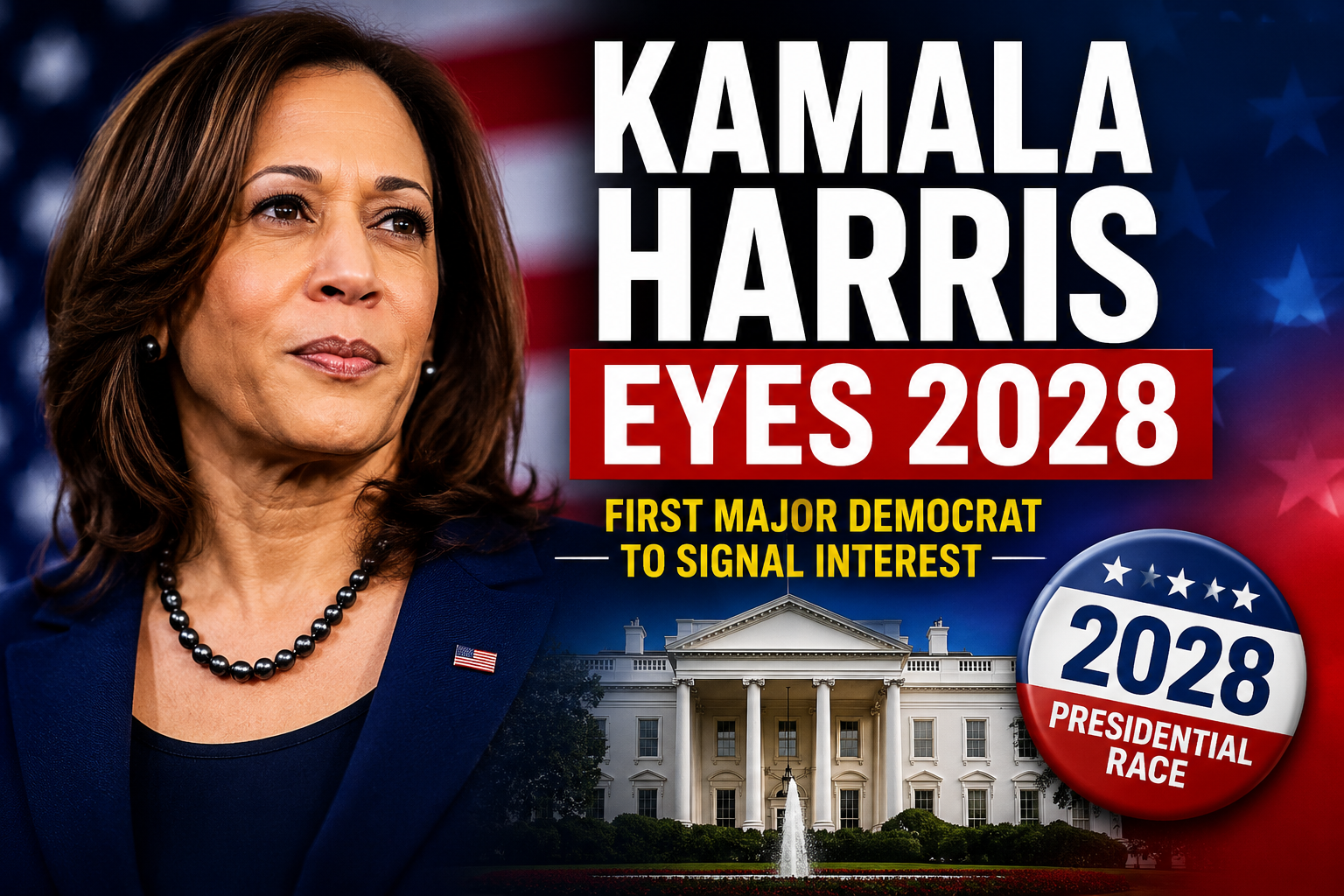
Former Vice President Kamala Harris has officially reignited speculation about her political future after publicly acknowledging that she is considering a run for president in 2028.
The announcement makes Harris the first major Democratic figure to openly signal interest in the next presidential race, setting the stage for what could become one of the most competitive Democratic primary contests in decades.
Her comments arrive at a difficult moment for the Democratic Party.
Just over a year has passed since Harris lost the 2024 presidential election to Donald Trump, a defeat that left Democrats searching for answers after another disappointing national campaign.
Now, as the party debates its future direction, Harris appears ready to make the case that she deserves another opportunity.
The question is whether Democratic voters agree.
Harris Breaks the Silence
For months, political observers have speculated about Harris’s next move.
Would she step away from national politics?
Would she pursue another office?
Or would she attempt a political comeback on the biggest stage of all?
Her recent comments provided the clearest answer yet.
By publicly acknowledging that she is considering a 2028 campaign, Harris effectively placed herself at the center of the Democratic Party’s future conversation.
The announcement immediately generated attention throughout Washington.
Political strategists, donors, activists, and elected officials began analyzing what a Harris comeback campaign might look like.
Some welcomed the possibility.
Others expressed concerns.
The Shadow of 2024
Any discussion about a Harris presidential campaign inevitably returns to the 2024 election.
That race ended with a victory for President Donald Trump and significant setbacks for Democrats across multiple levels of government.
The party not only lost the White House but also suffered important losses in congressional races.
Many Democratic voters continue debating what went wrong.
Some argue the party struggled with messaging.
Others blame economic concerns, voter turnout challenges, or broader dissatisfaction with the direction of the country.
For Harris, the challenge is clear.
She must convince voters that a candidate who lost in 2024 can become the person who wins in 2028.
That is not an impossible task.
American political history includes several leaders who suffered major defeats before eventually succeeding.
But it remains a difficult argument to make.
A Party Searching for Direction
Perhaps the biggest obstacle facing Harris is not Donald Trump.
It may be her own party.
Since the 2024 election, many Democratic donors and strategists have openly discussed the need for generational change.
Some believe the party needs fresh faces and new ideas.
Others argue Democrats should move away from figures closely associated with the Biden administration.
Those conversations have become increasingly public.
Major donors have indicated they are keeping their options open rather than immediately rallying behind Harris.
That reality suggests she would likely face a competitive primary rather than a clear path to the nomination.
The Democratic Party appears far from united on who should lead its next chapter.
The Growing List of Potential Rivals
If Harris enters the race, she is unlikely to have the field to herself.
Several prominent Democratic figures are widely viewed as potential contenders.
Among the names frequently mentioned are Josh Shapiro, Gretchen Whitmer, J. B. Pritzker, and Gavin Newsom.
Each brings different strengths.
Some have strong executive experience.
Others appeal to different ideological factions within the party.
Some may present themselves as representatives of a new Democratic generation.
The result could be one of the most crowded primary fields in recent memory.
Polling Presents Mixed Signals
One of the most interesting aspects of Harris’s position is that she remains both well-known and politically vulnerable.
Virtually every Democratic voter knows who she is.
That level of name recognition is a major advantage.
However, familiarity does not automatically translate into support.
Recent polling has produced mixed results.
While Harris remains a prominent figure among Democratic voters, surveys suggest many primary voters are interested in candidates who were not part of the 2024 election cycle.
One survey found that a majority of Democratic primary voters preferred someone who did not run in 2024.
That finding could become a major challenge for Harris if she decides to enter the race.
The Case Harris Will Make
If Harris runs, her campaign will likely focus on experience.
She can point to her service as vice president, senator, attorney general, and prosecutor.
Few potential candidates possess a comparable national political résumé.
Supporters argue that experience matters, particularly during periods of political instability.
They believe Harris understands the federal government and has already been tested on the national stage.
Her allies will likely argue that Democrats should not abandon experienced leadership simply because of one electoral defeat.
Instead, they will likely frame Harris as someone prepared to immediately govern.
The Criticism She Will Face
At the same time, Harris will face significant scrutiny.
Critics inside and outside the Democratic Party are likely to question her electability.
Some strategists worry that voters may associate her too closely with previous Democratic losses.
Others believe she struggled to build strong enthusiasm among key voter groups during past campaigns.
Republicans would almost certainly revisit many of the same criticisms used during previous election cycles.
That means Harris would enter any campaign with both clear strengths and clear vulnerabilities.
Why 2028 Could Be Different
Political environments change quickly.
What seemed impossible one election cycle can become entirely realistic in the next.
Economic conditions shift.
Public priorities evolve.
New political issues emerge.
Candidates who appear weak one year can become stronger the next.
Harris and her supporters are likely counting on those realities.
They believe the political landscape of 2028 may look dramatically different from that of 2024.
If that happens, opportunities could emerge that do not currently exist.
The Democratic Identity Crisis
Beyond Harris herself, the story reflects a larger challenge confronting Democrats.
The party is still trying to define its future.
Should it move toward younger leaders?
Should it embrace more moderate policies?
Should it become more progressive?
Should it focus on economic issues above all else?
These questions remain unresolved.
The answers could determine not only Harris’s future but also the future of the Democratic Party itself.
Final Thoughts
Kamala Harris’s decision to publicly consider a 2028 presidential campaign has immediately reshaped the conversation about the Democratic Party’s future.
Supporters see an experienced leader preparing for another opportunity.
Critics see a candidate tied to past defeats.
Meanwhile, Democratic voters are left with an increasingly important choice.
Do they want familiarity and experience?
Or do they want a completely new direction?
The 2028 race is still years away.
But with Harris now signaling interest, the battle for the Democratic Party’s future has already begun.