
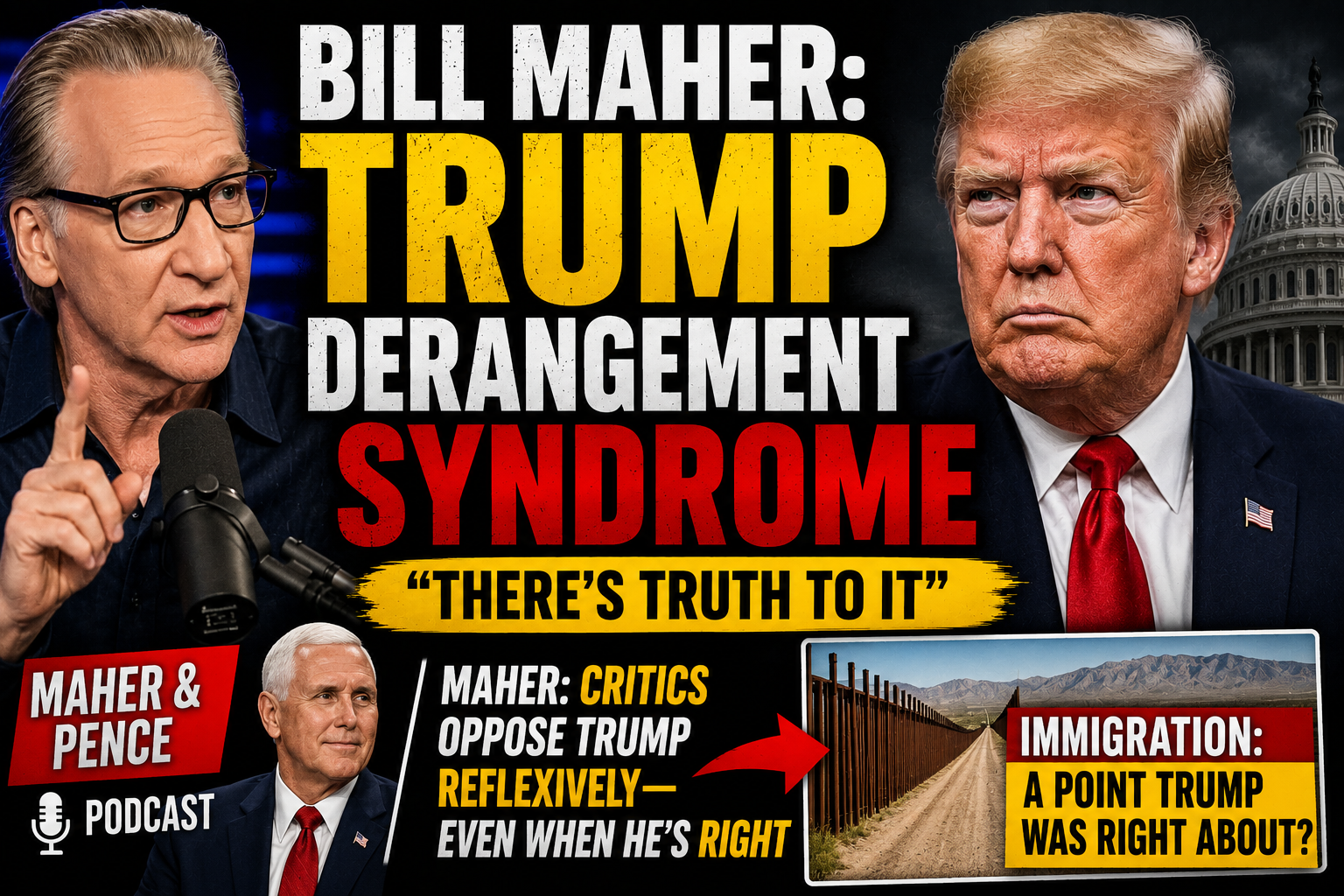
Political commentator Bill Maher has once again found himself at the center of controversy after suggesting there may be some truth to the concept commonly referred to as “Trump Derangement Syndrome.”
During a podcast conversation with former Vice President Mike Pence, Maher argued that some critics of President Donald Trump have become so intensely opposed to him that they automatically reject anything he says, regardless of whether the issue itself has merit.
The comments immediately triggered reactions from both the left and the right.
Trump supporters praised Maher for what they viewed as a rare moment of honesty from a prominent liberal voice.
Critics accused him of helping normalize Trump’s rhetoric and political agenda.
As is often the case with Maher, his remarks generated headlines not because they fit neatly into one political camp, but because they challenged assumptions held by both sides.
The controversy also reopened one of the most divisive questions in American politics:
Can people oppose Donald Trump while still acknowledging that he may be right about some issues?
What Maher Actually Said
During the discussion, Maher addressed the idea that some people react negatively to Trump no matter what position he takes.
He argued that reflexive opposition has become increasingly common in modern politics.
According to Maher, there are cases where critics immediately dismiss Trump’s concerns without seriously evaluating the underlying issue.
One example he highlighted was immigration.
Maher suggested that Trump raised legitimate concerns about border security and immigration enforcement long before the issue became a major focus for many Democrats.
While he did not endorse every aspect of Trump’s approach, he argued that dismissing the issue entirely was a mistake.
That observation immediately ignited debate across political circles.
The Meaning of “Trump Derangement Syndrome”
The phrase “Trump Derangement Syndrome” has become a popular term among Trump supporters.
It is often used to describe individuals who are perceived as opposing Trump so intensely that they cannot evaluate his actions objectively.
Critics of the phrase argue that it is simply a way to dismiss legitimate concerns about Trump’s behavior, policies, or statements.
Supporters believe it accurately describes a political culture where some people automatically reject anything associated with Trump.
Maher’s comments did not fully endorse the phrase as a medical or psychological condition.
Instead, he suggested that the broader idea behind it contains an element of truth.
That distinction is important.
His argument was less about Trump himself and more about how political tribalism affects public debate.
Immigration Remains a Dividing Issue
The issue Maher specifically highlighted was immigration.
For years, Trump made border security one of the defining themes of his political movement.
Supporters argued that stronger enforcement was necessary to maintain national security and protect American workers.
Critics accused Trump of using inflammatory language and promoting overly harsh policies.
However, public opinion on immigration has evolved over time.
Even some Democratic leaders who once strongly opposed Trump’s approach have acknowledged challenges related to border management and immigration systems.
Maher argued that dismissing every concern raised by Trump prevented serious discussion about real policy issues.
For him, that represented a failure of political discourse rather than a defense of Trump personally.
Why Maher Frustrates Both Sides
One reason Maher remains such a controversial figure is that he rarely stays within traditional political boundaries.
Although he is generally identified with liberal viewpoints, he has repeatedly criticized progressive activists, media organizations, and Democratic politicians.
At the same time, he frequently criticizes Trump, conservative media, and Republican policies.
This willingness to challenge both sides has earned him supporters and critics across the political spectrum.
Some view him as an independent thinker.
Others view him as intentionally provocative.
Regardless of opinion, his comments often attract attention because they do not fit easily into partisan narratives.
Trump’s Supporters Celebrate the Comments
Conservative commentators quickly seized upon Maher’s remarks.
Many argued that his comments validated arguments they have been making for years.
According to supporters of the former president, media organizations and political opponents often focus more on attacking Trump than addressing substantive policy questions.
They argue that Trump has occasionally been correct about issues such as immigration, trade, foreign policy, and government bureaucracy, but critics refuse to acknowledge those points because of their opposition to him.
For Trump supporters, Maher’s comments represented a rare acknowledgment from outside conservative circles.
That is one reason the remarks generated so much attention.
Critics Push Back
Not everyone agreed.
Many critics argued that opposition to Trump is based on specific concerns regarding his conduct, rhetoric, and policies rather than blind hostility.
They contend that the phrase “Trump Derangement Syndrome” unfairly dismisses legitimate criticism.
Some also argued that acknowledging concerns about immigration should not automatically be interpreted as validating Trump’s broader political agenda.
For these critics, Maher’s comments risk oversimplifying complex political disagreements.
They believe it is possible to oppose Trump’s policies for substantive reasons without being accused of irrational bias.
The disagreement highlights how polarized political discussions have become.
A Bigger Problem in American Politics
Perhaps the most important aspect of Maher’s comments has little to do with Trump himself.
Instead, it relates to a broader trend in American politics.
Increasingly, people evaluate ideas based on who says them rather than what the ideas actually are.
When a political ally proposes something, supporters often defend it.
When an opponent proposes something similar, critics often attack it.
This pattern affects both major parties.
Political scientists have documented how partisan identity increasingly shapes opinions on issues ranging from healthcare to foreign policy.
Maher’s argument touches directly on that phenomenon.
The Rise of Political Tribalism
Many analysts believe tribalism has become one of the defining characteristics of modern politics.
Voters increasingly identify with political teams rather than individual policies.
As a result, political debates often resemble sports rivalries more than discussions about governance.
Every issue becomes a contest.
Every compromise becomes suspect.
Every disagreement becomes personal.
Maher suggested that this environment makes honest conversations more difficult.
People become reluctant to acknowledge when political opponents make valid points because doing so may be perceived as helping the other side.
That dynamic contributes to polarization.
Why the Conversation Matters
The reaction to Maher’s comments demonstrates how difficult it has become to discuss controversial topics in a nuanced way.
Many people immediately interpreted his remarks as either a defense of Trump or an attack on Trump’s critics.
In reality, his argument was more complicated.
He was questioning whether political opposition sometimes becomes so intense that it prevents objective evaluation of policy issues.
That question extends beyond Trump.
It applies to politicians across the political spectrum.
The challenge for democratic societies is finding ways to debate ideas without reducing every discussion to partisan conflict.
Final Thoughts
Bill Maher’s latest comments have reignited a debate that has followed Donald Trump throughout his political career.
Is “Trump Derangement Syndrome” a real phenomenon, or simply a political slogan used to dismiss criticism?
Supporters and critics continue to disagree.
What is harder to dispute is Maher’s broader point about political tribalism.
In an era of intense polarization, many Americans increasingly judge arguments based on who makes them rather than whether they are correct.
Whether one agrees with Trump, opposes him, or falls somewhere in between, that tendency affects public debate in profound ways.
And judging by the reaction to Maher’s remarks, the conversation is far from over.