
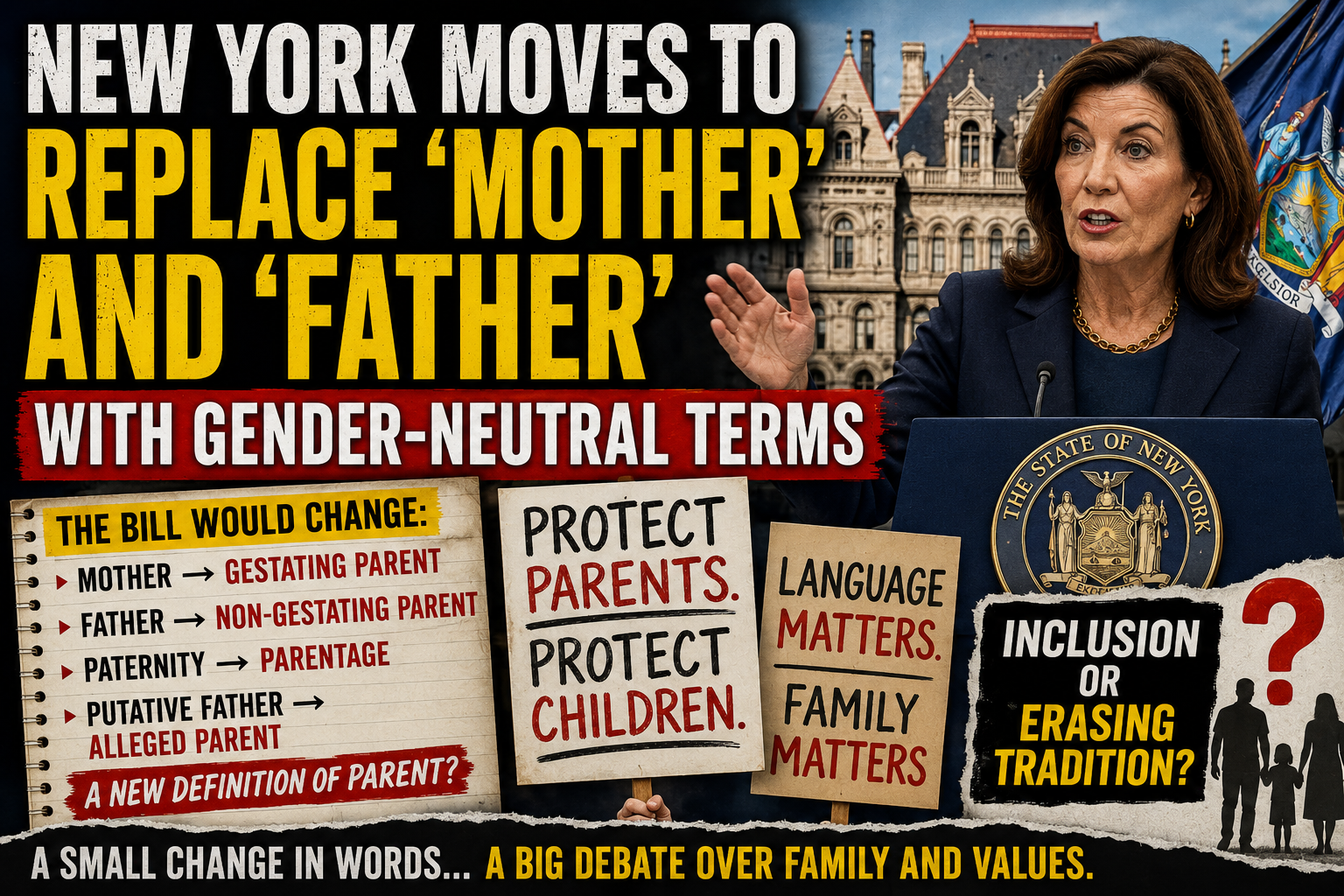
A new bill advancing through New York’s legislature is igniting a fierce debate over language, family, and the role of government in redefining traditional terms.
The proposal would replace words such as “mother” and “father” in portions of state law with gender-neutral alternatives like “gestating parent” and “non-gestating parent.” Supporters say the changes are necessary to reflect modern family structures, including same-sex parents, surrogacy arrangements, and evolving family court practices. Critics argue the legislation is unnecessary, confusing, and part of a broader effort to erase traditional language from public life.
As the bill moves closer to becoming law, it has quickly become one of the most controversial cultural and political debates in New York.
What Would Actually Change?
Under the legislation, numerous references throughout family-related laws would be updated.
Among the most notable changes:
- “Mother” would become “gestating parent.”
- “Father” would become “non-gestating parent” or simply “parent.”
- “Paternity” proceedings would become “parentage” proceedings
- “Putative father” would become “alleged parent” in legal records and proceedings
Supporters say these revisions are designed to make state law more inclusive and better aligned with how courts already handle cases involving adoption, surrogacy, and same-sex couples.
Why Supporters Say the Change Is Necessary
Backers of the legislation argue that family structures have evolved significantly over the past several decades.
Today, courts regularly deal with:
- Same-sex couples raising children
- Surrogacy agreements
- Assisted reproductive technology
- Adoptive families with nontraditional parental arrangements
Supporters contend that older legal language does not always reflect these realities and can create unnecessary complications in family court.
According to lawmakers behind the proposal, the goal is to make legal terminology more flexible and inclusive while ensuring consistency across state statutes.
Critics Say the Bill Solves a Problem That Doesn’t Exist
Opponents see the issue very differently.
Many critics argue that replacing “mother” and “father” with technical terms such as “gestating parent” and “non-gestating parent” makes laws harder to understand and strips away language that carries deep cultural and social meaning.
Some lawmakers have questioned whether New Yorkers were demanding these changes in the first place.
Others argue that the state should be focused on issues such as:
- Crime
- Housing costs
- Taxes
- Public transportation
- Education
Rather than rewriting long-established family terminology.
The Debate Goes Beyond Words
What makes this story so controversial is that it is not really about vocabulary.
For supporters, the bill represents inclusion and legal modernization.
For critics, it represents something much larger: a cultural shift in how society defines family, parenthood, and biological reality.
The argument has become part of a broader national debate over:
- Gender identity
- Inclusive language
- Government policy
- Traditional institutions
As a result, what might otherwise have been viewed as a technical legal update has become a symbolic political battle.
New York Has Been Moving Toward Gender-Neutral Language for Years
The proposed changes did not emerge in a vacuum.
In recent years, New York has adopted several measures aimed at increasing the use of gender-neutral language in government documents and legal frameworks.
The state already allows parents on birth certificates to choose “father,” “mother,” or “parent” as their designation.
New York also recognizes an “X” gender marker on birth certificates and has previously approved broader gender-neutral language requirements in government documents.
Supporters, therefore, view the latest bill as a continuation of an existing trend rather than a dramatic departure.
Why the Backlash Has Been So Intense
Despite that context, public reaction has been strong.
Social media has been flooded with arguments from both sides.
Critics question why lawmakers would replace commonly understood terms with language many people find awkward or clinical.
Supporters counter that legal language is not intended to be emotional—it is intended to be precise and inclusive.
The disagreement highlights a growing divide over how institutions should balance tradition with changing social norms.
A Political Issue Heading Into Future Elections
The controversy may also have electoral consequences.
Issues involving education, gender identity, parental rights, and cultural values have increasingly become major campaign themes across the United States.
As a result, legislation involving terms like “mother” and “father” often attracts attention far beyond the actual legal changes being proposed.
Both parties are likely to use debates like this to energize supporters and frame broader arguments about the direction of society.
The Bigger Question
At its core, the debate raises a simple but powerful question:
Should government language evolve to reflect changing family structures, or should traditional terms remain unchanged because of their cultural significance?
Reasonable people can disagree.
Supporters see modernization.
Critics see unnecessary social engineering.
And that is exactly why the issue has become so politically explosive.
Conclusion
New York’s proposal to replace “mother” and “father” with gender-neutral terms has quickly become one of the state’s most talked-about legislative battles.
Supporters argue it reflects the realities of modern families and creates more inclusive legal language.
Critics argue it replaces clear and meaningful terms with bureaucratic language that few people asked for.
Whether the bill ultimately becomes law or not, the controversy highlights a much larger national debate about identity, language, and the changing definition of family in America.