
Artificial intelligence has officially become one of the biggest political battlegrounds in America.
For years, AI was viewed as a technology story.
Silicon Valley talked about it.
Tech companies invested billions into it.
Researchers debated its future.
Most ordinary Americans paid little attention.
That has changed.
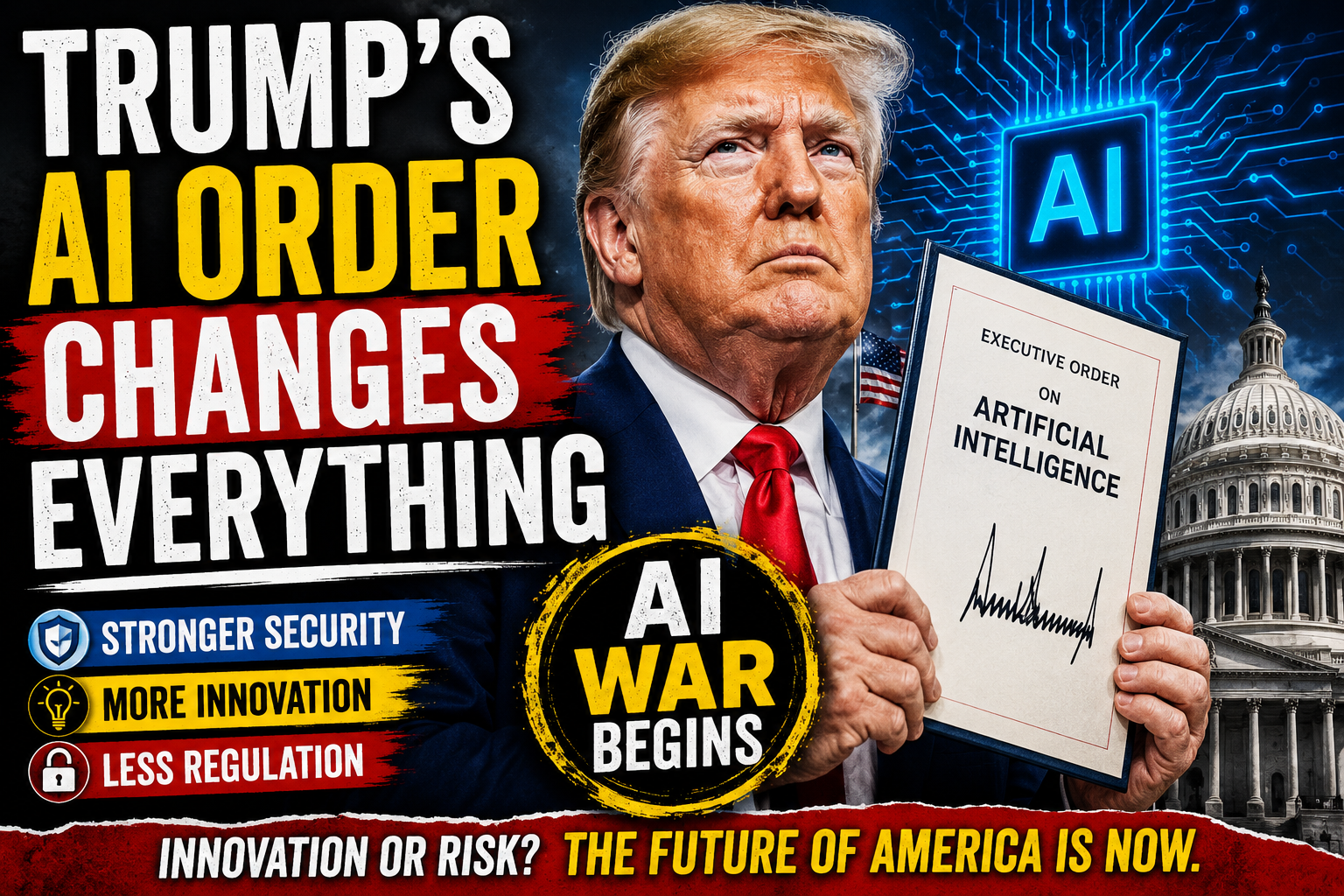
President Donald Trump’s latest executive order on artificial intelligence signals that AI is no longer just a business issue. It is now a national security issue, an economic issue, and potentially one of the defining political issues of the next decade.
Supporters say the order protects American innovation.
Critics argue it could give powerful technology companies even more influence.
Either way, one thing is becoming increasingly clear:
The race to control artificial intelligence has begun.
Why AI Suddenly Matters to Washington
A few years ago, most Americans interacted with AI without realizing it.
Recommendation algorithms.
Search engines.
Social media feeds.
Voice assistants.
The technology was present but largely invisible.
Today, AI can write articles, generate images, produce videos, create software code, analyze legal documents, and perform tasks that once required highly trained professionals.
That changes everything.
The technology is moving faster than governments can regulate it.
And that has lawmakers worried.
Questions that once sounded like science fiction are now being discussed in Congress.
Could AI eliminate millions of jobs? Can foreign governments weaponize AI? Can artificial intelligence be used to manipulate elections?
Could it eventually become too powerful to control?
These concerns are driving political action.
What Trump’s Executive Order Actually Does
The executive order establishes a voluntary framework allowing developers of advanced AI systems to work with federal agencies before releasing highly capable models to the public.
The administration says this approach strengthens cybersecurity while avoiding heavy-handed regulations that could slow innovation.
At the same time, the order rejects mandatory licensing systems that some policymakers have proposed.
That decision is significant.
Many technology leaders have called for stricter oversight of advanced AI development.
Others argue that excessive regulation would cripple American competitiveness.
Trump’s approach clearly favors innovation over regulation.
His administration appears to believe that America’s greatest threat is not developing AI too quickly.
It’s falling behind competitors.
The China Factor
You cannot understand this executive order without understanding China.
For years, American leaders have viewed artificial intelligence as a strategic competition similar to the space race.
The country that dominates AI could gain enormous advantages.
Economic advantages.
Military advantages.
Technological advantages.
National security advantages.
Chinese companies continue investing heavily in artificial intelligence infrastructure.
New developments, including China’s underwater AI data centers and expanding computing capabilities, have increased concerns among American policymakers.
From Washington’s perspective, slowing down AI development could allow rivals to gain ground.
That fear influences nearly every discussion about AI regulation.
Silicon Valley Loves This
Many technology companies will likely view Trump’s approach favorably.
Why?
Because regulation often creates costs.
Compliance requirements.
Government reviews.
Legal restrictions.
Reporting obligations.
Companies generally prefer flexibility.
The executive order’s voluntary structure gives businesses more room to innovate while still encouraging cooperation with government agencies.
Supporters argue this balance is necessary.
They believe innovation cannot flourish under excessive bureaucracy.
Critics see things differently.
They worry that voluntary participation may not be enough when dealing with technology that could transform society.
The Job Loss Debate
This is where things become personal.
Many Americans aren’t worried about geopolitical competition.
They’re worried about their jobs.
Artificial intelligence is rapidly expanding into industries that were once considered safe from automation.
Customer service.
Marketing.
Accounting.
Programming.
Graphic design.
Data analysis.
Administrative work.
The list continues growing.
Companies are already experimenting with ways to reduce labor costs through automation.
Some businesses openly acknowledge that AI could allow them to operate with fewer employees.
That reality creates anxiety.
Not because every worker will be replaced.
But because nobody knows exactly which jobs will survive unchanged.
Could the Middle Class Be the Biggest Loser?
For generations, the American middle class relied heavily on knowledge-based work.
Office jobs.
Professional services.
Administrative careers.
Corporate employment.
Those careers offered stability.
Predictable income.
Benefits.
Retirement plans.
Many of those positions are now being examined through the lens of automation.
If AI can perform large portions of white-collar work, what happens next?
That’s the question nobody can answer with certainty.
Some economists believe new industries will emerge.
Others fear a prolonged period of disruption.
History offers examples supporting both arguments.
Critics See a Dangerous Gamble
Opponents of the executive order argue that voluntary oversight may not be sufficient.
They point out that technology companies are under enormous pressure to release increasingly powerful AI systems.
Competition is intense.
The financial rewards are massive.
The temptation to move quickly is obvious.
Critics believe stronger safeguards may eventually become necessary.
They warn that waiting until problems emerge could be risky.
Their concern isn’t necessarily about today’s AI.
It’s about what comes next.
Supporters See a Necessary Strategy
Supporters view the issue differently.
They argue that America became a global technology leader by encouraging innovation rather than restricting it.
From this perspective, excessive regulation could drive talent and investment elsewhere.
If competitors continue advancing while America slows itself down, the long-term consequences could be severe.
Supporters believe the executive order strikes the right balance between security and progress.
Whether history agrees remains to be seen.
The Bigger Question Nobody Is Asking
The debate often focuses on regulation.
But the bigger question may be much simpler.
Who controls the future?
Governments?
Technology companies?
Artificial intelligence researchers?
Voters?
The answer matters because AI is increasingly shaping the world around us.
The decisions being made today could influence economic opportunities, privacy rights, national security, and political power for decades.
That makes this conversation far larger than one executive order.
Why This Matters to Every American
Many people assume AI only affects technology workers.
That’s a mistake.
Artificial intelligence is gradually moving into nearly every industry.
Healthcare.
Education.
Finance.
Manufacturing.
Retail.
Transportation.
Government.
Media.
Its impact will eventually touch almost everyone.
The question is whether society is prepared for that transformation.
Final Thoughts
Trump’s AI executive order is more than a policy announcement.
It’s a statement about how America intends to compete in the most important technological race of the century.
Supporters see a strategy designed to keep the United States ahead of its rivals.
Critics see a gamble that places too much trust in powerful technology companies.
Both sides agree on one thing.
Artificial intelligence is changing the world.
The only remaining debate is who will control that change—and who will benefit from it the most.
The AI era isn’t coming.
It’s already here.