
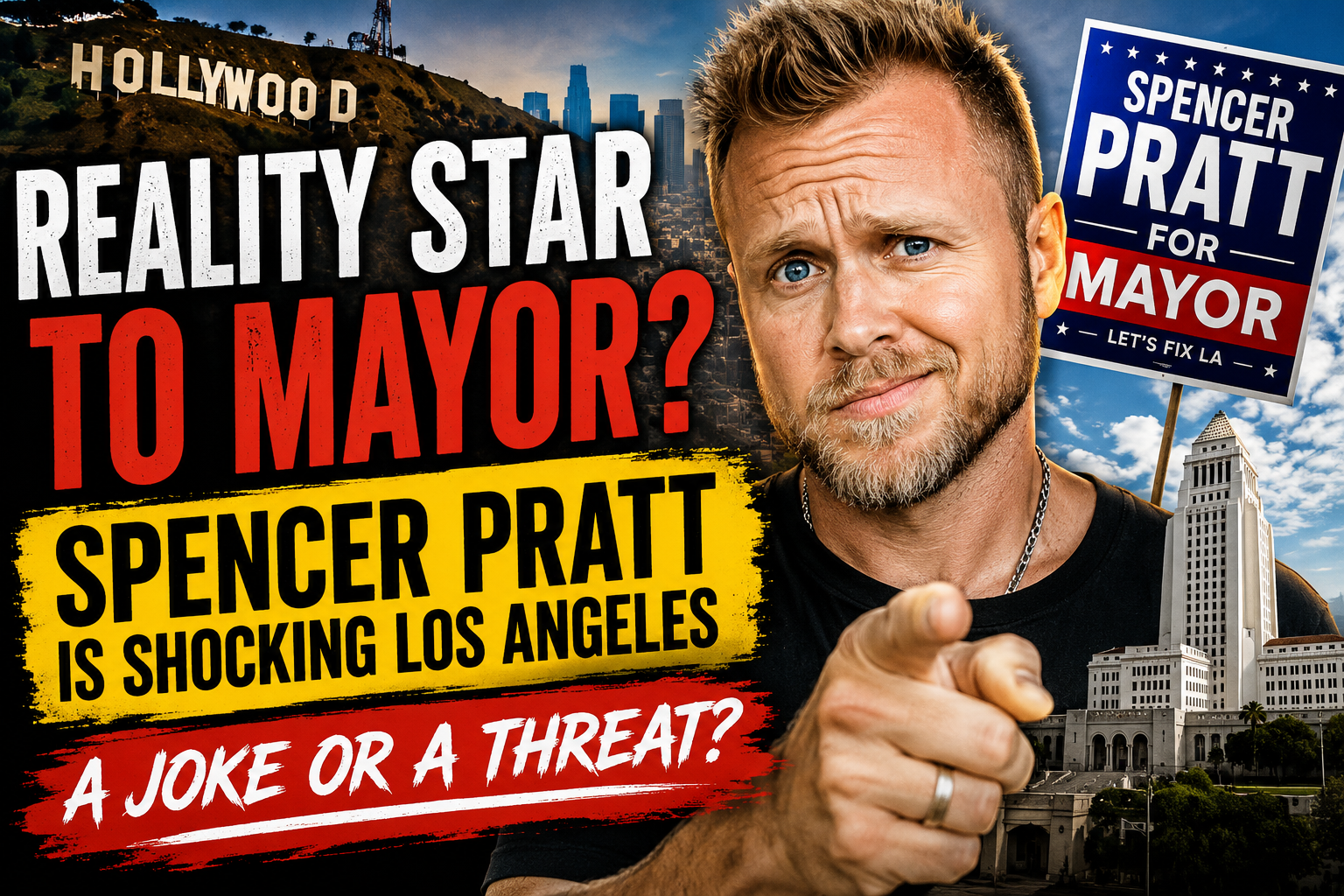
What exactly is happening to American politics?
That’s the question many voters are asking after seeing Spencer Pratt, a man who became famous arguing on reality television, emerge as a serious contender in the Los Angeles mayoral race.
Not a joke candidate.
Not a publicity stunt.
A real candidate attracting real voters.
And whether you find that inspiring or terrifying probably says a lot about how you view modern America.
Twenty Years Ago This Would Have Been Impossible
Imagine telling someone in 2008 that a star from a reality TV show would one day be competing for control of America’s second-largest city.
They would have laughed.
Back then, Spencer Pratt was known primarily as reality television’s most infamous troublemaker.
He built a brand around controversy.
Drama.
Conflict.
Attention.
Nobody was discussing his policy proposals, analyzing his vision for urban governance, or thinking he would ever become part of a serious political conversation.
Yet here we are.
The Establishment Created This Moment
Many commentators are focusing on Spencer Pratt.
They may be focusing on the wrong thing.
The bigger story isn’t Pratt.
The bigger story is why voters are willing to listen to him.
For years, Los Angeles residents have complained about rising housing costs.
Growing homelessness.
Traffic congestion.
Public safety concerns.
Government inefficiency.
And now, wildfire recovery.
Whether those criticisms are fair or not, frustration has been building.
When people lose confidence in traditional politicians, they often start looking elsewhere.
Sometimes they look toward outsiders, they look toward celebrities, and they look toward people who promise to disrupt the system entirely.
Why Spencer Pratt Is Connecting With Voters
His supporters don’t see a reality star.
They see someone who experienced the same disaster that many Angelenos experienced.
After losing his home in the Palisades wildfire, Pratt became one of the loudest critics of city leadership.
That gave him something politicians often struggle to create.
A personal story.
A grievance.
A mission.
Many voters relate to that.
Especially those who believe government institutions have failed them.
The Question Nobody Wants to Ask
What if Spencer Pratt isn’t the problem?
What if he’s the symptom?
Political insiders often mock outsider candidates.
But outsider candidates usually appear when voters stop trusting insiders.
Pratt’s rise may say less about celebrity culture and more about public dissatisfaction.
Millions of Americans increasingly believe politicians spend more time talking than solving problems.
When that belief spreads, unconventional candidates suddenly become viable.
Has Politics Become Entertainment?
This is where the debate becomes uncomfortable.
Many critics argue that politics is becoming indistinguishable from entertainment.
Campaigns are driven by social media.
Candidates build personal brands.
Attention becomes currency.
Viral moments matter more than policy papers.
In that environment, celebrity candidates have an obvious advantage.
They already understand how to capture attention, already know how to dominate headlines, and already know how to build loyal audiences.
The question is whether that translates into effective leadership.
The Trump Comparison
Some observers have compared Pratt’s rise to broader trends that transformed American politics over the last decade.
Not because the two men are identical.
They’re not.
But because both benefited from the same underlying phenomenon.
Voters are becoming increasingly willing to reject traditional political figures.
The lesson is simple.
Never underestimate voter frustration.
When people believe the system is broken, they often become willing to take risks.
Political risks.
Electoral risks.
Even cultural risks.
Why Los Angeles Matters
This isn’t just about one city.
Los Angeles is often treated as a symbol of modern progressive governance.
When voters there begin seriously considering outsider candidates, people across the country notice.
Supporters see it as a demand for accountability.
Critics see it as evidence of growing political instability.
Either way, it attracts attention.
And attention drives national conversation.
The Real Debate
The debate isn’t actually about Spencer Pratt.
It’s about competence versus disruption.
Experience versus change.
Establishment versus outsider.
Voters are being asked a fundamental question:
Would you rather trust someone with years of political experience?
Or someone who argues that the experienced politicians created the problems in the first place?
That question is becoming increasingly common across America.
What Happens Next?
Even if Pratt ultimately loses, his campaign has already accomplished something significant.
It forced political observers to acknowledge growing voter frustration.
It demonstrated the power of outsider candidates.
And it reminded everyone that political norms can change very quickly.
The fact that a former reality television personality can become a serious mayoral contender would have sounded absurd a decade ago.
Today, it’s front-page news.
Final Thoughts
Spencer Pratt’s campaign may end in victory.
It may end in defeat.
But either way, it reveals something important about the current political climate.
Large numbers of voters are tired of hearing that things are improving when they don’t feel improvement in their daily lives.
They’re willing to consider alternatives.
Even unconventional ones.
Especially unconventional ones.
The biggest mistake political insiders could make is laughing at Spencer Pratt.
Because history has repeatedly shown that when voters become frustrated enough, the candidates everyone dismisses are often the ones who end up changing the conversation.