
Few topics create more heated debate in America than religion and politics.
When those two worlds collide, the reaction is often immediate and explosive.
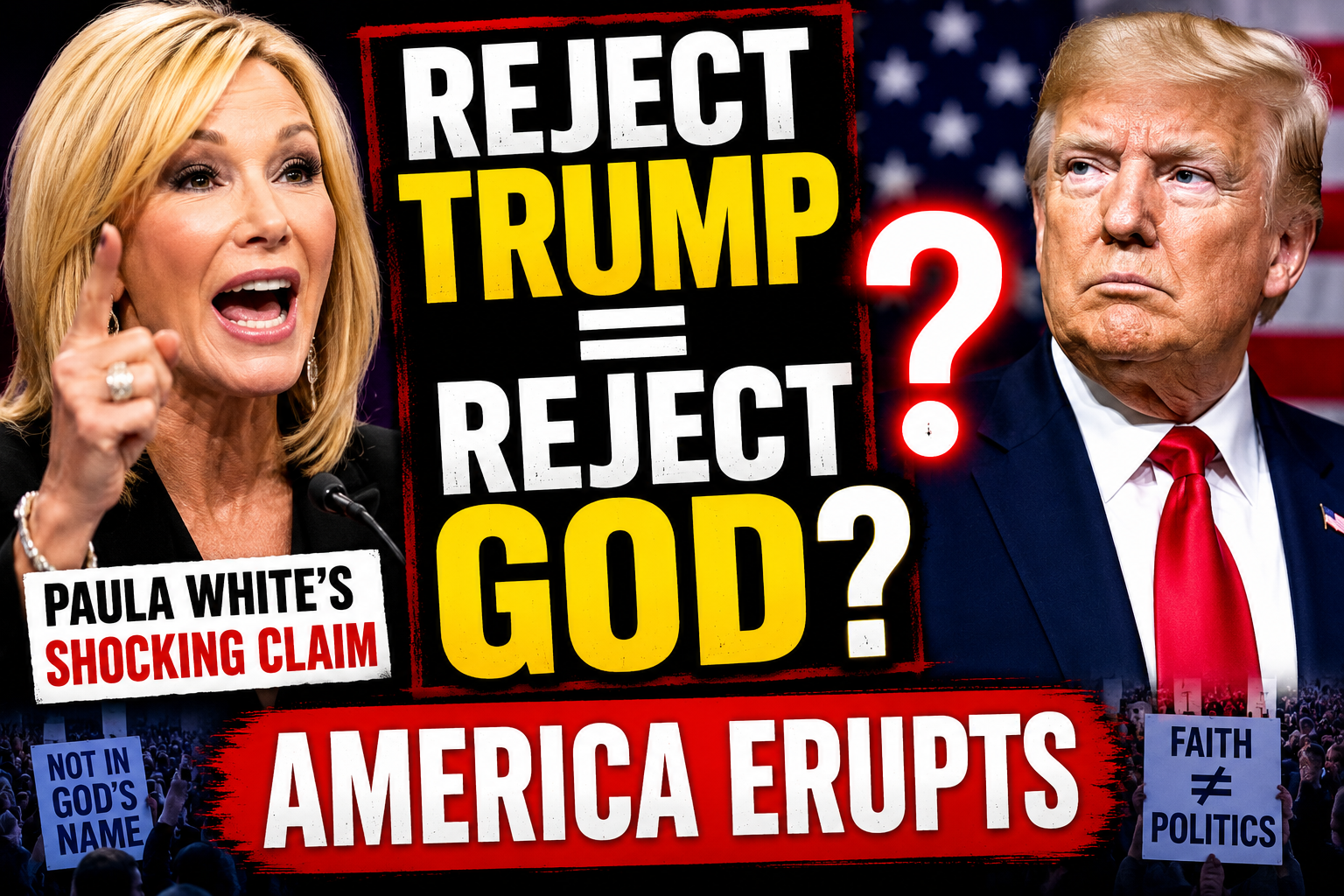
That is exactly what happened after comments from Paula White, one of the most influential faith leaders in conservative political circles, sparked a firestorm of criticism and support across social media and news platforms.
The controversy centers on statements that many interpreted as linking support for President Donald Trump with obedience to God.
To supporters, her remarks reflected a spiritual conviction about leadership and God’s role in national affairs.
To critics, they crossed a line that should never be crossed in a democratic society.
The backlash has reignited a debate that has been simmering in America for decades:
Can political loyalty and religious faith become too closely connected?
And what happens when faith leaders appear to place elected officials alongside divine authority?
Who Is Paula White?
Paula White is not an ordinary pastor.
For years, she has been one of the most recognizable religious figures associated with Donald Trump.
She has served as a spiritual adviser to Trump and has remained a prominent voice among many evangelical supporters.
Because of that relationship, her public statements often receive national attention.
Unlike many religious leaders who avoid political involvement, White has openly embraced political engagement.
Her supporters argue that she is simply exercising her right to participate in public life.
Her critics argue that the close relationship between religion and political power creates dangerous consequences.
That debate exploded once again following her latest comments.
The Statement That Started It All
The controversy emerged after remarks that many interpreted as suggesting that opposition to Trump could amount to opposition to God’s will.
Whether that was her exact intention remains a subject of debate.
Supporters insist her words have been misunderstood or taken out of context.
Critics argue the message was clear.
For them, the implication was deeply troubling.
America was founded on principles that separate religious authority from political authority.
Many observers believe those boundaries exist for a reason.
When politicians are treated as divinely chosen figures beyond criticism, critics argue that democratic accountability begins to weaken.
That concern quickly spread online.
Why Critics Are Alarmed
For many Americans, faith is deeply personal.
Politics is deeply personal too.
Combining the two can create powerful emotions.
Critics of White’s comments argue that no politician should ever be elevated to a position where disagreement is portrayed as spiritual rebellion.
In their view, political leaders are public servants.
They are elected by citizens, accountable to voters, and are not religious figures.
Some observers worry that presenting political support as a test of faith risks dividing religious communities and turning political disagreements into moral battles.
Others argue that it places unnecessary pressure on believers who may share a faith but hold different political views.
For these critics, the issue is bigger than Trump.
It is about protecting the distinction between religious belief and political allegiance.
Supporters See Things Differently
Not everyone agrees with the criticism.
Many supporters of Paula White believe the backlash is exaggerated.
They argue that faith leaders have always spoken about politics, leadership, and national direction.
From civil rights leaders to modern pastors, religious figures have often weighed in on public issues.
Supporters say White was expressing a belief that God can work through political leaders and national movements.
They point out that people throughout history have viewed certain leaders as part of a larger spiritual purpose.
In their eyes, critics are intentionally interpreting her words in the most negative way possible.
They see the controversy as another example of media outlets targeting religious conservatives.
The Bigger Debate: Faith and Political Power
The reaction to Paula White’s comments reveals something much larger than a disagreement over one statement.
It exposes a deep divide within America itself.
Many Americans believe faith should influence public life.
Others believe religion should remain largely separate from political decision-making.
These competing views have shaped debates for generations.
Questions about prayer in schools.
Religious symbols in public spaces.
Faith-based organizations.
Religious freedom laws.
All of these issues reflect the ongoing tension between religion and government.
Paula White’s comments simply reopened a conversation that never really ended.
Trump’s Unique Relationship With Religious Supporters
Part of the reason this controversy has gained so much attention is that Donald Trump occupies a unique position in American politics.
Few modern presidents have inspired such intense loyalty from supporters and equally intense opposition from critics.
Among many evangelical Christians, Trump is viewed as a leader who fought for causes they consider important.
Among his opponents, he represents a deeply polarizing political figure.
That means comments involving Trump often trigger reactions far beyond the original statement itself.
People are not simply responding to Paula White.
They are responding to everything Trump represents in American politics.
Social Media Erupts
As expected, social media quickly became a battleground.
Supporters defended White and accused critics of distorting her message.
Opponents accused her of blurring the line between faith and political worship.
The arguments spread rapidly.
The posts generated thousands of comments.
Videos attracted millions of views.
The debate expanded beyond religious circles and entered mainstream political discussion.
In many ways, the reaction itself demonstrates how sensitive the issue has become.
Few subjects create stronger emotions than faith and politics.
Combining them guarantees controversy.
Why This Matters Beyond One Comment
It would be easy to dismiss this story as another political argument.
But the issues involved are significant.
Democracies depend on citizens being able to question leaders.
Religious communities depend on spiritual authority remaining distinct from political authority.
When those lines become blurred, tensions emerge.
Some people see moral leadership.
Others see political manipulation.
Some see conviction.
Others see danger.
The disagreement is unlikely to disappear anytime soon.
Final Thoughts
Paula White’s comments have once again placed the relationship between faith and politics under a national spotlight.
Supporters view her words as an expression of spiritual conviction and loyalty.
Critics view them as a troubling example of political leaders being elevated beyond appropriate limits.
Regardless of where people stand, the controversy reveals how deeply divided America remains on questions involving religion, politics, and power.
One statement was enough to trigger a nationwide debate.
And judging by the reaction, that debate is far from over.