
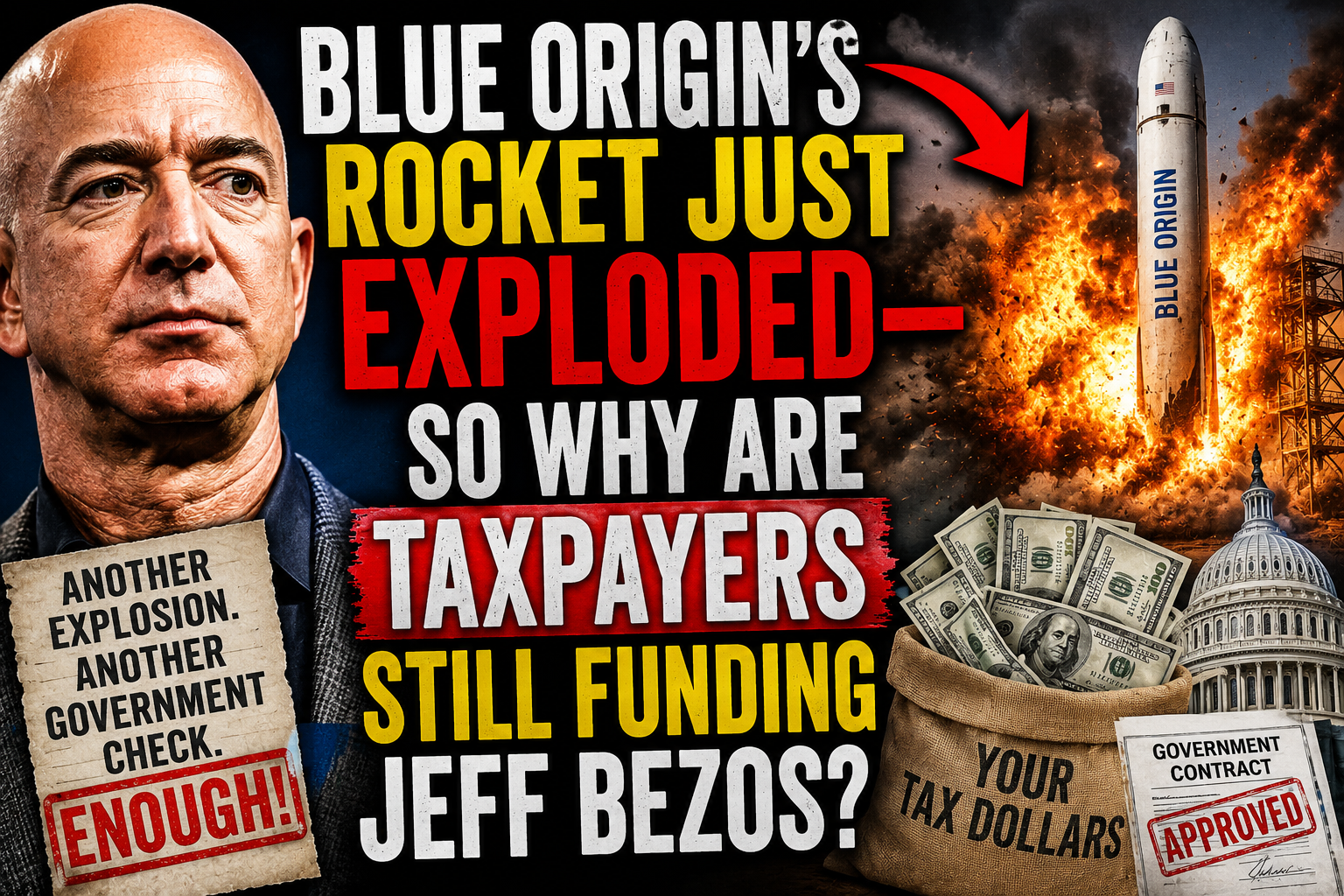
A giant fireball erupted from Blue Origin’s New Glenn rocket during a hot-fire test in Florida this week.
Within minutes, videos were spreading across social media.
Some viewers saw an unfortunate engineering setback.
Others saw something entirely different.
They saw yet another billionaire-owned company receiving government support while ordinary Americans struggle with rising prices, housing costs, healthcare expenses, and mounting debt.
The explosion immediately reignited a debate that goes far beyond rockets.
It is a debate about power.
It is a debate about influence.
And perhaps most importantly, it is a debate about where taxpayer money should be going.
Because for millions of Americans, the question is no longer whether Jeff Bezos can build rockets.
The question is why one of the richest men in human history continues to receive support tied to government contracts while average citizens are constantly told there isn’t enough money for their priorities.
That question is making people angry.
And the latest Blue Origin setback is pouring gasoline on an already raging fire.
The Rocket Exploded. The Contracts Didn’t.
Let’s start with the obvious.
Rocket development is difficult.
Even the most successful space companies have suffered failures.
SpaceX experienced numerous explosions before becoming the dominant force in commercial spaceflight.
NASA endured catastrophic setbacks throughout its history.
Nobody seriously expects space exploration to be risk-free.
But many Americans are asking a different question.
If a rocket explodes, why do government contracts keep flowing?
That question becomes even louder when the company involved belongs to a man worth hundreds of billions of dollars.
For critics, the issue is not engineering.
The issue is accountability.
When ordinary businesses fail, they often lose customers, investors, and credibility.
When government-backed projects fail, taxpayers frequently remain on the hook.
That’s where frustration begins.
The Jeff Bezos Problem
This isn’t really about Blue Origin.
It’s about Jeff Bezos.
Whether people admire him or dislike him, he has become a symbol.
To supporters, he represents innovation, ambition, and technological progress.
They point to Amazon’s success, job creation, and investments in long-term projects that governments often cannot undertake alone.
To critics, he represents something very different.
They see a system where the ultra-wealthy gain access to opportunities unavailable to ordinary Americans.
They see billionaires competing for government contracts while communities struggle with failing infrastructure, rising crime, and economic uncertainty.
When Bezos launches a rocket, many Americans no longer see science.
They see politics.
And that’s a problem Blue Origin cannot solve with engineering.
Americans Are Starting to Ask Uncomfortable Questions
There was a time when public enthusiasm for space exploration united the country.
The Apollo missions inspired millions.
Astronauts were heroes.
Rocket launches brought people together.
Today, the atmosphere feels different.
Space exploration has become deeply political.
Every launch is analyzed through partisan lenses.
All contracts become controversial.
All billionaires involved become targets.
Some Americans believe private space companies are essential to maintaining national competitiveness.
Others believe public money should never help fund projects associated with people who already possess unimaginable wealth.
The latest Blue Origin explosion has intensified those divisions.
The SpaceX Comparison Is Brutal
No discussion about Blue Origin can avoid one uncomfortable reality.
SpaceX exists.
And right now, SpaceX dominates almost every major category in commercial spaceflight.
Launches.
Satellite deployment.
Reusable rocket technology.
National security contracts.
Human spaceflight.
The gap between the two companies has become impossible to ignore.
Supporters of Blue Origin argue that competition is healthy and that no industry should depend entirely on a single company.
Critics respond with a simple question.
If one company is consistently delivering results while another continues experiencing major setbacks, why should taxpayers continue treating them as equals?
That question may not be fair.
But it is being asked.
A lot.
The Billionaire Space Race Nobody Voted For
Here’s another reason this debate is exploding online.
Most Americans never voted for a billionaire space race.
They woke up one day and discovered that a handful of ultra-wealthy individuals were effectively shaping the future of space exploration.
Jeff Bezos.
Elon Musk.
A few others.
Whether people support them or oppose them, these individuals now wield enormous influence over an industry that was once dominated by governments.
That shift makes many people uncomfortable.
Supporters say private innovation is faster and more efficient.
Critics argue that critical national infrastructure should never become dependent on the ambitions of a few powerful individuals.
The New Glenn explosion has brought those concerns back into the spotlight.
Is This Really About Space?
Maybe not.
Perhaps this story is actually about trust and belief.
Belief in government institutions.
Trust in billionaires.
Belief in corporations.
Trust in how public resources are allocated.
The reason this story is generating so much attention isn’t that a rocket exploded.
Rockets explode.
That happens.
The reason people are talking about it is that the explosion touched a nerve that already existed.
Millions of Americans feel disconnected from decisions made by powerful institutions.
They see billions spent on projects they don’t fully understand while struggling to afford everyday necessities.
Whether that perception is fair or unfair almost doesn’t matter.
Perception drives politics.
And right now, public frustration is real.
The Debate Isn’t Going Away
Blue Origin will investigate what happened.
Engineers will identify the cause.
The company will rebuild.
Another rocket will eventually stand on the launch pad.
But the political debate surrounding billionaire influence, taxpayer funding, and public trust isn’t disappearing anytime soon.
In fact, the latest explosion may have intensified it.
For some Americans, Blue Origin represents the future.
For others, it represents everything wrong with the relationship between wealth and power.
And after this week’s fireball, both sides seem more convinced than ever that they’re right.
The question now is whether the rest of the country agrees.