
The state of Alabama has made one of the strongest legal moves in the country against crimes involving children.
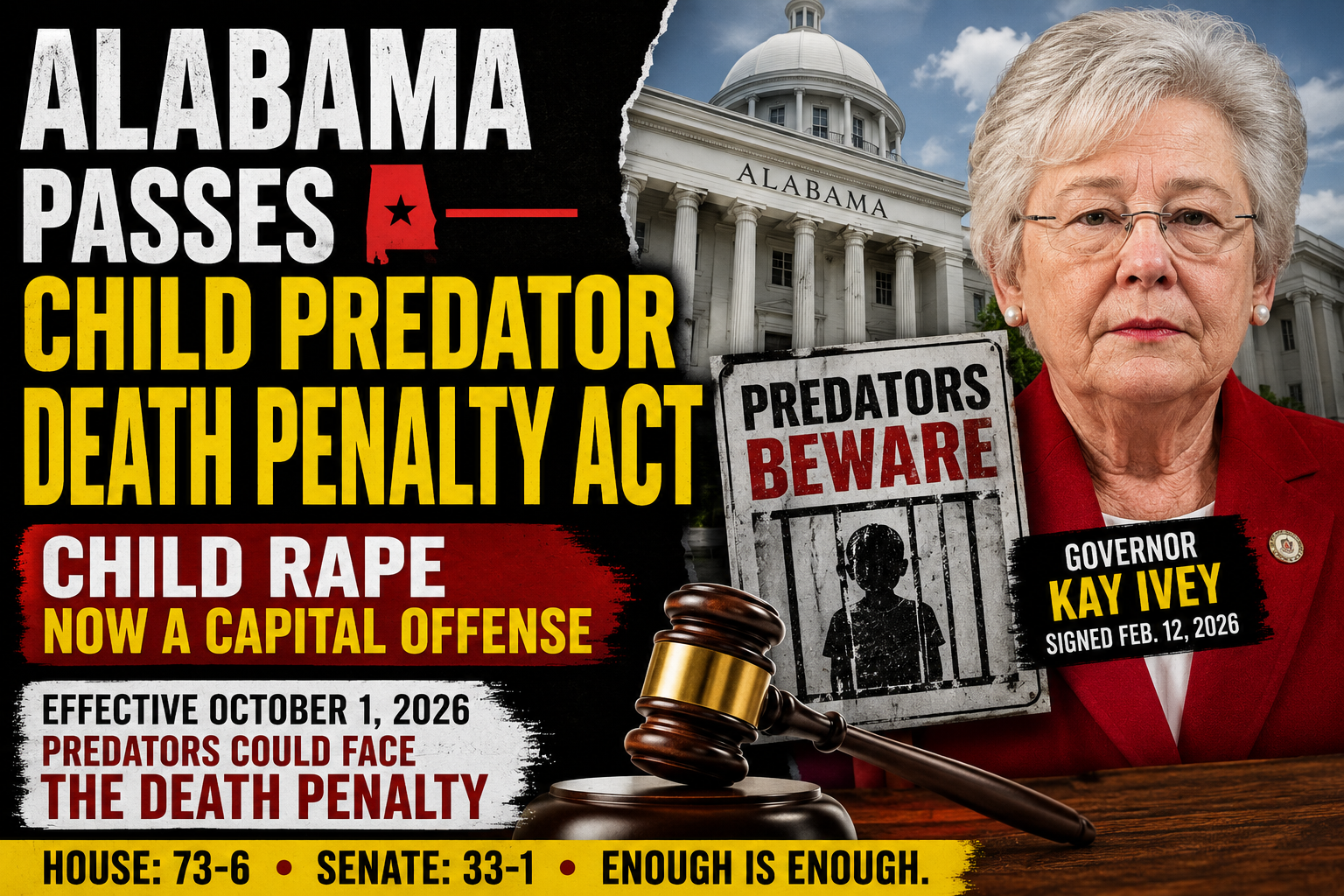
Governor Kay Ivey officially signed the Child Predator Death Penalty Act into law on February 12, 2026, creating a major shift in how Alabama plans to punish the most severe crimes against minors.
Starting October 1, 2026, individuals convicted of raping children under the age of 12 could face the death penalty in Alabama.
Supporters of the law say the message is simple: crimes against children deserve the harshest possible consequences.
The legislation was passed with overwhelming bipartisan support.
The Alabama House approved the bill by a vote of 73-6, while the Senate passed it 33-1, showing just how strongly lawmakers backed the measure.
State Representative Matt Simpson and State Senator April Weaver sponsored and carried the bill through the legislature.
For many supporters, this was not just about politics. They say it was about responding to horrifying crimes that shocked communities across the state.
What the New Law Does
Under the Child Predator Death Penalty Act, prosecutors in Alabama can now seek capital punishment for individuals convicted of raping children under 12 years old.
That means certain child sexual abuse cases could now carry the same punishment currently reserved for crimes like capital murder.
The law officially takes effect on October 1, 2026.
Supporters argue the measure is designed to protect children, deter predators, and send a clear signal that Alabama intends to take a zero-tolerance approach to crimes involving minors.
Critics, however, have already raised constitutional concerns.
The U.S. Supreme Court previously ruled in the 2008 case Kennedy v. Louisiana that the death penalty for child rape, where the victim does not die, violated the Eighth Amendment’s prohibition against cruel and unusual punishment.
Because of that ruling, many legal experts expect Alabama’s new law to face immediate court challenges once it takes effect.
Still, Alabama lawmakers moved forward anyway.
Supporters of the bill argue that the severity of certain crimes against children justifies revisiting the legal debate.
The Case That Changed Everything
Many lawmakers pointed to a disturbing case out of Bibb County as one of the major reasons the bill gained momentum.
In 2025, authorities arrested eight individuals accused of horrific crimes involving children.
According to investigators, the suspects were charged in connection with rape, trafficking, and the sexual torture of multiple children allegedly held captive.
Some of the victims were reportedly as young as three years old.
The allegations shocked Alabama residents and triggered intense public outrage.
For supporters of the new law, the Bibb County case represented the kind of extreme criminal behavior they believe deserves the maximum possible punishment.
Lawmakers repeatedly referenced the case while discussing the legislation.
Many argued that existing penalties were not strong enough for crimes involving severe abuse of young children.
Why the Law Is Nationally Significant
Alabama’s decision immediately placed the state at the center of a national legal and political debate.
Most states do not allow the death penalty for crimes other than murder.
Because of the Supreme Court’s Kennedy v. Louisiana ruling, laws like Alabama’s are expected to face constitutional scrutiny.
However, some supporters believe the current Supreme Court could eventually reconsider earlier rulings involving capital punishment.
Others see Alabama’s move as part of a broader trend in states taking tougher positions on violent crime and crimes against children.
The law also reflects growing frustration among many Americans who believe predators receive sentences that are too lenient compared to the trauma inflicted on victims.
Supporters say the legislation prioritizes the protection of children over concerns about criminal defendants.
Governor Kay Ivey’s Position
Governor Kay Ivey strongly supported the legislation before signing it into law.
Supporters praised her decision, arguing Alabama is taking a firm stand against predators who target vulnerable children.
Many conservatives across social media celebrated the bill’s passage, calling it one of the toughest anti-predator laws in the nation.
The law’s supporters believe severe penalties can serve both as punishment and deterrence.
Critics, meanwhile, argue that expanding capital punishment raises legal and ethical concerns.
Civil liberties groups and death penalty opponents are expected to challenge the law once prosecutors attempt to use it in court.
The Constitutional Battle Ahead
Legal experts widely expect the law to face immediate challenges after taking effect.
The biggest issue is the Supreme Court’s previous decision limiting the use of the death penalty in non-homicide crimes.
If Alabama prosecutes a defendant under the new law and seeks execution, the case could eventually reach federal courts and potentially the U.S. Supreme Court.
That means Alabama’s law may become part of a major national legal showdown over the future limits of capital punishment.
Some constitutional scholars believe the current Supreme Court may be more open to reconsidering older rulings than previous courts.
Others argue the precedent established in Kennedy v. Louisiana remains firmly in place.
Regardless of the outcome, Alabama’s decision has already reignited a national debate over punishment, public safety, and how society responds to crimes against children.
Public Reaction
Reaction to the law has been intense.
Many people applauded Alabama lawmakers for taking aggressive action against child predators.
Supporters argue that crimes involving the abuse of very young children are among the worst acts imaginable and deserve the harshest penalties available.
Others worry the law could create complicated legal issues and prolonged appeals processes.
Some criminal justice experts have also argued that constitutional conflicts could prevent the law from surviving in court.
Still, public anger over violent crimes against children remains extremely high.
For many Alabama residents, the law represents a direct response to cases that deeply disturbed communities across the state.
Final Thoughts
Alabama has now positioned itself at the forefront of one of the most controversial criminal justice debates in America.
Beginning October 1, 2026, child rape involving victims under 12 could become a capital offense punishable by death under Alabama law.
Supporters say the state is protecting children and delivering justice against predators.
Critics say the law will almost certainly face constitutional challenges.
But one thing is clear: Alabama lawmakers wanted to send a message.
After years of horrific abuse cases and rising public outrage, the state says it is prepared to impose the harshest possible punishment on those convicted of targeting children.