
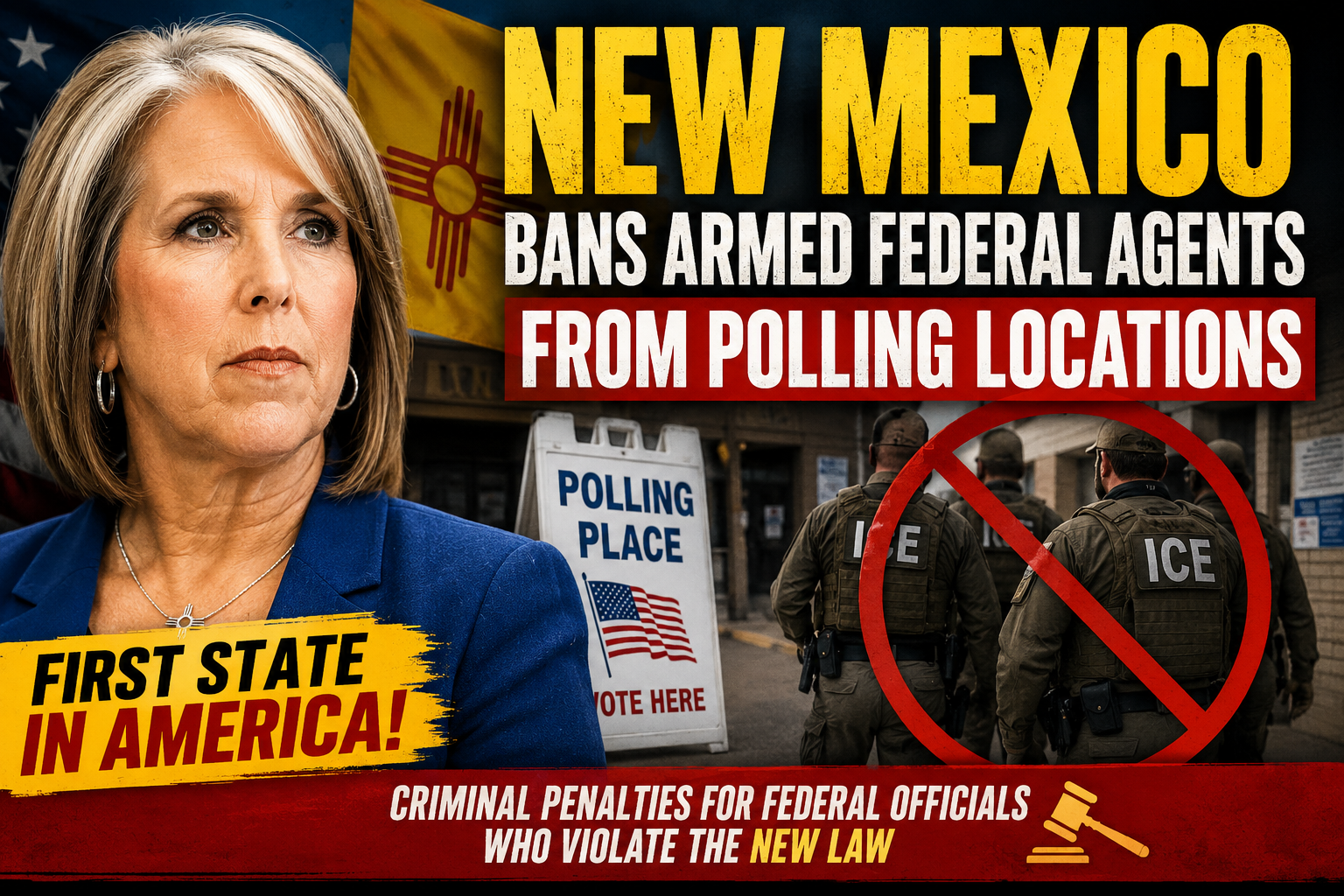
A fierce political and constitutional debate is erupting across America after New Mexico officially became the first state in the nation to prohibit armed federal agents from being stationed near polling places and ballot drop boxes during elections.
Governor Michelle Lujan Grisham signed Senate Bill 264 into law, creating sweeping restrictions that block armed federal personnel, including agents from U.S. Immigration and Customs Enforcement, from entering voting locations or positioning themselves near official ballot collection sites.
The law goes beyond simply banning officers from entering polling stations. It also prohibits armed federal personnel from nearby parking areas and from coming within 50 feet of any official ballot drop box statewide. Violators could face criminal penalties under New Mexico law.
Supporters are celebrating the move as a major victory for voting rights and voter protection. Critics, however, are calling it one of the most controversial election laws passed lately, accusing the governor of intentionally blocking federal oversight while the country remains deeply divided over election security and immigration enforcement.
The legislation has now placed New Mexico at the center of a growing national battle over federal authority, election integrity, immigration policy, and the future of American democracy.
What Is Senate Bill 264?
Senate Bill 264 was introduced to prevent voter intimidation and protect the election process from what supporters describe as “armed interference.”
Under the law:
- Armed federal officers cannot enter polling locations
- Federal personnel are barred from the nearby parking lots connected to voting sites
- Armed agents cannot come within 50 feet of official ballot drop boxes
- Violators may face civil or criminal consequences
- Election workers and voters can report violations or intimidation
The law specifically targets armed federal presence during active voting periods and on Election Day.
According to supporters of the bill, the goal is to ensure voters feel safe when casting ballots without fear of being questioned, monitored, or intimidated by heavily armed government personnel.
The legislation reportedly gained momentum after national concerns grew over increased tensions surrounding immigration enforcement and election monitoring ahead of future federal elections. (pbs.org)
Why The Law Is Generating Massive Controversy
The political backlash was immediate.
Conservative commentators, border security advocates, and some election integrity groups argue the law goes too far by effectively creating what they call a “federal exclusion zone” around voting infrastructure.
Critics believe the legislation could prevent legitimate federal monitoring activities and make it harder for federal authorities to respond quickly to potential election-related crimes or threats.
Others argue the bill sends a direct political message against the policies championed by former President Donald Trump, who has consistently emphasized strict border enforcement and stronger election security measures.
Opponents also point to the broader political direction of Governor Grisham’s administration. This is the same governor who previously signed the Immigrant Safety Act, legislation that limited ICE detention facilities within New Mexico.
For critics, SB 264 represents another step in what they view as a coordinated effort to reduce federal immigration enforcement influence inside the state.
Some conservative analysts are already questioning whether the law can survive future court battles, particularly because of the Supremacy Clause of the U.S. Constitution, which generally gives federal law authority over conflicting state laws. Legal experts expect challenges could eventually reach federal courts if enforcement disputes arise. (pjmedia.com)
Supporters Say It Protects Voters From Intimidation
Defenders of the law strongly reject claims that it undermines election security.
Voting rights groups and Democratic lawmakers argue that the visible presence of armed federal agents near polling places can discourage people from voting, especially immigrants, minority communities, and first-time voters.
Supporters say elections should be conducted in a calm civilian environment, not under the shadow of armed enforcement personnel.
Governor Grisham defended the measure by saying every eligible voter deserves to cast a ballot without fear, intimidation, or political pressure. (koat.com)
Election officials within New Mexico also emphasized that states are constitutionally responsible for administering elections, not federal law enforcement agencies. (pbs.org)
Civil rights organizations have praised the legislation as a preventive measure designed to avoid situations where voters feel pressured or unsafe at the polls.
The Immigration Debate Behind The Law
Immigration politics are deeply tied to the controversy surrounding SB 264.
New Mexico shares a border region connected to broader national immigration debates, and tensions surrounding federal immigration enforcement have intensified lately.
The Trump administration repeatedly pushed aggressive border enforcement policies, expanded deportation operations, and increased federal immigration activity across southern states.
Democratic governors in several states responded by introducing policies aimed at limiting cooperation with federal immigration authorities.
Governor Grisham has consistently positioned New Mexico as one of the states resisting tougher federal immigration crackdowns.
Critics argue that SB 264 is less about election safety and more about continuing that broader political resistance against federal enforcement agencies like ICE.
Supporters counter that immigration enforcement has no place near polling locations and that the right to vote should never feel connected to fear of immigration consequences.
Could Other States Follow?
Political analysts believe New Mexico’s law could inspire similar legislation in other Democratic-led states.
Reports suggest lawmakers in multiple states are already discussing expanded voter protection laws that limit armed presence near elections and ballot drop boxes. (latimes.com)
If more states adopt similar measures, the issue could quickly escalate into a nationwide constitutional showdown between state governments and federal authorities.
Republican-led states, meanwhile, may move in the opposite direction by increasing election monitoring and security operations.
That growing divide reflects the broader polarization currently shaping American politics.
Election Integrity vs Voter Protection
At the center of this debate is a question that continues to divide America:
What matters more: aggressive election security measures or preventing voter intimidation?
Supporters of stricter election enforcement argue that visible security helps maintain trust in election outcomes and deters illegal activity.
Opponents believe heavy law enforcement presence can intimidate voters and suppress turnout, especially in vulnerable communities.
Both sides claim they are defending democracy, but they fundamentally disagree on what democracy should look like during elections.
That disagreement is becoming increasingly intense as the United States heads toward future presidential elections.
What Happens Next?
Legal experts expect SB 264 to face heavy scrutiny in the coming months.
Questions remain about:
- Whether states can legally restrict armed federal personnel
- How federal agencies will respond during future elections
- Whether federal courts will intervene
- If other states will copy New Mexico’s approach
- How the law will affect future election security operations
For now, New Mexico stands alone as the only state in America with a law this aggressive toward armed federal presence near elections.
The political consequences could be enormous.
What started as a state election law may soon become one of the biggest constitutional and political battles in the country.