
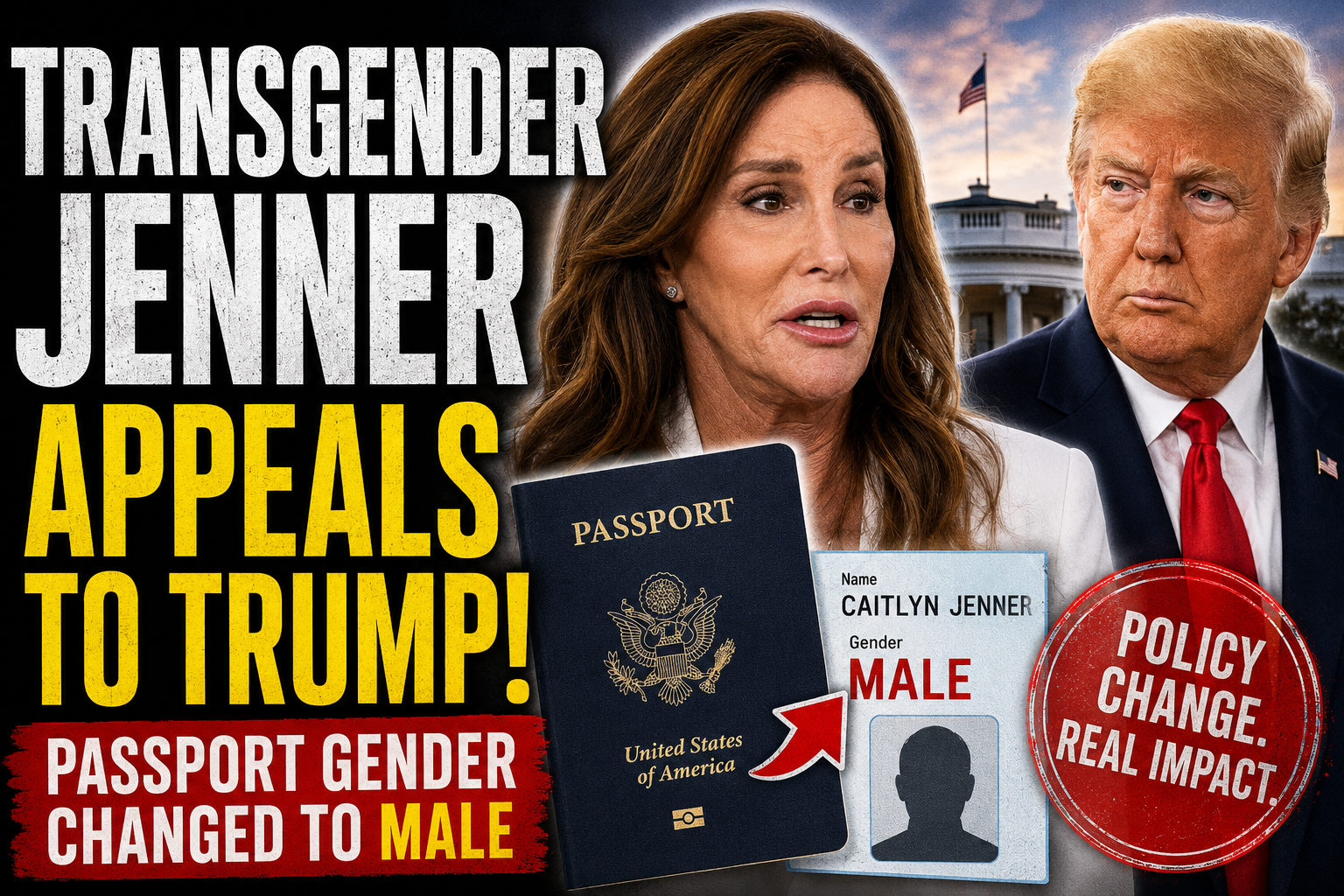
Former Olympian and media personality Caitlyn Jenner is publicly appealing to former President Donald Trump after reporting that her passport gender marker was changed to “male” under newly implemented federal policy adjustments.
The development has sparked a renewed national debate over government-issued identification, gender classification standards, and the real-world consequences of shifting federal documentation rules for transgender Americans.
Jenner, who has been a high-profile supporter of Trump in the past, says the change has now created serious complications for international travel and personal identification verification.
What Jenner Is Claiming
According to Jenner, the passport change occurred following updates in federal policy governing gender markers on official documents.
She says her passport now lists her gender as “male,” which does not reflect her legal identity or lived reality.
Jenner has stated that the change has already created practical problems, including:
- Complications with international travel documentation
- Issues with identity verification at checkpoints
- Concerns about consistency across federal records
She is now calling on Trump for assistance in addressing what she describes as an urgent administrative and personal issue.
Why Passport Gender Markers Are Controversial
Gender markers on passports have long been a sensitive policy area in the United States and globally.
In recent years, federal policy has shifted back and forth regarding how gender is recorded on identification documents, including:
- Recognition of “M” and “F” classifications
- Expansion or restriction of non-binary or flexible markers
- Requirements for medical documentation in some cases
- Agency-level interpretation of executive policy changes
Supporters of stricter documentation rules argue that consistent sex-based markers are necessary for:
- National security screening
- Identity verification consistency
- International travel standards
Critics argue that rigid classification systems can create:
- Administrative errors
- Identity mismatches
- Barriers for transgender individuals traveling or accessing services
Jenner’s situation has become a focal point in that broader debate.
A Political and Personal Collision
What makes this case particularly notable is Jenner’s political alignment.
As a well-known public figure who has previously expressed support for Trump, her appeal introduces an unusual dynamic: a supporter directly impacted by policy changes associated with the administration she backed.
This has led to discussion across political and media circles about:
- Whether policy impacts are being fully anticipated
- How documentation systems handle complex identity cases
- The separation between political loyalty and policy consequences
For some observers, the situation highlights the unpredictability of large-scale administrative changes once they are implemented.
Travel Complications Raise Practical Concerns
Passport inconsistencies can create serious logistical problems.
International travel relies heavily on matching identity documents across systems, including:
- Passports
- Visas
- Airline records
- Border control databases
If any of these documents contain conflicting information, travelers may face delays, questioning, or denial of entry.
Jenner’s claim underscores how administrative changes—regardless of intent—can have immediate real-world consequences when they affect cross-border identity verification systems.
Supporters and Critics React
The situation has triggered sharply divided reactions.
Supporters of stricter policy frameworks argue:
- Government documents should maintain standardized classifications
- Identity systems must prioritize consistency and verification
- Clear rules reduce administrative confusion
Critics argue:
- Individuals should not face bureaucratic harm due to policy changes
- Identity documentation should reflect lived and legal identity
- Administrative errors can disproportionately affect transgender people
Jenner’s appeal has intensified both perspectives, particularly because of her public visibility and political history.
The Broader Policy Debate
At the heart of the issue is a larger national discussion about how government systems define sex and gender.
Federal documentation policy affects:
- Immigration systems
- Airport security screening
- Social services eligibility
- Healthcare documentation
- International treaty compliance
Because these systems are interconnected, even small policy adjustments can have widespread effects.
This is why the passport gender marker policy has become a recurring flashpoint in U.S. politics.
Trump’s Role and Political Implications
Jenner’s request for assistance directed at Trump adds another layer of political complexity.
It raises questions about:
- Whether former allies can influence policy outcomes after changes occur
- How political relationships intersect with administrative enforcement
- Whether individual cases can lead to broader policy reconsideration
So far, there has been no official response confirming whether Trump intends to intervene in the matter.
Why This Story Is Getting Attention
This case is drawing attention not only because of Jenner’s celebrity status, but because it represents a real-world example of how policy shifts affect individuals in unexpected ways.
It touches on:
- Identity documentation systems
- Political loyalty versus policy outcomes
- Bureaucratic impacts on personal rights
- The intersection of sports, celebrity, and politics
As a result, it has become part of a larger cultural and political conversation.
Conclusion
The passport dispute involving Caitlyn Jenner highlights the growing tension between federal documentation policies and individual identity recognition.
While supporters of stricter classification systems argue they improve consistency and security, critics say they can create unintended consequences for individuals navigating complex identity and travel systems.
Jenner’s appeal to Trump adds a political dimension to what is already a highly sensitive policy issue—one that continues to generate debate across the United States.
As the situation develops, it is likely to remain a focal point in discussions about identity, governance, and the real-world impact of federal policy changes.