
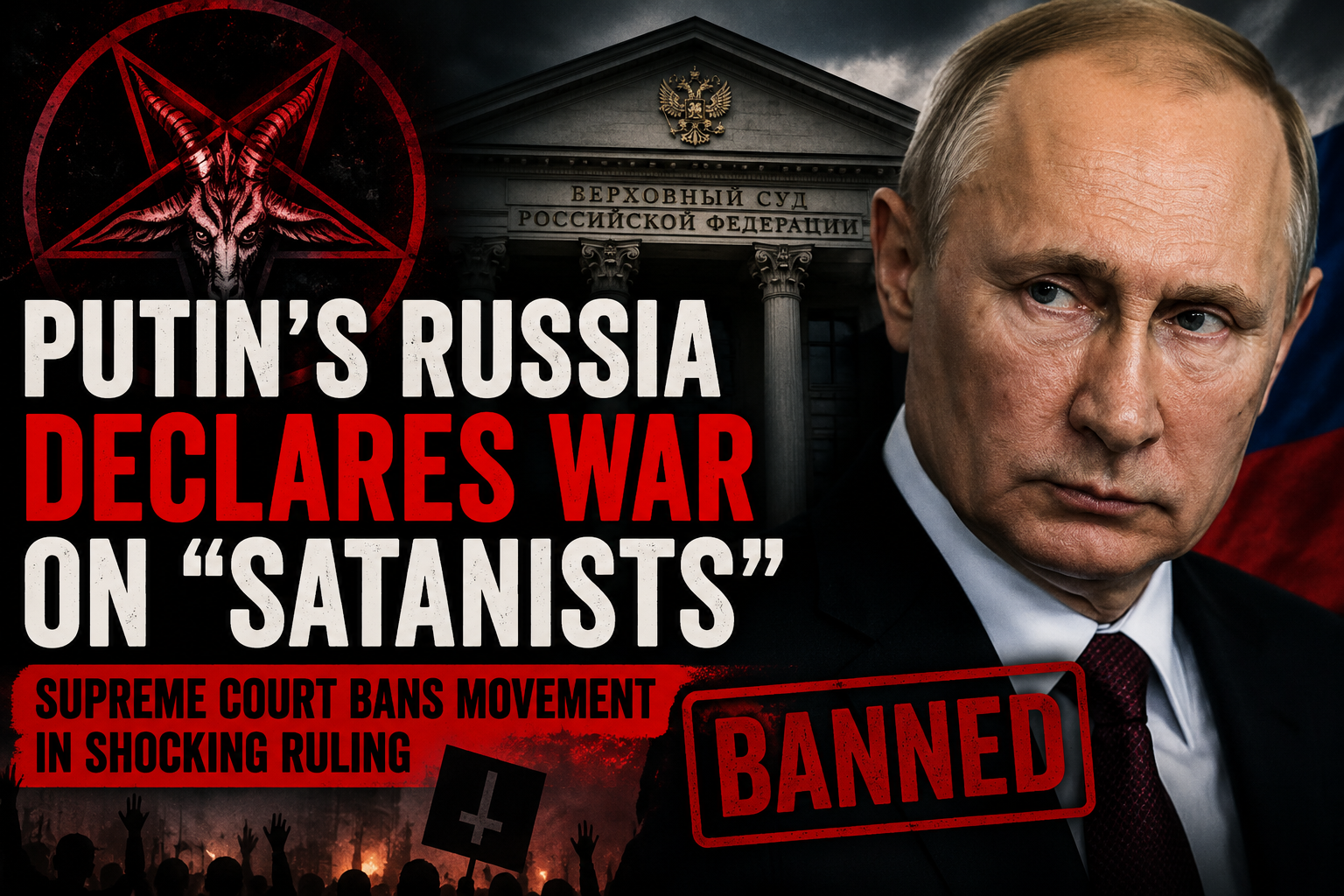
Russia’s Supreme Court has officially banned the “International Movement of Satanists,” declaring it an extremist organization. Prosecutor General Igor Krasnov initiated the lawsuit behind Wednesday’s ruling, reflecting the Kremlin’s tightening cultural and ideological control.
The Prosecutor General’s Office stated that the court found the movement rooted in extremist ideology that promotes hatred toward traditional religions.
” With the decision, any involvement in or association with the group is now illegal under Russian law.
The Court Ruling and Official Justification
The Supreme Court’s decision formalizes the government’s position that the so-called movement poses a threat to Russia’s social and spiritual order. Authorities argue that the ban is necessary to defend “traditional religions” and prevent ideological fragmentation within society.
In its statement, the Prosecutor General’s Office emphasized that the group’s beliefs and activities were incompatible with Russia’s constitutional framework, which explicitly protects and promotes historically dominant religious institutions such as the Russian Orthodox Church.
The ruling does not only dissolve the organization in legal terms—it also criminalizes its presence in public life, making participation, organization, or promotion subject to prosecution.
Expanding Definition of “Extremism”
While the government frames the decision as a protective measure, it also highlights a broader legal trend in Russia: the expanding and increasingly flexible definition of “extremism.”
Over the past decade, Russian authorities have applied extremism laws to a wide range of groups, including political opposition movements, independent religious organizations, and informal ideological communities. Critics argue that this legal framework allows the state to suppress nonconforming beliefs without directly engaging in debates over censorship.
By placing a belief-based movement under the same category as violent extremist organizations, the ruling raises questions about where Russia draws the line between public safety and ideological control.
Political Context Under Putin’s Administration
Under President Vladimir Putin, the Russian state has increasingly emphasized traditionalism, nationalism, and religious identity as pillars of national unity. The government frequently positions itself as a defender of cultural stability against what it describes as destabilizing Western influences and internal ideological threats.
This latest ruling fits into that broader pattern.
Rather than treating the case as a purely religious issue, analysts interpret it as part of a wider strategy to consolidate ideological conformity and reduce tolerance for alternative belief systems.
The use of judicial authority to enforce ideological boundaries further underscores the integration of legal institutions into the state’s broader political objectives.
Human Rights and International Reactions
Human rights observers have consistently warned that Russia’s extremism laws are broad and selectively enforced, giving authorities significant discretion in targeting groups that fall outside approved social or ideological norms.
Although this particular ruling focuses on a loosely defined movement, critics argue that it sets a precedent for expanding restrictions on unconventional or minority belief systems. The concern is less about the specific group involved and more about the legal mechanism being used.
International reactions are expected to be critical, particularly from organizations monitoring freedom of religion and expression, who see such measures as part of a shrinking civic space in Russia.
A Broader Pattern of Ideological Enforcement
The ban on the “International Movement of Satanists” is not an isolated development but part of a broader trajectory in Russian governance. Over recent years, the state has increasingly intervened in cultural, religious, and political spheres under the justification of protecting national identity.
What stands out in this case is the symbolic nature of the ruling. Even without widespread evidence of organized activity, the movement has been elevated into a national security concern, illustrating how ideology itself has become a regulated domain.
As Russia continues to define and refine its concept of acceptable belief, the boundary between religious protection and ideological enforcement appears to be narrowing further.