
Should public spaces be completely neutral, or should they reflect the identities of the people who use them?
Texas has once again become the focal point of a national conversation about the boundaries between public infrastructure, political expression, and cultural visibility.
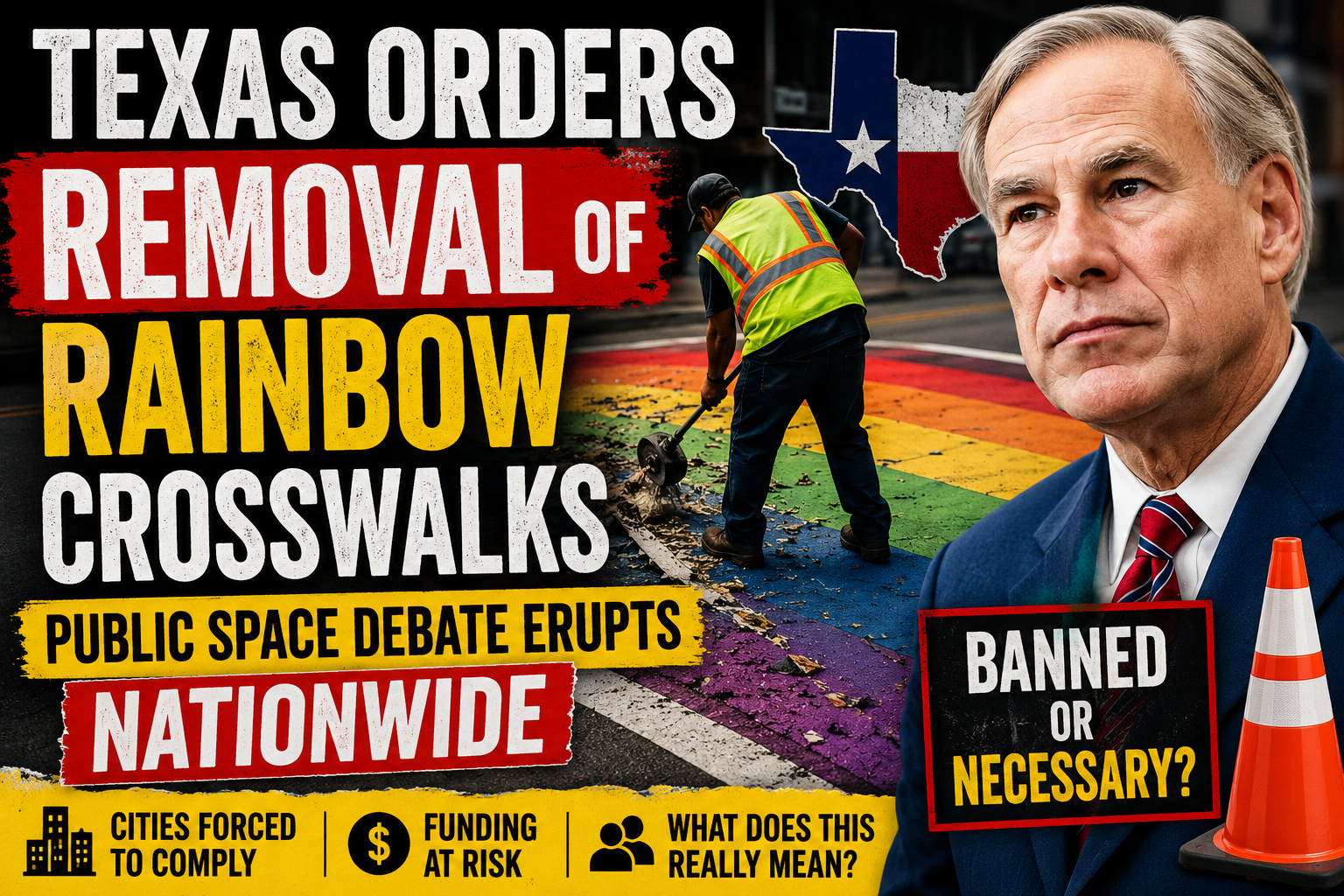
Governor Greg Abbott has reportedly directed the Texas Department of Transportation (TxDOT) to require the removal of LGBTQ rainbow crosswalks across the state, or risk losing transportation funding.
The decision has already triggered compliance in multiple major cities and sparked renewed debate over what belongs in public space and who gets to decide.
While supporters frame the move as a matter of regulatory consistency, critics argue it represents a broader shift in how civic environments handle public visibility and symbolic representation.
Cities Begin Responding to State Pressure
Following the directive, several major Texas cities, including Houston, Dallas, and Austin, have reportedly begun taking steps to remove rainbow-painted crosswalks or transition them out of public roadways.
These crosswalks, often installed during Pride Month or as part of local inclusion initiatives, have existed in various forms as symbolic installations meant to represent diversity and community identity in public spaces.
In San Antonio, officials removed a Pride-themed crosswalk at Main and Evergreen after increased state pressure. While public statements from city officials have varied, the underlying concern appears consistent: compliance may be necessary to avoid financial consequences tied to transportation funding.
The use of funding leverage has become a central point in the debate, with cities facing a difficult decision between maintaining local symbolic projects and preserving access to state and federal transportation resources.
The State’s Justification: Roadway Standards and Uniformity
From the perspective of state officials and supporters of the directive, the issue is not cultural but procedural.
Authorities argue that roadway markings are subject to strict design standards intended to ensure safety, clarity, and consistency for drivers and pedestrians.
Consequently, this interpretation considers non-standard decorative crosswalks, regardless of message, incompatible with transportation guidelines.
Supporters of the move emphasize that public infrastructure must remain uniform to avoid confusion or distraction on roadways. In this view, the removal of rainbow crosswalks is framed not as a political act, but as enforcement of established transportation policy.
U.S. Transportation Secretary Sean Duffy has reportedly backed the directive at the federal level, reinforcing the position that roadway design standards should take priority over localized symbolic installations.
Critics Argue the Issue Is Not Just Technical
Opponents of the policy strongly disagree with the framing of the issue as purely regulatory.
Civil rights advocates, LGBTQ organizations, and local community leaders argue that rainbow crosswalks were never intended to function as traffic instructions. Instead, they were symbolic installations meant to reflect inclusion, recognition, and community presence within public civic spaces.
From this perspective, the removal of these crosswalks is seen as part of a broader pattern in which visible expressions of identity are being systematically reduced in public environments.
Critics argue that while the justification is presented in technical terms, the practical outcome is the removal of culturally significant symbols from shared public infrastructure.
This disagreement has intensified the broader conversation about whether public space can—or should—reflect social identity in addition to functional design.
Public Space, Symbolism, and the Question of Neutrality
At the center of this debate is a larger philosophical question: what does neutrality in public infrastructure actually mean?
Supporters of the policy argue that neutrality requires removing symbolic or expressive elements from government-managed spaces. In this interpretation, roads, crosswalks, and transportation infrastructure should serve purely functional purposes without cultural or political messaging.
Opponents, however, argue that neutrality is not simply the absence of symbols, but the equal inclusion of all communities.
Furthermore, this perspective suggests that removing certain forms of expression while maintaining others may not be neutral in practice, even if policy language frames it as such.
This tension between functional neutrality and representational inclusion has become a recurring theme in local and national debates across the United States.
Financial Leverage and State–City Tension
Another key factor in the controversy is the use of funding as enforcement.
The directive reportedly ties compliance to transportation funding, meaning cities that refuse to remove non-compliant crosswalks risk losing financial support for infrastructure projects.
This dynamic has intensified long-standing tensions between state governments and municipalities, particularly in areas where political leadership differs in approach or ideology.
For city officials, the decision is not only about symbolic infrastructure, but also about managing budgets, transportation projects, and long-term urban planning priorities.
Broader Cultural Context in Texas
Texas has increasingly become a central stage for national debates involving education, public policy, and cultural expression. This latest directive adds to a growing list of policy decisions that intersect with identity, public visibility, and governance.
Supporters of Governor Abbott view the move as consistent with a broader philosophy of regulatory clarity and traditional infrastructure standards.
Furthermore, critics view the move as part of a wider cultural shift that reshapes how public spaces treat identity-related symbolism.
Regardless of interpretation, the policy is already becoming part of the political narrative leading into future elections, including Abbott’s reported bid for a fourth term in 2026.
Political Implications Heading Into 2026
Consequently, as political attention shifts toward upcoming election cycles, analysts evaluate these policies based on their cultural and symbolic impact rather than just their administrative merit.
For supporters, the directive reinforces a message of governance focused on order, uniform standards, and state authority over infrastructure decisions.
For critics, it represents a broader debate about inclusion, visibility, and the role of government in shaping public expression.
Consequently, the political consequences of this decision will likely evolve as public reaction develops and as other states discuss similar policies.
The Central Question Behind the Debate
Beyond legal interpretations and administrative enforcement, the issue ultimately raises a more fundamental question about public life:
Should public infrastructure be strictly functional and uniform, or should it also reflect the identities and values of the communities it serves?
Consequently, the answer to this question will likely shape not only Texas policy discussions but also broader national conversations about public space, symbolism, and governance in the years ahead.