
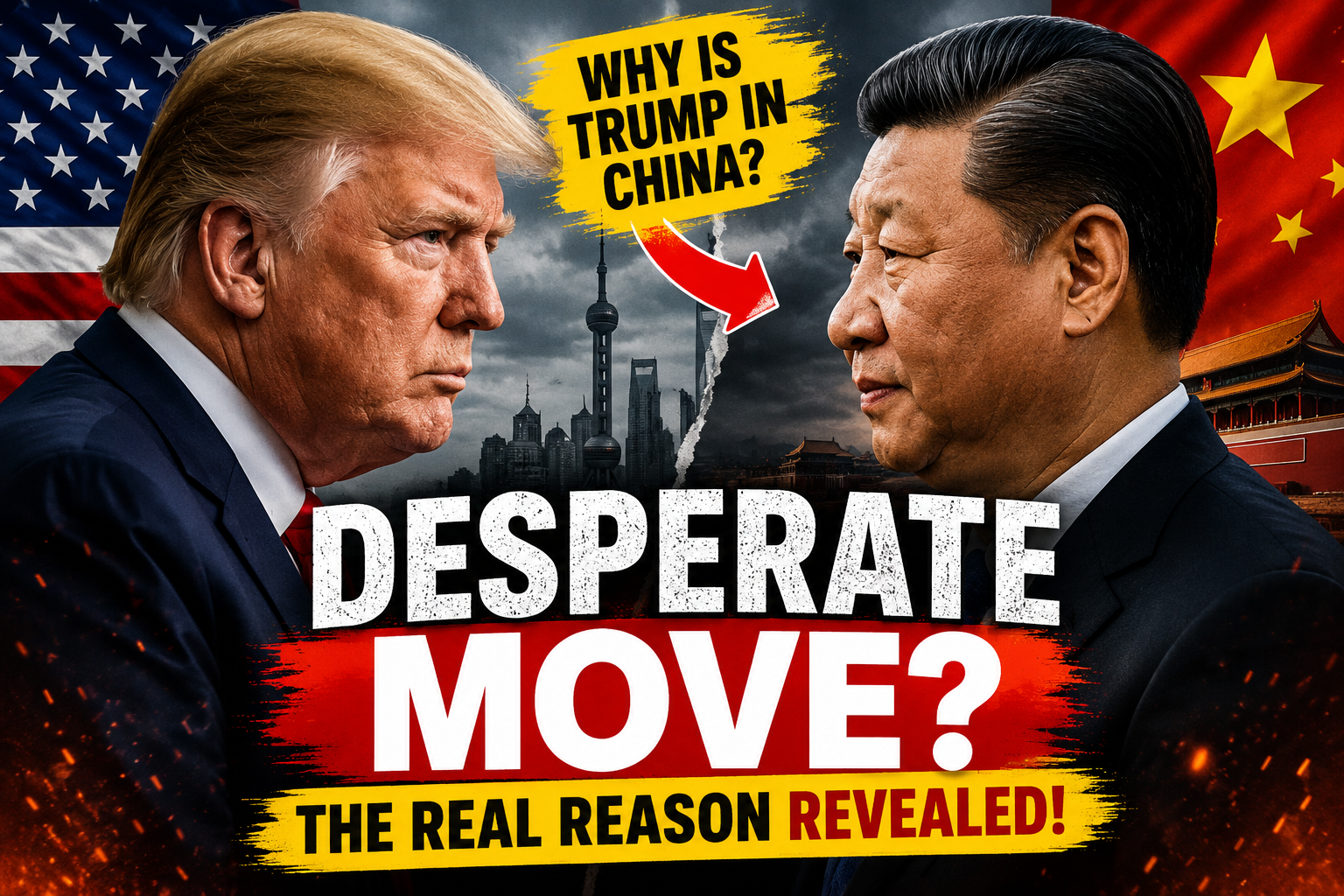
Donald Trump doesn’t fly halfway across the world without a reason, especially not now.
With a struggling economy back home, a costly standoff with Iran, and political pressure tightening by the day, his sudden trip to China isn’t just diplomacy; it’s a move that’s raising uncomfortable questions.
Is this a calculated power play?
Or is the former president running out of options?
Because behind the handshakes and official statements, insiders suggest something far more urgent is unfolding, something that could define not just Trump’s political future, but America’s position on the global stage.
A Presidency Under Pressure
To understand this trip, you have to start at home.
Trump’s approval ratings have reportedly taken a hit. The U.S. economy is showing signs of fatigue, sluggish growth, uneasy markets, and rising uncertainty. At the same time, the ongoing conflict involving Iran has dragged on longer than expected, draining both political capital and public patience.
This is the kind of environment where presidents look for a reset moment, a single, powerful win that can shift the narrative overnight.
And that’s exactly what this visit to China appears to be.
The Iran Factor: A Silent Emergency
The most urgent issue isn’t trade. It’s not even politics.
It’s Iran.
The ongoing conflict has created ripple effects across global energy markets, particularly around the Strait of Hormuz, a critical artery for oil shipments. Any disruption here doesn’t just hurt the U.S.; it shakes the entire world economy.
Here’s where China becomes crucial.
As one of Iran’s strongest economic partners, China holds leverage that Washington simply doesn’t. By engaging directly with Xi Jinping, Trump may be attempting something far bigger than diplomacy:
Using China as a back channel to de-escalate a war he cannot easily end alone.
Most people stop at “Trump wants peace.” But the deeper reality is this:
If China intervenes, even subtly, it gives Trump a way to claim progress without appearing to concede.
That’s not diplomacy. That’s strategic repositioning.
The Economic Reality: A Deal He Can’t Afford to Lose
The U.S. economy isn’t collapsing, but it’s not thriving either.
And Trump knows one thing better than most politicians:
Perception often matters more than reality.
A strong trade deal with China could:
- Stabilize markets
- Boost investor confidence
- Create the appearance of economic momentum
The focus? Large-scale Chinese commitments to purchase:
- American aircraft
- Agricultural goods
- Energy exports
But here’s the part most analysts overlook:
China doesn’t need this deal as much as Trump does.
That imbalance shifts negotiating power. It means this visit may not be about dominating the deal, but simply securing any deal that can be presented as a win back home.
The Political Rebrand: Optics Over Outcomes
With midterm elections approaching, optics matter more than ever.
Trump’s previous tariff-heavy strategy has faced criticism, with some labeling it ineffective or even damaging. A high-profile meeting with Xi Jinping offers something different:
- Visual proof of leadership
- A break from confrontation toward cooperation
- A narrative shift from conflict to control
Even if the outcomes are modest, the imagery alone of two powerful leaders meeting, negotiating, and shaking hands can reshape public perception.
And in modern politics, perception is often the real battlefield.
The AI Angle Nobody Is Talking About
While headlines focus on trade and war, there’s a quieter, more strategic conversation happening in the background:
Artificial Intelligence.
U.S. companies like Nvidia are watching this visit closely, hoping for expanded access to the Chinese market. But this isn’t just about business.
It’s about control over the future.
AI is rapidly becoming the defining technology of global power. Whoever leads in AI doesn’t just dominate economically; they gain military, surveillance, and geopolitical advantages.
So why would the U.S. even consider cooperation?
Because isolation has limits.
By opening discussions on AI safety and collaboration, Trump may be attempting to:
- Slow down an unchecked AI arms race
- Maintain influence over global AI standards
- Prevent China from advancing entirely on its own terms
This isn’t just diplomacy, it’s technological containment disguised as cooperation.
The Real Question: Strategy or Survival?
At first glance, this trip can look like desperation.
- A struggling economy
- A complicated war
- Political pressure at home
But there’s another way to see it:
A calculated risk.
Trump is stepping into one of the most complex diplomatic arenas possible, engaging with a strategic rival during a time of global instability.
If it works, he gains:
- A diplomatic breakthrough
- Economic momentum
- Political revival
If it fails, it reinforces every criticism currently surrounding his leadership.
There’s very little middle ground.
Final Thought: A Gamble With Global Consequences
This isn’t just about Trump.
And it’s not just about China.
It’s about how power is shifting in real time.
The world is moving toward a new balance, one where the U.S. no longer acts alone, and where rivals must sometimes cooperate to avoid mutual instability.
Trump’s trip to China may be remembered in one of two ways:
- As a desperate attempt to salvage a presidency
- Or as a bold move that reshaped global dynamics
Right now, it’s too early to say which.
But one thing is certain:
This isn’t just a visit. It’s a gamble.